Wuchen
1. The Evolution of Zhenwu’s Image
The belief in the Perfected Warrior, Supreme Emperor of the Dark Heaven (Zhenwu), and the formation and development of his image went through a long historical process. Zhenwu was anciently called “Xuanwu” (the Dark Warrior) and was shown as a tortoise entwined with a snake. In the Han this gradually developed into a combined tortoise-and-snake form, though in Han pictorial artifacts Xuanwu is sometimes a tortoise alone. When Wang Yi of the Eastern Han wrote in his Commentary on the Songs of Chu that “the heavenly tortoise, the water spirit, attends and escorts me,” he was interpreting “Xuanwu” as a tortoise. Han images of Xuanwu had an important influence on later generations.
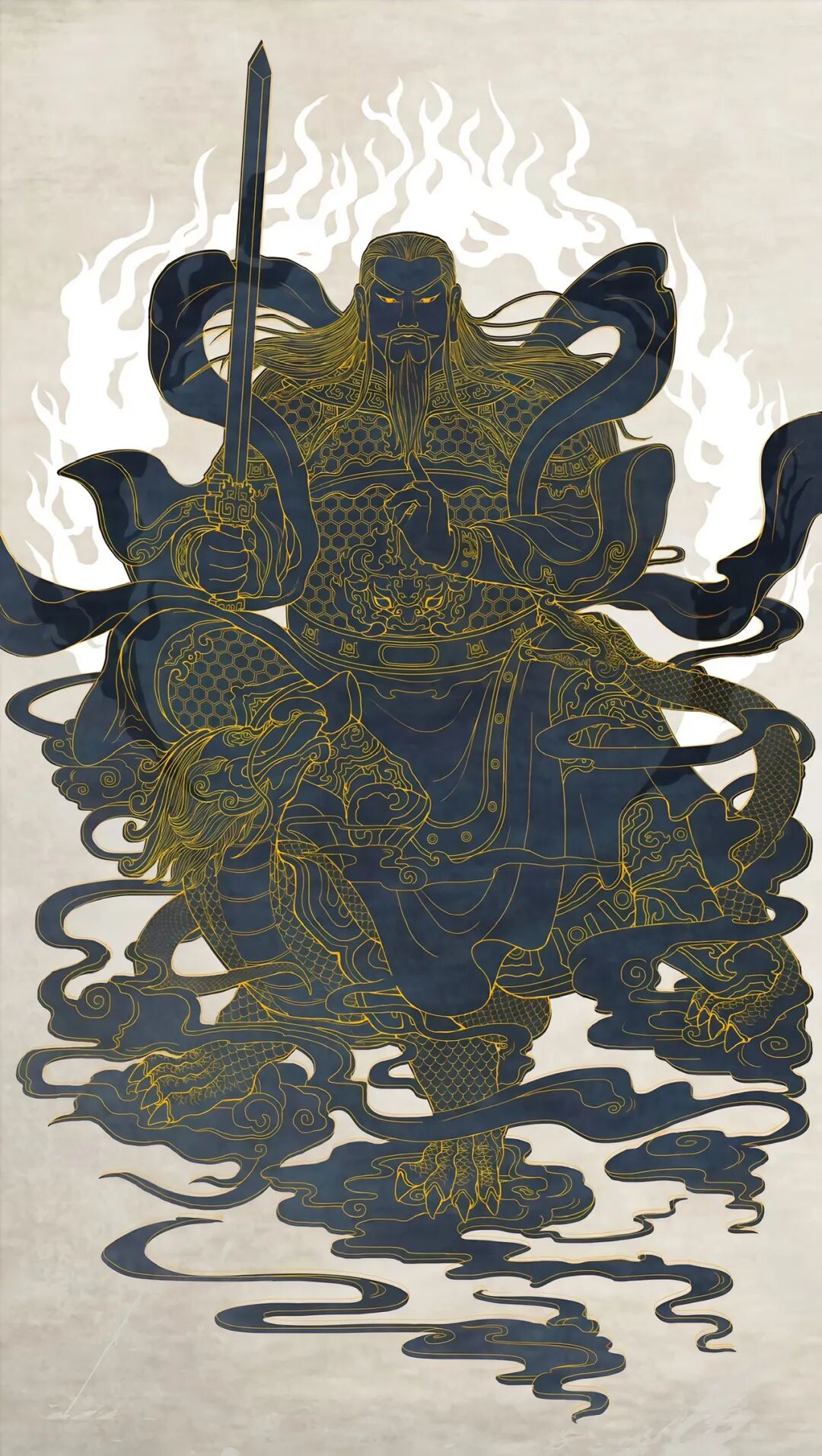
Xuanwu’s change from a divine beast of entwined tortoise and snake into an immortal in human form—this personification—took place roughly in the Tang and Song. The image of a war god wearing a battle helmet and armor, gripping a long sword, and standing on a tortoise-shaped base is the most representative image of Zhenwu from this period.
The statue of Zhenwu in Cave 10 at Shimenshan in Dazu, from the Southern Song, is a typical example; its depiction as a guardian deity clearly continues the Tang artistic treatment of divine generals.
A rubbing of a Zhenwu image now in the Princeton University Art Museum in the United States represents the mature Song form, displaying the majestic air of a military general.
Although images of Zhenwu as a scholar had already appeared in the Tang, they were very few.
The Tang jade seated statue of Zhenwu in the collection of the Wudang Museum is carved from a single piece of jade. The figure wears a round-collared robe beneath and a long straight-collared gown over it, the round collar of the inner robe and the open front of the outer robe complementing each other. His hair falls loose and his feet are bare as he sits serenely cross-legged; his hands are clasped with palms upward, left hand below and right above, resting at the elixir field (dantian); his expression is gentle and kindly, showing the focused bearing of one engaged in inner refinement and cultivating perfection—rendered to the life.
The Song was the turning point in the development of the Zhenwu faith, and his deification was completed in this period. Zhenwu was promoted by the state as the guardian deity of the north. Because the name of the Holy Ancestor of the Song, Zhao Xuanlang (a distant ancestor posthumously honored by the Song court), shared a taboo character with “Xuanwu,” Emperor Zhenzong of the Song, during the Dazhong Xiangfu era (1008–1016), officially renamed “Xuanwu” as “Zhenwu,” and his image gradually completed its change from a stellar deity to a personified god. But this change was still at an early stage, so no uniform standard had formed, and diverse forms of Zhenwu appeared in different places.
The common Song images of Zhenwu were mostly of a war god, though some images of him as a civil deity also appeared at that time. An example is the bronze Zhenwu in the Wudang Museum from the Chongning to Daguan eras of the Northern Song (1102–1110): his hair hangs loose down his back, his feet are bare, and he wears a broad robe, sitting upright cross-legged with a natural dignity; his face is full and gentle, his eyes half closed. This statue may be called a model; later scholarly images of Zhenwu mostly took it as their prototype and followed its spirit and conventions.
The Zhenwu faith continued and developed in the Yuan. The tendency to incorporate elements of scholar-official dress into his image was further strengthened and his scholarly character grew ever more evident, giving the Zhenwu faith more cultural content and approachability while it retained its religious nature. On the basis of the diverse Song iconography of Zhenwu, Yuan images of Zhenwu divided into two main types, the war god and the civil god, and showed clear regional characteristics as well as sectarian features of the Quanzhen and Zhengyi schools.
The Yuan jade statue of Zhenwu in the Wudang Museum likewise has loose hair and wears a wide-lapelled robe, but has neither armor nor sword. This division reflects not only the different interpretations of the Zhenwu faith among the Taoist schools of the Yuan, but also the expression in religious art of the cultural differences between north and south.
The Ming was the glorious age of the Zhenwu faith. The Ming emperors revered Zhenwu greatly and even regarded him as the “deity protecting the state and the dynasty.” Against this background, the Zhenwu faith spread widely among the people and became further secularized, making him a god worshipped widely by ordinary people.
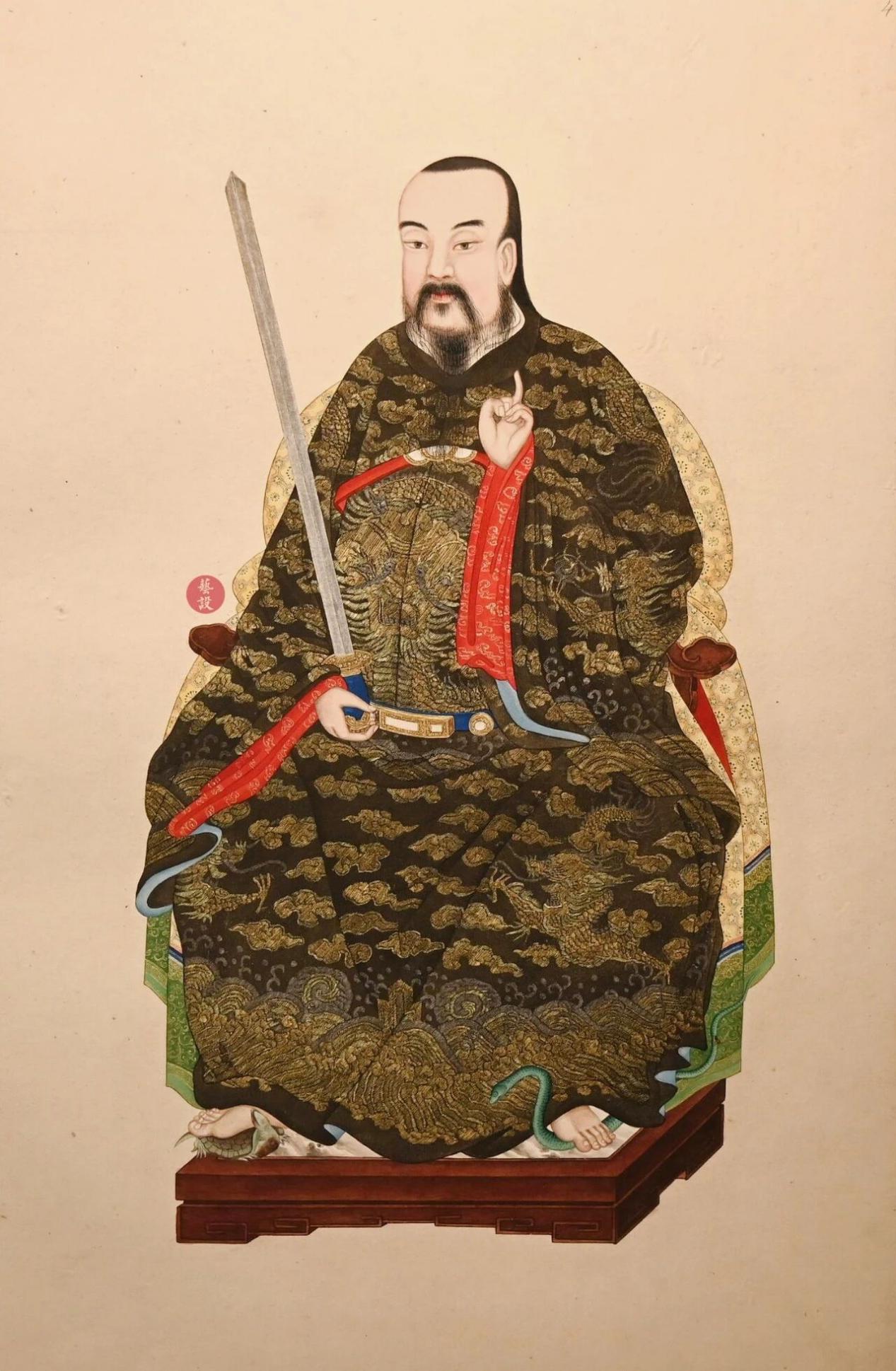
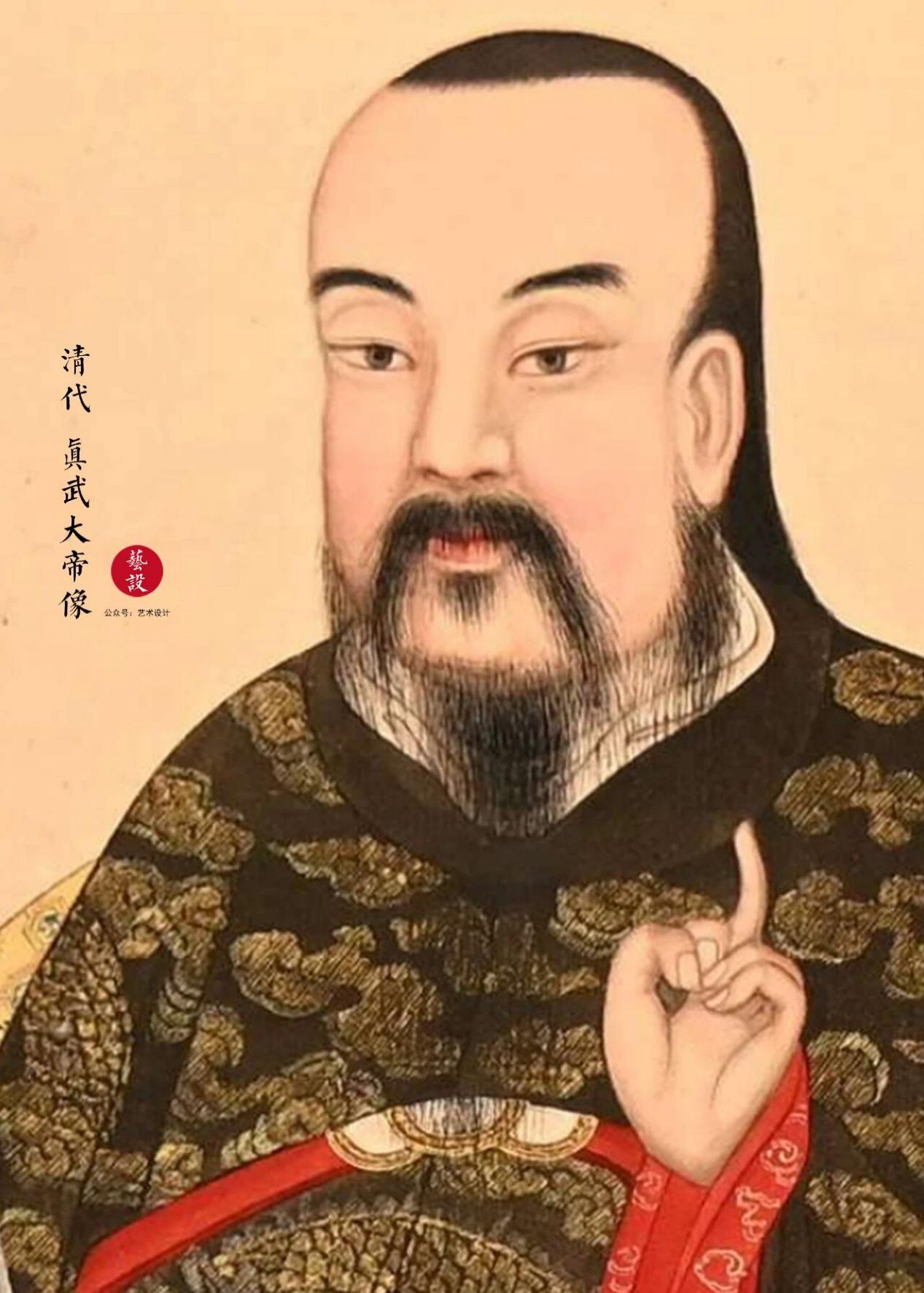
In this stage the change in Zhenwu’s image was very marked. Even the cast bronze Zhenwu in the Golden Hall of the Wudang Mountains, which takes the form of a war god to display the military prowess of the Yongle Emperor, retains the features of the northern war god of the Yuan only in details, such as a glimpse of armor scales. In fact, throughout the Ming, the war-god image of Zhenwu gradually weakened, and the scholarly image became mainstream. In artistic expression it continued the southern tradition of the civil god since the Song, chiefly showing him as a civil official in a scholar’s cap and broad robe, holding a court tablet or a scroll.
By the Qing, as the Zhenwu faith as a whole declined, the creation of his image stagnated accordingly, with little artistic innovation or breakthrough. The evolution of Zhenwu’s image—from the northern war god of the early period, to the loose-haired, barefoot figure devoted to spiritual practice in the Song, to the scholarly image of the Ming and Qing—embodies a shift from a guardian war god to a scholar who helps the world.
2. The Multiple Factors Behind the Evolution of Zhenwu’s Image
The scholarly transformation of Zhenwu’s image is related to the political environment from the Song onward.
Tradition holds that the founding of the Song dynasty was aided by Zhenwu. The Record of the Revelations of the Supreme Emperor of the Dark Heaven says: “In the Xingyuan years, when Taizu (of Song) served under Shizong (of Zhou), he once commanded at Yingzhou. The planet Venus suddenly passed by and transformed into a Taoist priest in white robes, who urged Taizu to accumulate the Tao, virtue, benevolence, and good deeds, and said he would become extraordinarily noble and eminent in the future. Taizu then said: ‘What numinous response does the Heavenly Bureau have to help me to eminence?’ The Taoist said: ‘Along the borders there are rebellious barbarians and traitorous ministers, so the court has entrusted you to capture and execute them. That the traitors and rebels are now quiet is all due to the secret protection of Zhenwu, Great Emperor of the North Pole.’ Having spoken, the Taoist turned into white light and returned to heaven.” Therefore, after the founding of the Northern Song, the court vigorously promoted the Zhenwu faith. Later, Emperor Zhenzong raised Zhenwu’s divine rank, adding the title “True Lord of Numinous Response, the Perfected Warrior.” To suit the cultural preferences of the imperial house, Zhenwu’s image began to incorporate some gentler, more refined elements, laying the foundation for his scholarly transformation.
In the Ming, the Yongle Emperor (Chengzu) claimed to be a reincarnation of Zhenwu, and most images of Zhenwu were created with his likeness as the model. To remove the element of his having seized power by force of arms, the images of Zhenwu began to shed the elements of a “war god,” and their scholarly air grew stronger.
The popularity of Zhengyi (Orthodox Unity) images of Zhenwu in the south also greatly advanced the scholarly transformation of his images. Because the Zhengyi school “was established especially for filial children and loving parents, benefiting human relations and strengthening morals—great indeed is its merit!” (Zhu Yuanzhang, Preface to the Imperially Composed Ritual Texts for Fasts and Offerings of the Mysterious Teaching), the Ming government gave the Zhengyi school a measure of support. The Zhengyi school closely combined the Zhenwu faith with Confucian ethics, and to distinguish itself from the war-god images of the northern Quanzhen school (Complete Perfection), Zhengyi in the south mainly adopted scholarly images.
The influence of folk culture was another important factor. As the Zhenwu faith developed, it was given more functions. In southern folk belief, Zhenwu was not only a war god but also a god who helps in the imperial examinations, a god of marriage, and so on, and a scholarly image of Zhenwu clearly suited such roles better.
There was also the influence of the aesthetics of image-making. By the Song, with the rise of literati painting, its particular aesthetic affected not only painting but also sculpture and other art forms. Literati painting emphasized the spirit of “a free, casual brush that does not seek formal likeness,” valued restraint and reserve, and opposed overly elaborate and ornate forms of expression. This artistic style was introduced into images of Zhenwu, making their forms simple and natural, ethereal and leisurely, and this artistic ideal also influenced the scholarly transformation of Zhenwu’s images.
The scholarly transformation of Zhenwu’s image was a complex process of evolution. Under the combined influence of politics, region, art, and folk belief and custom, the image of Zhenwu absorbed more elements of Confucian culture and placed more emphasis on the function of moral education in society, thus completing his evolution from a majestic deity into a refined scholar. This process also vividly reflects the social and cultural changes of different historical periods.
3. The Most Representative Ming Image of Zhenwu
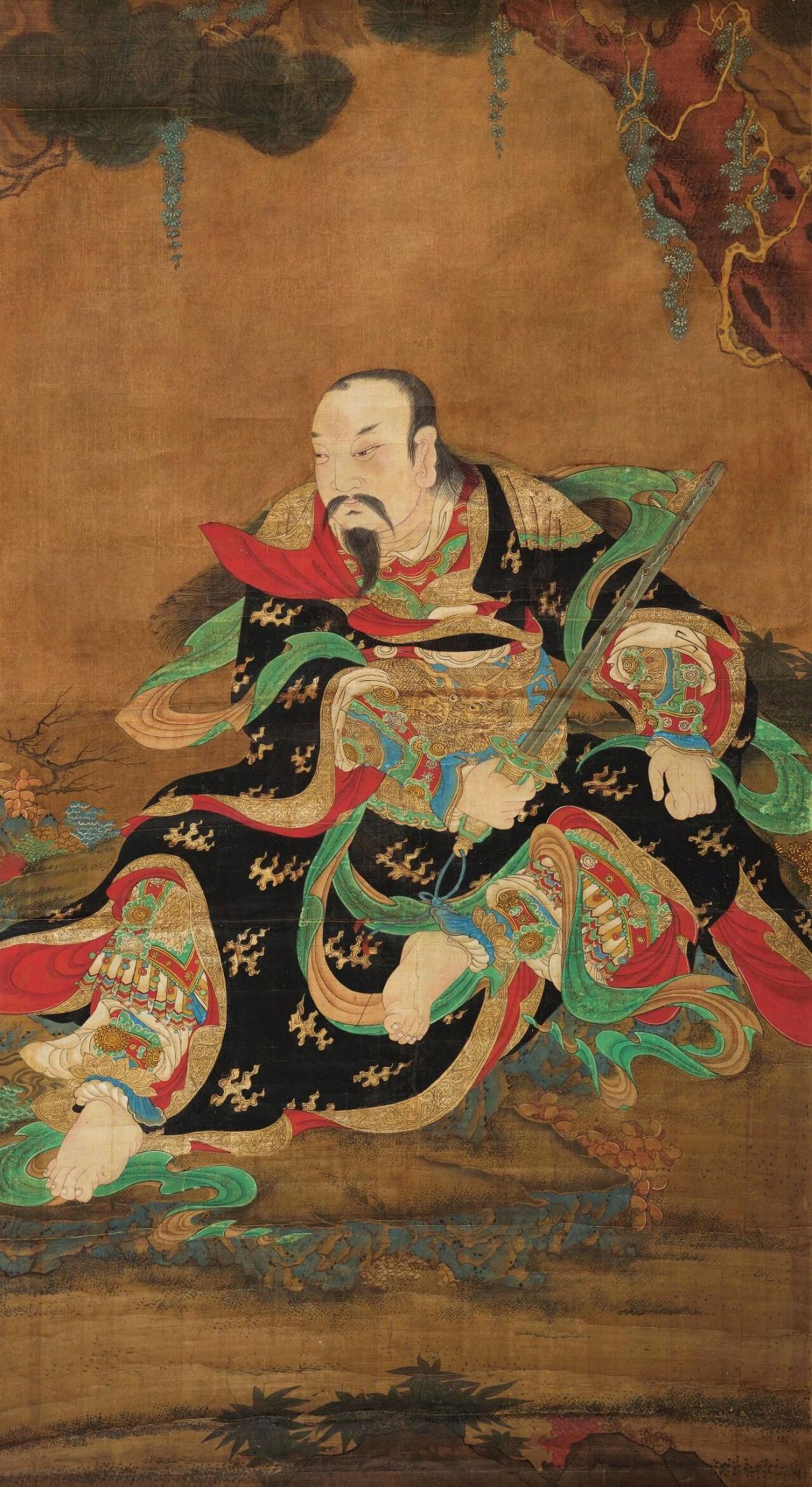
The anonymous Ming Portrait of Zhenwu is a work following the standard iconographic conventions of Ming Taoist paintings of deities, and a typical relic of the height of the Zhenwu faith from the Yongle era onward.
Zhenwu’s full title is “the Perfected Warrior Who Guards Heaven from the North Pole, Supreme Emperor of the Dark Heaven.” The Wondrous Scripture of the Divine Incantations of the Original Biography of Zhenwu, Great Sage of the Dark Heaven, Spoken by the Most High states clearly that he was the eighty-second incarnation of Lord Lao the Most High (Taishang Laojun), born as the crown prince of the Kingdom of Pure Joy. He renounced the throne and entered the Wudang Mountains, where he cultivated the Tao for forty-two years; his work complete, he ascended in flight and was enfeoffed by the Jade Emperor to govern and guard the north and its Ren-Gui water virtue, holding the office of “Heavenly Worthy Who Vanquishes Demons,” charged with subduing all evil demons, ghosts, and malign spirits under heaven and protecting the peace of family and state.
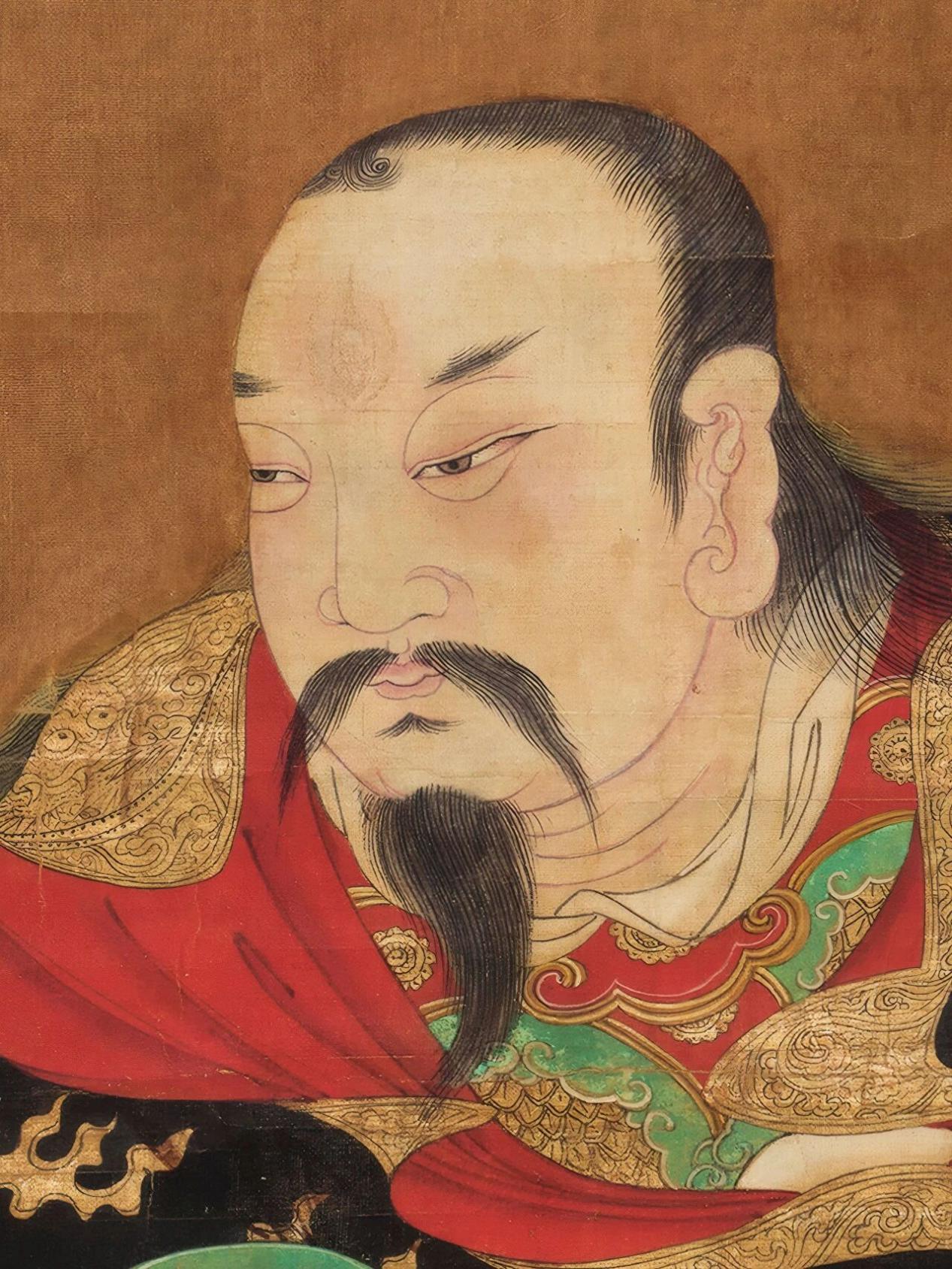
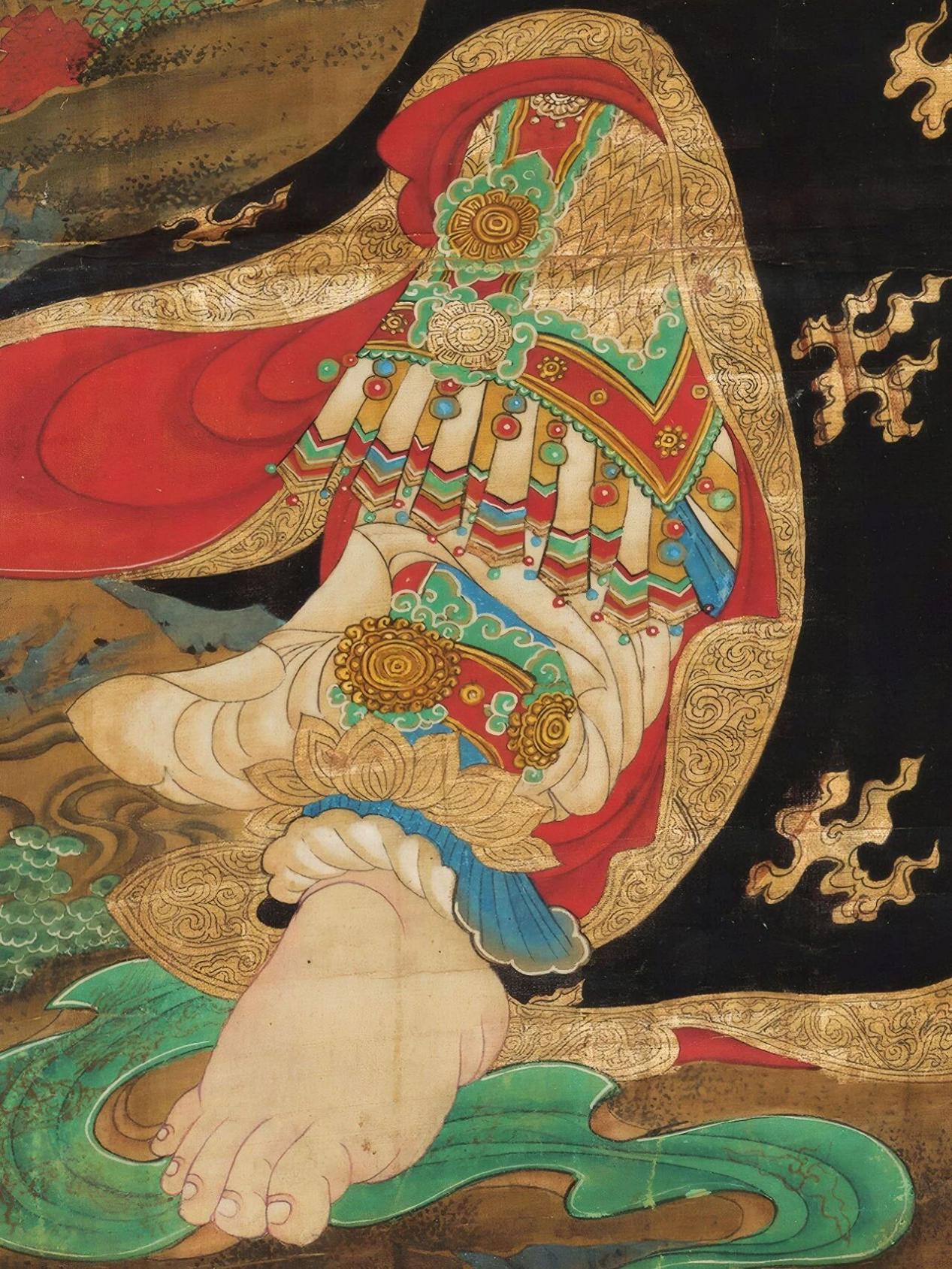
In the painting, Zhenwu’s image—“loose-haired and barefoot, holding the Seven-Star Sword”—accords completely with the iconographic rules of the scriptures. His black robe corresponds to the water virtue of the north, and the gold-painted walking dragons and flame patterns on it symbolize both his divine authority over the Three Realms and his divine nature as slayer of demons and exorcist of evil.
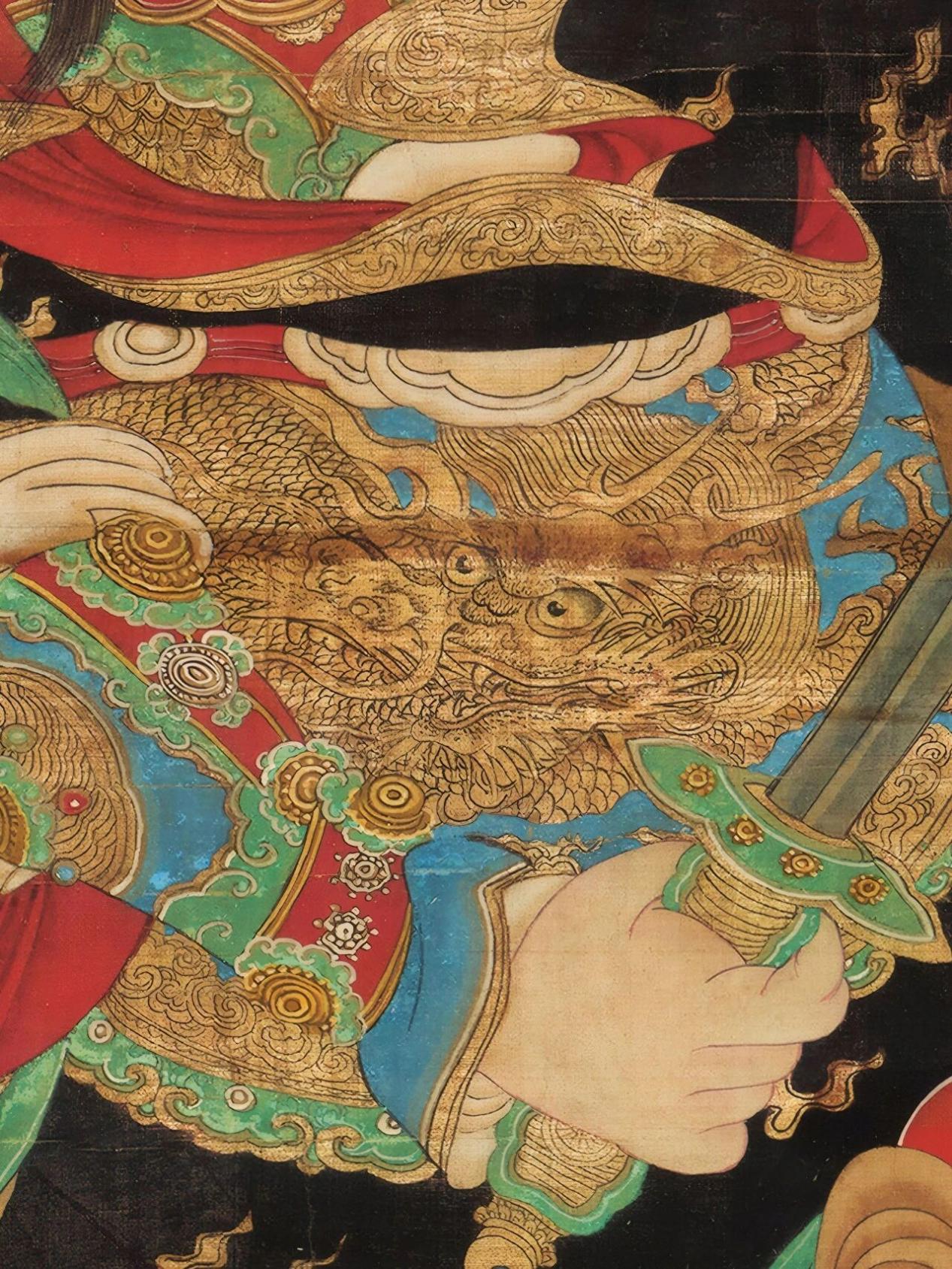
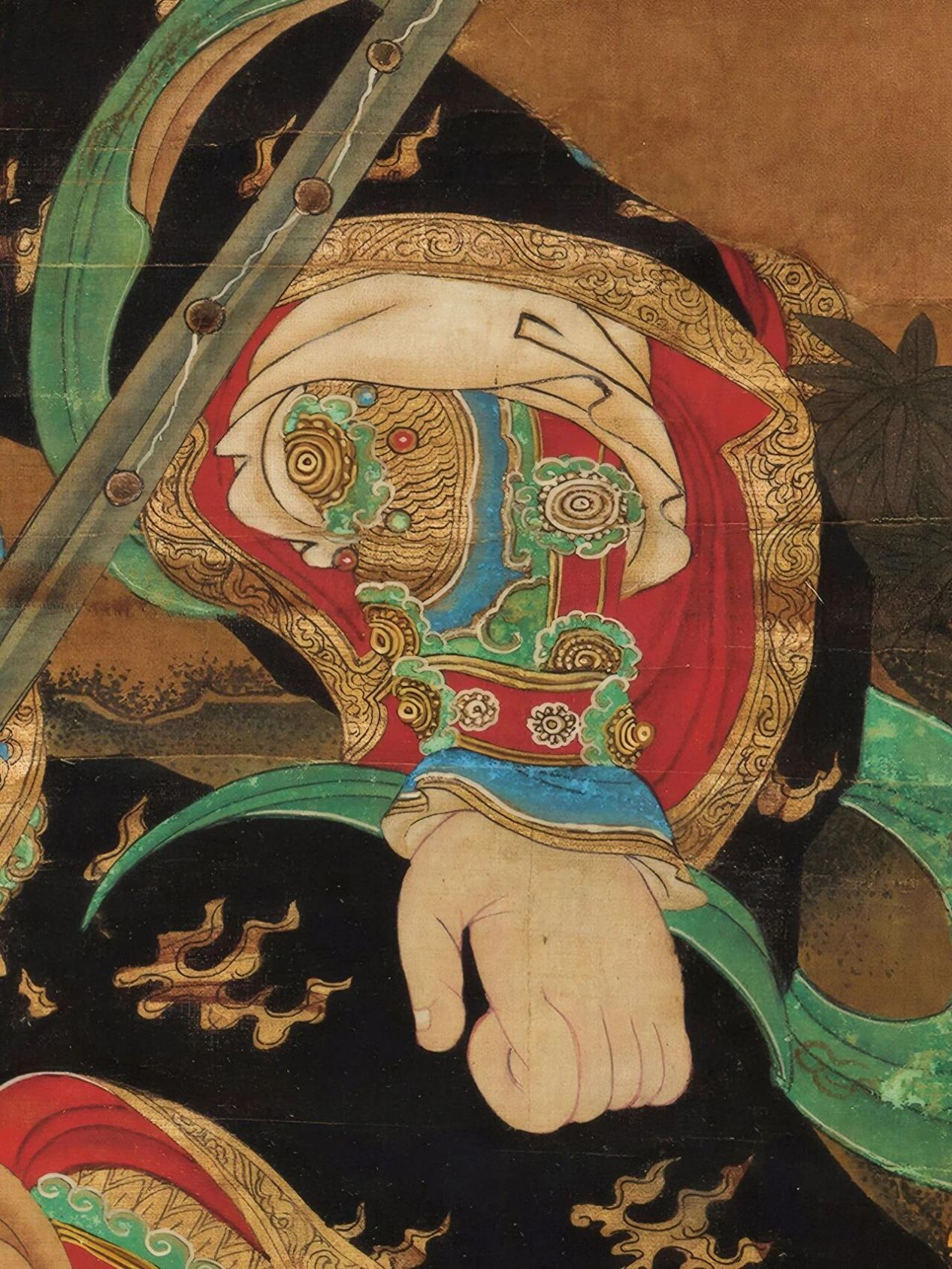
In artistic expression, the work is painted in the meticulous, heavily colored technique. The drapery is outlined in “iron-wire” line, both firm and supple; the mineral pigments are rich yet steady, and the strong contrast of the black ground with gold and with red and green decoration fully displays the refined craftsmanship of Ming religious painting.
The figure’s bearing is reserved and calm, his gaze grave and steady; without glaring eyes he nonetheless carries a power to awe, perfectly matching the divine character of Zhenwu in the scriptures: “majestic but not fierce, compassionate in helping all beings.” The background of old pines and secluded rocks subtly evokes the setting of cultivating the Tao in the Wudang Mountains, the immortals’ mountain, and the color of the aged silk adds a sense of antiquity and the passage of time.
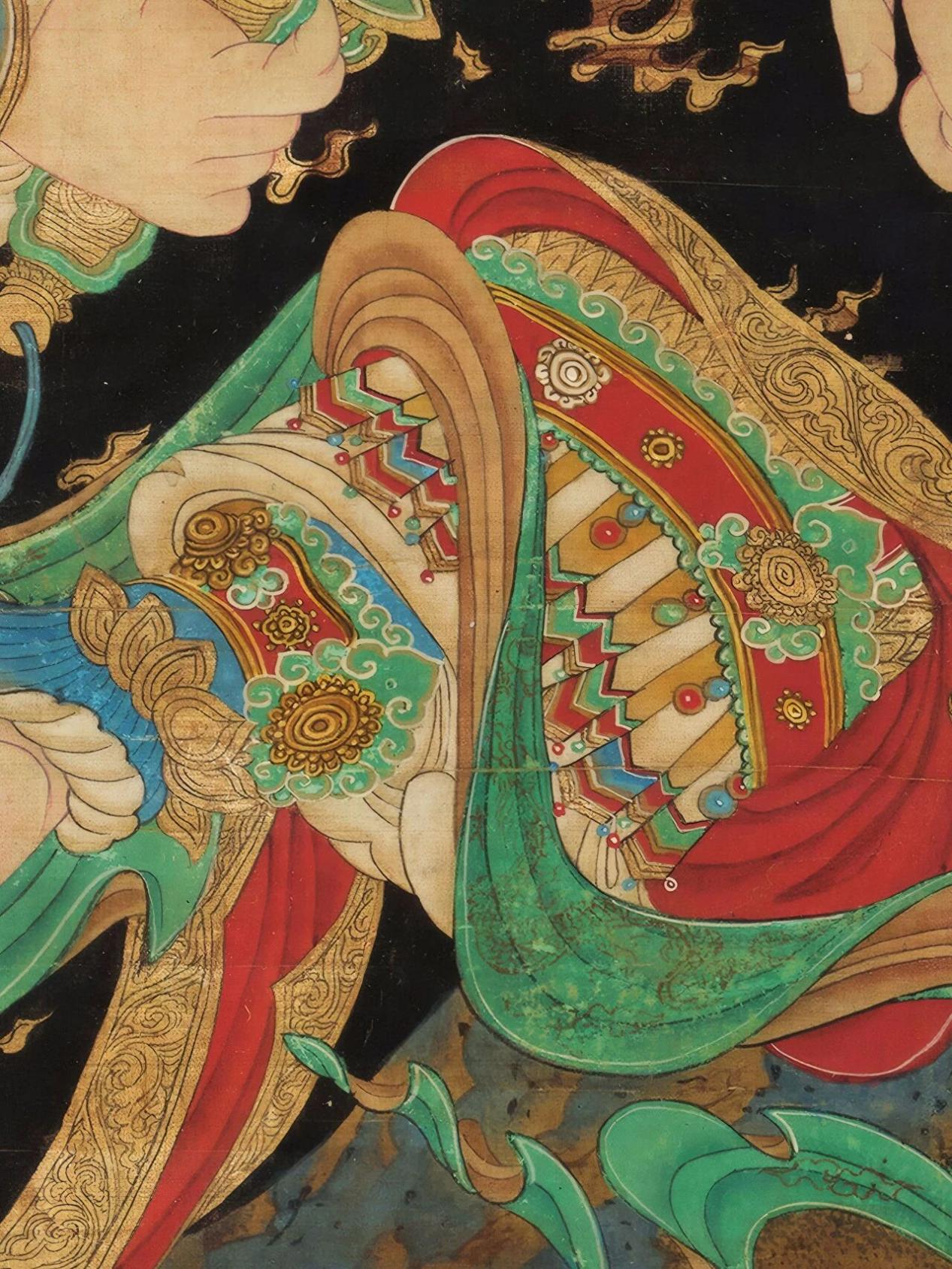
The Zhenwu faith reached its height in the Ming because of imperial patronage. This work both carries the iconographic meaning of the Taoist Supreme Emperor of the Dark Heaven and reflects the Ming Taoist painting’s combination of sacredness and artistry. It is an important object for the study of Ming Taoist art and folk belief.