
Dao Bu Ke Dao
The Taoist mountains of the immortals are one of the most common subjects in Chinese painting. The immortal mountains are the dwelling places of the immortals: “Above are the heavens of the Three Pure Ones, below are the grotto-heavens and blessed lands, to the east are the three divine mountains in the sea, and to the west is Mount Kunlun” (Hu Fuchen, ed., Great Dictionary of Chinese Taoism). Accordingly, images of immortal mountains in Chinese painting fall into two kinds: first, those depicting the legendary mountains of the immortals or showing the natural scenery of the grotto-heavens and blessed lands; and second, images of immortal mountains serving as the backdrop to Taoist paintings of seeking immortals and the Tao, or of ascending as a feathered immortal. As an artistic vehicle for Taoist thought, the images of immortal mountains in Chinese painting through the ages vividly reflect the Taoist pursuit of the unity of heaven and humanity and of “the Tao follows what is so of itself.”
Legends of the immortal mountains go back a long way. As early as the Warring States period there were legends that the three divine mountains of Penglai, Fangzhang, and Yingzhou held “the elixir of deathlessness,” and the Records of the Grand Historian (Shiji) records how the rulers of Qi “sent men out to sea” to look for them. Mount Kunlun is the dwelling of the immortals most fully described in the Classic of Mountains and Seas; the series of myths that grew out of Mount Kunlun (with its Jasper Pool) and the Queen Mother of the West laid the foundation for later mythology and for the Taoist pantheon of immortals, and Mount Kunlun became the immortal mountain where ancient emperors sought to meet immortals and prayed for long life.
The Liezi renames “Fangzhang” as “Fanghu” and lists it with Daiyu, Yuanjiao, Yingzhou, and Penglai as the Five Mountains … These myths and legends became an important source of the Taoist conception of immortal mountains. The Northern Song Seven Slips from the Cloudy Satchel (Yunji Qiqian) went further, summing up the immortal mountains as the “Ten Continents and Three Mountains,” which became an important subject of Taoist painting.
There are two main formats for depicting immortal mountains in Chinese painting: the “immortal isles in the sea” and the “mountain pavilions of the immortals.” Because they embody people’s imaginings of the realm of the immortals, the mountains in these paintings are usually places wreathed in clouds and mist, surrounded by the sea, and cut off from the world; “clouds,” “sea,” and “haze” became indispensable elements in creating the atmosphere of an immortal mountain.
The “immortal isles in the sea” format presents immortal islands and fairylands amid vast, misty waves. For example, the Ming painter Qiu Ying’s Fairyland of Penglai uses the meticulous blue-and-green landscape technique to depict the blessed land of sheer cliffs and illusory immortal pavilions on the boundless sea. The surging waves set off the facing cliffs and distant peaks on left and right, the swirling clouds and mist heighten the steepness of the peaks, and the waves, clouds, mist, and green pines and cypresses together create the magical, dreamlike quality of the immortal pavilions of Penglai.
The Ming painter Wen Boren’s Fanghu depicts Fanghu emerging amid ten thousand qing of blue waves and swirling auspicious clouds: Fanghu, floating in the sea, is an island ringed by towering peaks; several Taoist temples stand upon it, one of them in the center of the peaks. The work is detailed and meticulous in brushwork and bright and beautiful in color.
The Qing painter Yuan Jiang’s Immortal Isle of Penglai emphasizes the misty, cloud-wrapped atmosphere of the fairyland, using exquisitely detailed pavilions, towering rocks, and the vast, hazy sea to set off an immortal mountain created through the painter’s artistic imagination.
The “mountain pavilions of the immortals” format presents immortal pavilions amid layer upon layer of peaks. For example, the Southern Song painter Zhao Boju’s Immortal Pavilions in the Mountains adopts a “corner” composition, with the rocks and trees concentrated mainly in the lower right, and foreground, middle ground, and distance clearly layered; an unbroken succession of rocks forms a continuous sequence from front to back, strengthening the painting’s depth and unity; the halls are half hidden among rocks and trees, their glazed tiles and balustrades all the more brilliant against the blue-green mountains. The Ming painter Wen Jia’s Immortal Companions of Yingzhou shows the pavilions and buildings on Mount Yingzhou hidden deep in the forest or wrapped in clouds and mist, as if in a place human footsteps could hardly reach.
From the Six Dynasties to the Tang, as Taoism flourished, real famous mountains and great rivers were gradually “immortalized,” giving rise to the idea of “grotto-heavens and blessed lands.” Compared with the ethereal, insubstantial immortal mountains in the sea, the fairyland implied by the grotto-heavens and blessed lands is far more real. Here one can hollow out a cave for spiritual practice, gather herbs and refine elixirs, and above all seek immortals and the Tao, meet immortals and ascend to immortality. As geographic spaces closely linking real natural landscapes with the world of the immortals, the grotto-heavens and blessed lands are thus both religious and artistic.
Taoist paintings of “grotto-heavens and blessed lands” differ little from ordinary landscape painting, but they show certain details and add more layers of meaning. For example, in Mountain Hall of the Grotto-Heaven, traditionally attributed to Dong Yuan of the Five Dynasties, great mountains soar with majestic force; at lower left are the buildings of Taoist temples and monasteries, and at right a waterfall and stream with a small bridge and travelers. The halls rise high, wreathed in clouds, and where cloud meets ridge there are cave mouths of various sizes with light shining through them—an expression of the Taoist view of caves in famous mountains as “immortal palaces and numinous abodes,” lit within by their own sun and moon.
The Yuan painter Fang Congyi’s Jade Forest of the Divine Peak depicts the Qionglin Terrace on Mount Longhu (Dragon and Tiger Mountain), the famous Taoist mountain. In the foreground are lush woods, with a water gap, narrow within and open without, leading deep inward; in the middle ground houses glimpse through bamboo groves, and at left a recluse leaning on a staff climbs the terrace; the peaks rise abruptly from the ground, painted with a free brush, expressing the vitality and otherworldliness of Mount Longhu.
The Ming painter Qiu Ying’s Immortal Source of the Jade Grotto depicts an earthly paradise far from the dusty world, yet what it presents is the ideal reclusive setting of the scholar-officials. The painting shows fantastic peaks and steep ridges, green pines and cypresses, jade towers and waterside pavilions, limestone caves and flowing streams, with clouds and haze drifting among them and the mountains and gullies now hidden, now revealed. Before a limestone cave with a babbling stream, an elder sits cross-legged by the water, his qin set aside, while not far off boys set out fruit and serve tea. The painting is finely outlined, elegant and delicate, and within its secluded beauty and tranquility it adds joyful, bright tones—highly distinctive. These paintings of “grotto-heavens and blessed lands” both depict natural landscapes and embody the pursuit of an ideal.
Taoism has many stories of seeking immortals and the Tao and of ascending as a feathered immortal, and these stories are also important themes of Taoist painting. If the depiction of immortal mountains is a visual presentation of the ideal realm Taoism pursues, then Taoist story paintings are a visual expression of Taoist practice. Although these story paintings belong to the genre of figure painting, painters usually devote a large part of the picture to the setting in which the story takes place, and this too became an important part of Taoist immortal-mountain imagery.
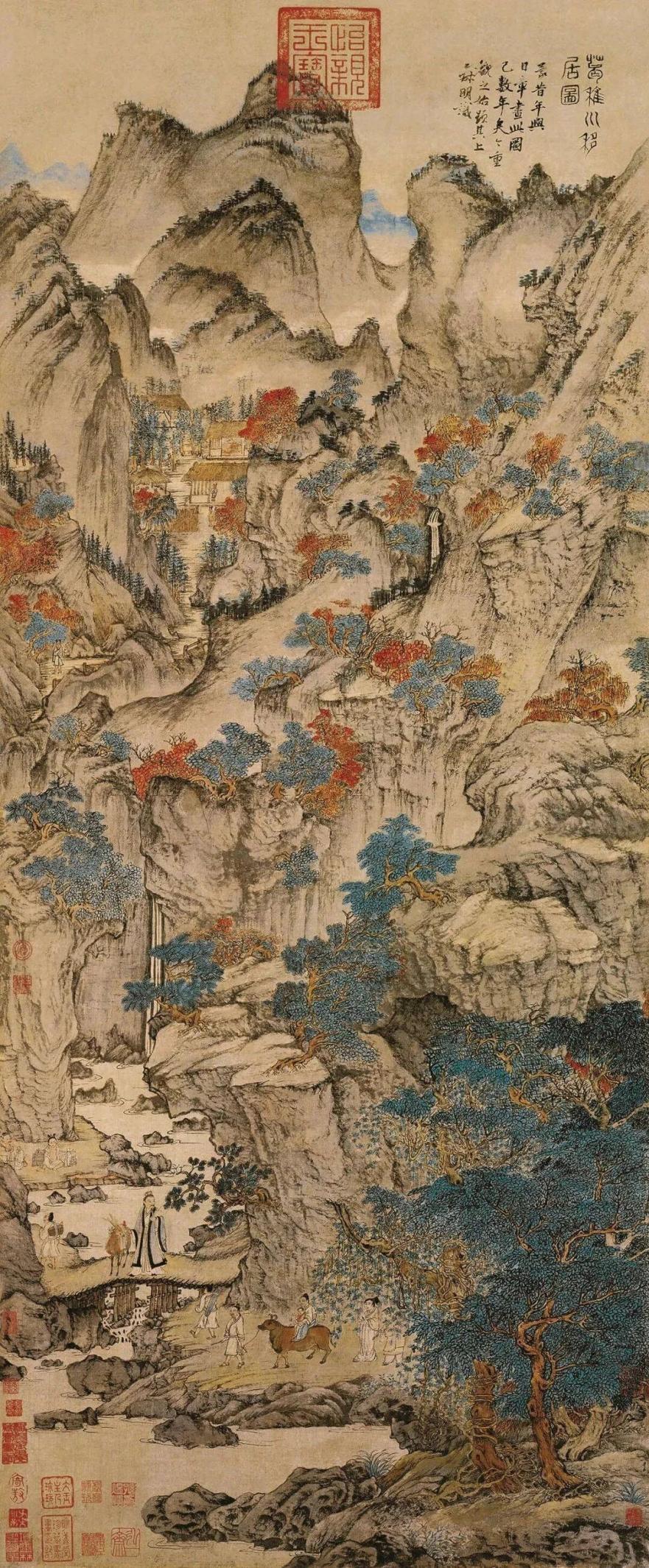
For example, the Yuan painter Wang Meng’s Ge Zhichuan Moving His Dwelling depicts the story of Ge Hong of the Eastern Jin moving in his later years to Mount Luofu, to refine elixirs, becoming an immortal. The landscape of Mount Luofu, the famous Taoist mountain, forms the main body of the painting, with figures by the stream depicted only at the bottom; the picture is filled with layered crags and peaks, red branches and green trees, with waterfalls and springs threading among them; at the top, between two mountains, stands a cottage of a few rafters, the place where Ge Hong refined his elixir. The work depicts the beauty of autumn mountains and expresses the painter’s reclusive aspiration to lose himself in landscape.
The Ming painter Dai Jin’s Asking About the Tao at the Grotto-Heaven depicts the story of the Yellow Emperor Xuanyuan going to Mount Kongtong to ask Guangchengzi about the Tao. The painting highlights the scenery of Mount Kongtong, the famous Taoist mountain: on the left, peaks thrust abruptly up into the clouds; on the right, ancient pines grow lush, with old trunks and twisting branches. On a perilous path in the valley, the Yellow Emperor, in imperial robes, goes alone to the grotto-heaven to ask about the Tao. The brushwork is strong and elegant and the coloring light, giving a sense of mystery, ethereality, depth, and remoteness.
From Taoist myths and legends, to real grotto-heavens and blessed lands, to real settings of Taoist practice, Taoist immortal-mountain imagery carries meanings on many levels and reflects the rich cultural content of Taoist thought. Immortal-mountain images on these different levels display the Taoist interpretation of the relation between the Tao and the myriad things. The immortal mountains evolved gradually from legendary fairylands into grotto-heavens and blessed lands among real natural landscapes, becoming a path of communication between humans and gods and a site of Taoist practice. The immortal-mountain images in Chinese painting are like “Taoist heaven and earth in miniature”: they not only embody Taoist reverence for natural landscape but also reflect Taoist aesthetic thought and ideals, guided by the unity of heaven and humanity and by “the Tao follows what is so of itself.”