
Hanmo Chunqiu
The Wudang Mountains are one of China’s most famous Taoist holy lands and have held a lofty place through every dynasty. A mountain scenic area where natural and cultural landscapes blend perfectly, Wudang is renowned for its magnificent scenery, vast complexes of ancient buildings, long-standing Taoist culture, and profound Wudang martial arts. It has been hailed as “a wonderland unmatched through the ages, the foremost mountain of the immortals under heaven.”
Beyond the grandeur and sheer scale of its architecture, the Wudang Mountains are also home to many mysteries that have gone unsolved for centuries. The most famous is a bronze sea horse on the roof of the Golden Hall—a hall of solid gilded bronze standing on the highest peak of Wudang—which often breathes out mist.
The Golden Hall of Wudang is a palace-style hall with a double-eaved hip roof, the highest rank in traditional Chinese architecture; it is the only hall of this grade on the Wudang Mountains, and it enshrines a statue of the Perfected Warrior, Supreme Emperor of the Dark Heaven (Zhenwu). The sea horse sits on the ridge of the Golden Hall, which is also carved with dragons, phoenixes, lions, sea horses, and other rare birds and beasts, all vivid and lifelike. It is here that the “Sea Horse Breathing Mist,” one of the Four Wonders of Wudang, appears.
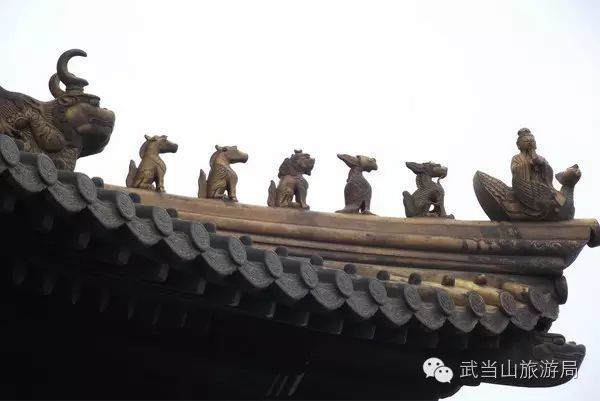
It is said that whenever it rains in summer, this sea horse breathes out clouds and mist and gives a whistling roar, hissing loudly; as the mist rises into the sky it at once turns into purple haze—an extraordinarily beautiful sight. The Gazetteer of Mount Taihe (Taihe Shan Zhi) from the Qianlong era also records the “Sea Horse Breathing Mist”: “Sea horses are set into the four corners of the Golden Hall. Every year after the summer solstice, the sea horses roar at night and breathe out vapor and flame.”
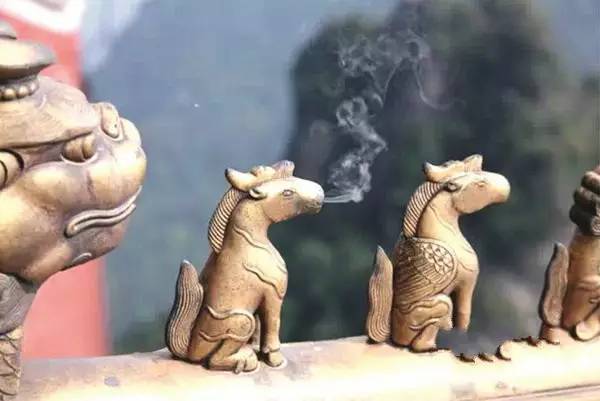
The “sea horse” breathing out clouds and mist