
Yixiang Tianjiukai
One day in the Kaiyuan era of the Tang dynasty, after returning from Mount Li, Emperor Xuanzong fell ill with malaria. The palace physicians tried everything to treat him for more than a month, yet his illness did not improve in the least. Just when the physicians were at their wits’ end, one day, as Xuanzong lay resting in bed in the daytime, he drifted off into a hazy sleep and suddenly had a dream. He dreamed of two ghosts, one large and one small. The small ghost wore red clothes; one foot had a shoe on it, while the other foot was lame and bare. The large ghost had glaring eyes and a bristling beard, wore a battered hat and a blue robe with a horn belt; one foot was bare and the other shod in an old court boot, and one arm was exposed. Gripping a sword, he was chasing the small ghost to kill it.
As soon as the small ghost saw the large ghost, it fled wildly around the hall, but the large ghost still caught it in one grab. The large ghost reached out a finger, gouged out the small ghost’s eyes, and tossed them into his mouth and ate them; then he tore the small ghost’s body apart and devoured it completely.
Xuanzong had been watching spellbound, but when he suddenly saw him eat the small ghost, he feared he would eat him next. Forcing himself to stay calm, he shouted: “Who are you?”
The large ghost came forward, bowed down, and said: “Your servant is Zhong Kui, a jinshi scholar from Zhongnan. In the Wude era I passed the jinshi examination, but because of my ugly appearance I was rejected. I sat the military examination many times without being accepted. Unwilling to accept it, I dashed myself to death against a pillar in the corridor behind the great gate of the palace hall. Your Majesty’s predecessor took pity on me and granted me the green robe of a jinshi for my burial. Grateful for this imperial grace, I vowed to rid Your Majesty of the Xuhao ghosts of emptiness and waste and of all other evil spirits.” He also told the emperor that the small ghost had stolen Yang Yuhuan’s purple sachet and the jade flute Xuanzong often played.
As soon as Zhong Kui finished speaking, Emperor Xuanzong awoke from his dream. On waking, the illness that had plagued him for days vanished at once and he was well. Only then did he realize that it had all been the mischief of the small ghost—no wonder the palace physicians had been helpless.
Emperor Xuanzong then urgently summoned Wu Daozi to the palace, described the scene in his dream in detail, and asked him: “Can you paint this Zhong Kui who catches ghosts?”
Receiving the imperial command, Wu Daozi at once began to conceive the picture. In a trance he seemed to see Zhong Kui before his eyes; spreading his white silk and taking up his brush, he finished it in one sweep and soon presented Xuanzong with a painting, Zhong Kui Catching Ghosts.
Emperor Xuanzong was astonished when he saw the painting: Zhong Kui looked exactly as he had in his dream—his left hand gripping the small ghost and his right hand gouging out its eye. Xuanzong marveled at how lifelike and vivid Wu Daozi’s painting was, and said to him: “Did you, my dear minister, share this dream with me? Otherwise, how could you re-create my dream so faithfully?”
Thus the first painting in history of Zhong Kui catching ghosts was created: the idea came from Emperor Xuanzong and the painter was Wu Daozi. Wu Daozi truly lived up to his name as the Sage of Painting, able to produce such a lifelike image from Xuanzong’s spoken description alone.
After the fall of the Tang, in the Five Dynasties, someone presented this painting to Meng Chang, the emperor of the Later Shu. He admired it greatly and hung it in his bedchamber to enjoy from time to time. But he was somewhat dissatisfied that Zhong Kui was gouging out the ghost’s eye with his index finger, so he summoned the famous painter of the day, Huang Quan, and said: “If this Zhong Kui gouged out the ghost’s eye with his thumb, it would be more powerful. Change it for me.”
A few days later, Huang Quan returned Wu Daozi’s painting unaltered, but had painted a separate portrait of Zhong Kui gouging out the ghost’s eye with his thumb. The emperor asked, displeased: “I told you to change Wu Daozi’s painting. Why did you not do as I said, and paint a new one instead?”
Huang Quan answered, trembling: “I studied Wu Daozi’s painting at home for several days. In Wu Daozi’s Zhong Kui, all the spirit and energy are concentrated in the gaze of the eyes, and all the strength of the body is gathered in the index finger, not the thumb. Changing it would ruin the painting, so I dared not alter it lightly, and could only paint another according to Your Majesty’s wishes.”
On hearing this, Meng Chang sighed that the painting was indeed a divine work of Wu Daozi, revered as the “Sage of Painting”—not a single stroke of his painting could be changed.
Wu Daozi’s style had a great influence on later generations, and the form of his first painted image of Zhong Kui became the model for later ages. But few of his original works survive; most of what remains are copies and rubbings, and this legendary painting of Zhong Kui catching ghosts, for one, has not come down to us. The Heavenly King Presenting a Son, said to be an original by Wu Daozi, is now in the Osaka City Museum of Fine Arts in Japan.
After Huang Quan, more and more painters painted Zhong Kui, each shaping the composition according to his own understanding, so the Zhong Kui images circulating among the people take a thousand different forms. Nevertheless, an ugly but fierce appearance, awe-inspiring righteousness, and poses such as catching ghosts sword in hand or gouging out their eyes and eating them are features common to all images of Zhong Kui. Zhong Kui’s mission is to drive out evil and catch ghosts for people, so his image is mostly hung in halls and living rooms; some also hang it on the back door, because according to folk legend the place where Zhong Kui dashed himself to death was in front of the rear gate of the imperial palace, so he is invited to serve as the door god of the back door.
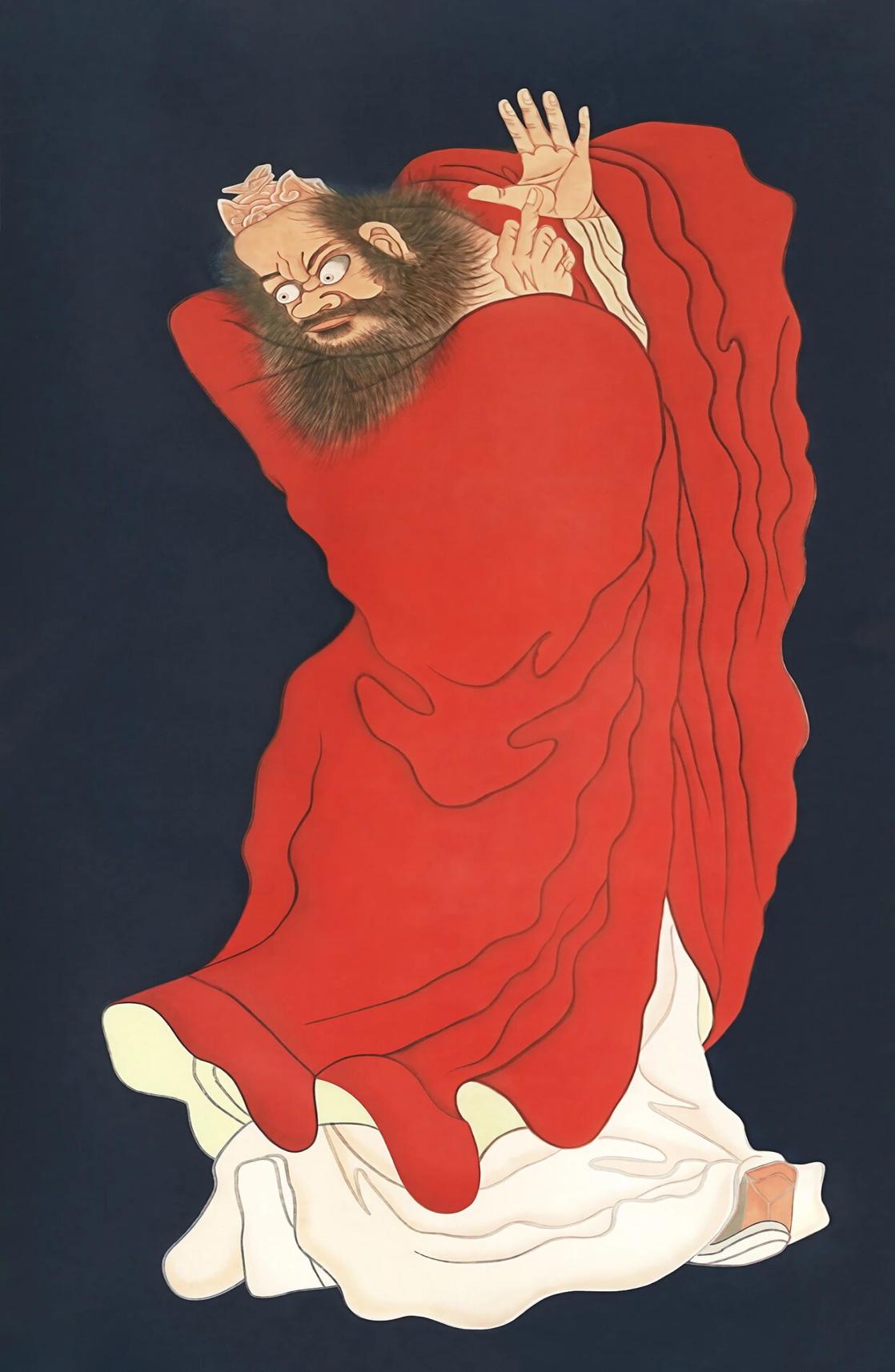
(Portrait of Zhong Kui in red)
In ancient Chinese Taoism, paintings and sculptures of Zhong Kui became popular in the Tang and Song as a way to protect peace, drive away ghosts and evil, and invite good fortune by praying for blessings at the New Year, and in the Ming and Qing this gradually evolved into the custom of hanging his image at the Dragon Boat Festival.
Shi Ke, a painter of the late Tang and Five Dynasties, was unconventional by nature and bold with the brush, and broadened the appeal of the Zhong Kui theme. His contemporary Sun Zhiwei, lofty and pure in character and above the common crowd, once painted pictures with allegorical meaning. After Wu Daozi, the Zhong Kui of the Northern Song painter Yang Fei deeply captured Wu Daozi’s charm, imposing and grand. Gong Kai, a Southern Song painter from Huaiyin who refused to serve under the Yuan, loved to paint Zhong Kui and ink ghosts, exchanging paintings and poems with others to great and delightful effect; with him the style changed, the figures becoming grotesque and the manner novel.
Most of China’s traditional gods are enshrined in Buddhist and Taoist temples, but Zhong Kui, “the Holy Lord of the Tang Who Bestows Blessings and Guards the Home,” is the only one among the gods whom people respectfully invite into their homes and devoutly worship as a household god who bestows blessings and guards the house. With a divine image and a sincere heart, one’s wishes will naturally be answered.
The spiritual charm of Zhong Kui art is chiefly characterized by “exaggeration and distortion, strong contrasts, romantic naivety, full compositions, an emphasis on plainness and on likeness of spirit, a strong national and folk flavor, a rich atmosphere of rural life, a sturdy simplicity, a rough and unrestrained freedom, and marked regional features,” giving it a rich historical quality, uniqueness, and strong artistic appeal.
There are many kinds of artworks depicting Zhong Kui, including statues, paper cuts, Chinese paintings, woodblock prints, and stele rubbings. Among the painted forms are many artistic variations such as the “Zhong Kui of Blessings, of Prosperity, of Longevity, of Happiness, the Judge Zhong Kui, the Zhong Kui of Sons, the Zhong Kui with His Sister, the Civil Zhong Kui, the Martial Zhong Kui, and the Zhong Kui of Wealth.” They have very high artistic quality and aesthetic value, and with the power that consecration (kaiguang) gives Zhong Kui to bestow blessings, guard the home, and bring success in the examinations, they stand for good fortune and justice, making them prized pieces for hanging and fine gifts for friends.
For example, when an elderly person is celebrating a birthday and a gift is needed, one can give a Zhong Kui Offering Birthday Wishes, showing him in official robes holding a bat and a longevity peach, to express the wish for divine protection, the welcoming of blessings and good fortune, long life and abundant years, and prayers for blessings and the banishing of evil.