
Yixiang Tianjiukai
1. Statues and Murals
The Wei, Jin, and Northern and Southern Dynasties were a period of major transformation for Taoism. Reshaped by intellectuals, Taoism became a complete and mature orthodox religion recognized by the state.
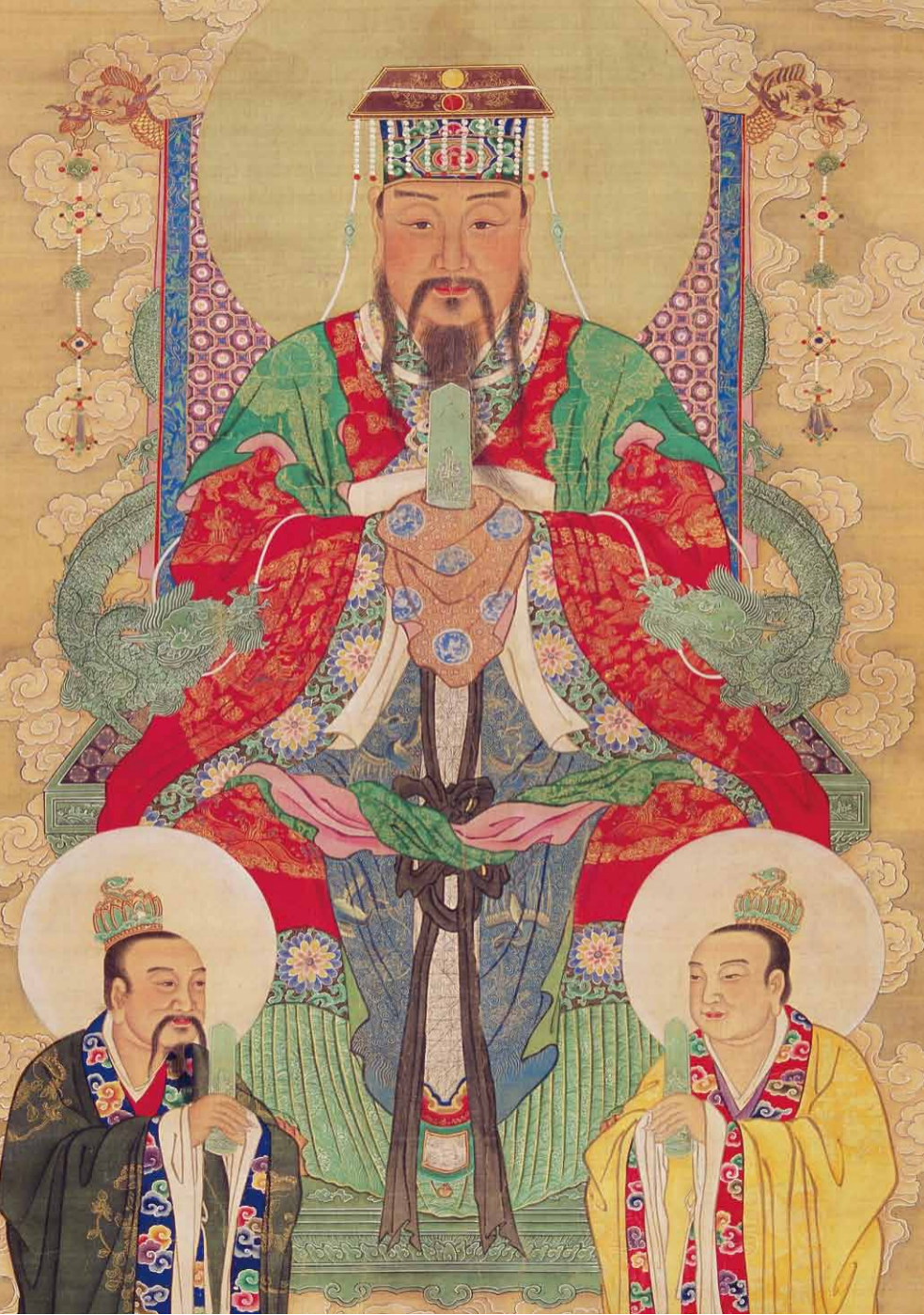
Taoist statues of this period were influenced by Buddhist statues in both style and form. In appearance, the faces, clothing, hand gestures, and seated postures of Taoist deities all carry traces of Buddhist images, and some are even hard to tell apart. In form of presentation, Taoist statues of this time likewise used round-arched niches and lotus thrones, with boat-shaped mandorlas and halos behind them, and some backgrounds were decorated with flying apsaras, yakshas, and the like. The differences are that Taoist figures wear Taoist dress and crowns, have beards on their chins, and hold a deer-tail whisk, or cross their hands before the chest, or hold a talisman; in addition, in the dedicatory inscriptions the donors call themselves “people of the Tao” or “women of the Tao.”
According to historical sources, the earliest surviving Taoist statue is the one respectfully made by Wei Wenlang in the first year of the Shiguang era (424) of the Northern Wei. It is a votive stele with niches on all four sides, carved in high relief with simple, unpolished knife work. The front of the stele has a round-arched niche with a dragon head, above which are auspicious birds and two flying apsaras. In the niche sit side by side a Taoist figure and a Buddha. The Taoist figure wears a Taoist crown and a wide-sleeved Taoist robe with a double-lapelled broad collar, and sits in the lotus position. The stele’s inscription reads: “In the first year of Shiguang, Wei Wenlang, a disciple of the Buddha and a commoner of Yangyuanchuan in Sanyuan County, Beidi Commandery, … made one image of the Buddha and the Tao on behalf of the men and women, to make offerings …” From this we know that the donors included both Buddhist and Taoist believers.
Images of feathered beings and flying immortals already appeared in the Han dynasty, but painted sculptures in high relief are rare; the painted feathered figure in Cave 297 of the Mogao Grottoes at Dunhuang is the representative example. The figure is 0.5 meters tall, with two horns on its head and a pair of feathered wings on its back; its upper body is half-naked, and it wears short trousers below; its hands are like bird claws, and it wears rings at its neck and ankles. It looks like a child, with a round face and thick lips, its face and body shaded in ochre red. Cave 297 is Buddhist in content, yet this painted feathered figure adopts the image of a Taoist figure, reflecting the mutual influence and absorption of Buddhist and Taoist culture in the Northern Dynasties; it is a precious work of Taoist art.
Taoism honors Laozi as its founder, and Laozi is first called Lord Lao in the “Biography of Kong Rong” in the Book of the Later Han. The earliest deities worshipped by Taoism were Lord Lao, the Three Officials, the Three Sovereigns, and other immortals. Among surviving Taoist statues, the first explicitly called “Lord Lao” is the image respectfully made by the brothers Li Tanxin in the second year of the Baoding era (562) of the Northern Zhou, whose inscription reads: “Completed on the fifteenth day of the second month of the second year of Baoding. The disciples of the Buddha, the brothers Li Tanxin, respectfully made one stone image of Shakyamuni, Lord Lao the Most High (Taishang Laojun), and the bodhisattvas.”
Five years later, in the third year of the Tianhe era (567) of the Northern Zhou, Du Shijing respectfully made an image of Lord Lao. The figure wears a Taoist robe and Taoist crown and has a beard; his right hand holds a talisman and his left rests on his knee; a Perfected stands in attendance on each side, and behind him are a boat-shaped mandorla and lotus petals.
In the Wei, Jin, and Northern and Southern Dynasties, as Taoist altars and temples were established, murals in Taoist temples and monasteries depicting stories of the immortals came into being.
Most of the famous painters of the Wei, Jin, and Northern and Southern Dynasties were skilled at murals, and artisans also painted them. The former were finer in brushwork, concentrating on expressing their conception and attentive to brush technique and spiritual resonance; the latter were practical and mostly subordinate to craft.
Murals were painted on the walls of Buddhist and Taoist temples and grottoes, and also on the walls of tombs. At this time murals were mostly sketched directly onto white plaster walls or red earth grounds; the outlines were fairly thick, the colors mostly red, green, and blue, and scenery such as trees, mountains, and rivers was mostly rendered in a patterned way. The main surviving Taoist murals of the Wei, Jin, and Northern and Southern Dynasties are the murals of the King Father of the East and the Queen Mother of the West in Cave 249 of the Mogao Grottoes at Dunhuang and the picture of Fuxi and Nüwa in Cave 285, along with some tomb murals.
The picture of the King Father of the East on the north slope of the ceiling of Mogao Cave 249 is trapezoidal, 125 cm high and 200 cm wide, a work of the Western Wei. The King Father of the East is an ancient Chinese immortal and also a Taoist immortal.
In the Biography of Mu, Son of Heaven, when King Mu of Zhou travels west to Kunlun to meet the Queen Mother of the West, she calls King Mu the King Father of the East. Taoism also calls him the Divine Lord of Eastern Florescence and the Primal Elder Lord of Azure Numen, one of the “Five Elders of the Five Directions,” who manages the registers of male immortals. In the picture the King Father of the East rides a four-dragon chariot; the canopy of the chariot and the heads of the King Father and his charioteer Zaofu are now damaged. The surviving parts show the dragon chariot, with two attendants on either side riding dragons and holding tallies as escort, and whales leaping beside them. In front of the dragon chariot are a “feathered being” with vertical eyes and a “Kaiming” guardian with a deer’s head, a horse’s body, and wings on its back; above, white cranes soar, and in the sky are stars, flying clouds, and heavenly flowers—together forming a realm of immortals riding dragons through the clouds, the whole wall seeming to move with the wind. The lower part of the picture shows rolling mountain ridges and dense forest, where hunters gallop on horseback chasing their prey; the hunted beasts run in terror and haste, while animals in the distance look relaxed and idle. The painter skillfully combined realism with rich imagination, showing the real human world and the wondrous “realm of the immortals” within a single picture. The composition is lively and ingenious, the brushwork concise yet expressive, the lines graceful, and spirit and form are both complete.
The picture of the Queen Mother of the West is on the south slope of the ceiling of Cave 249. It is trapezoidal, 120 cm high and 210 cm wide, a work of the Western Wei.
The Queen Mother of the West, an ancient Chinese goddess, first appears in the “Classic of the Western Mountains” of the Classic of Mountains and Seas; she is also a Taoist goddess who manages the registers of female immortals. In the picture the Queen Mother of the West rides a chariot drawn by three phoenixes, wearing a long wide-sleeved robe, her hair combed into a high chignon. The phoenix chariot has a canopy, with colored banners hanging from poles and pennants flying at the rear. A charioteer stands on the left of the chariot, and beside it whales and flying fish leap. There are also two Taoist figures, one in front holding a banner to lead the way and the other following behind holding a tally. In addition, a “feathered being” and a “Wuhuo” clear the way ahead, and a “Kaiming” guards the rear of the chariot. In the upper part of the picture flying apsaras dance, in the lower part a white tiger gallops, and between them meteors and flying clouds drift—a magnificent heavenly scene. The lower part of the picture depicts with great vividness the chase among wild beasts and the law of the jungle. The Queen Mother of the West picture faces the King Father of the East picture, and both are painted in a Buddhist cave, showing the Wei-Jin characteristic of Buddhism and Taoism being undifferentiated.
In the tomb of Princess Linhe of the Rouran, of the Eastern Wei, excavated at Dazhongying Village in Ci County, Hebei, the murals show ghosts and spirits racing and galloping; the proportions of the figures are accurate, the outlines vigorous and fluent, and the colors bright and rich.
The murals in the Dingjiazha tomb excavated in Jiuquan, Gansu, are close in style to the Northern Dynasties murals of Dunhuang; the compositions are rigorous, the forms lively, and the brushwork accomplished. They are works of the Sixteen Kingdoms period.
2. Taoist Paintings by Literati and Paintings by Taoist Priests
The Wei, Jin, and Northern and Southern Dynasties were one of the most brilliant ages in the history of Chinese painting. Painting technique advanced greatly in this period, and many famous painters appeared. Taoist figure painting became increasingly popular with the rise of the religion, and there were many painters skilled at Buddhist and Taoist figure painting.
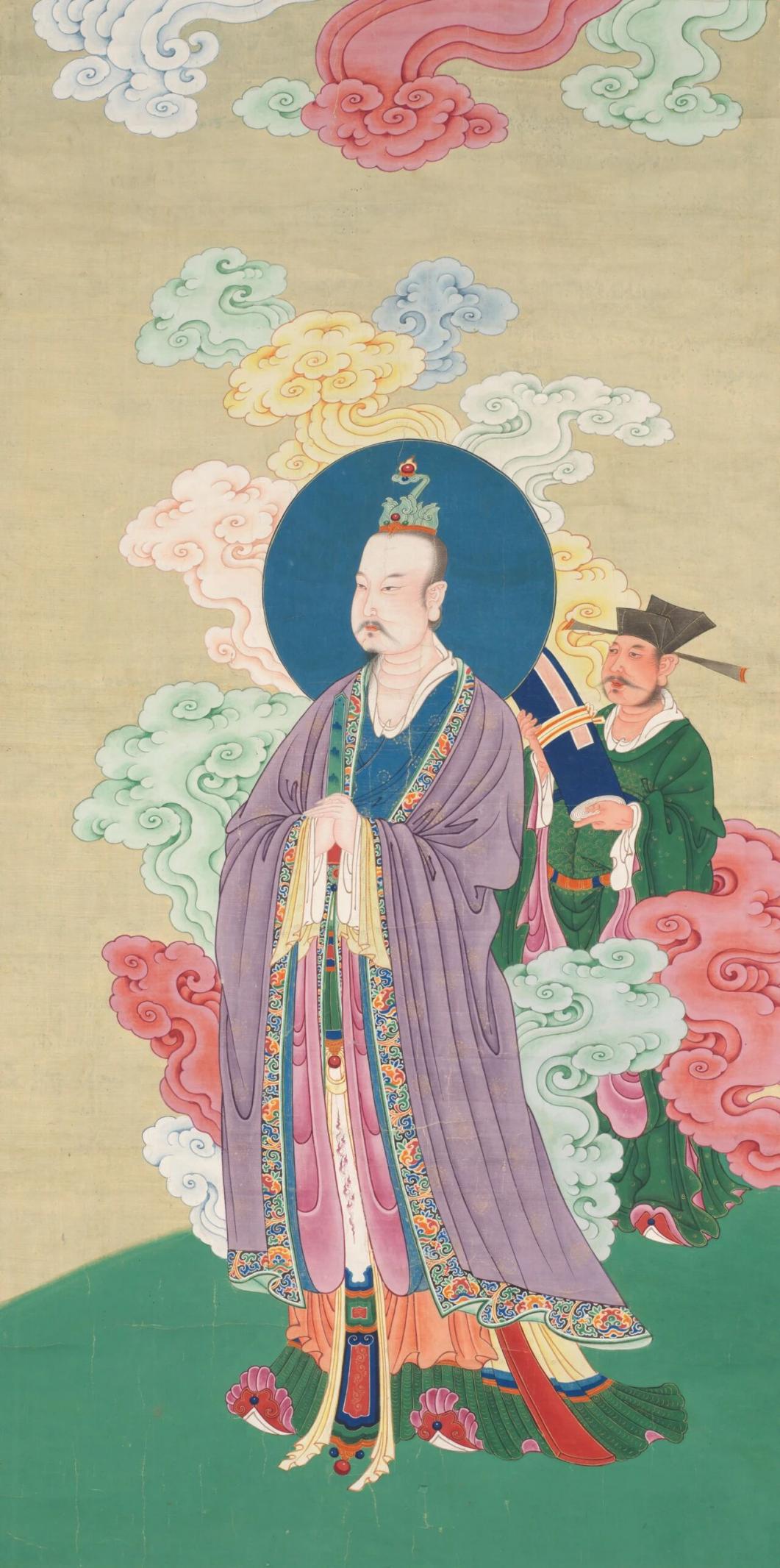
Taoist paintings of the time often took the dragon as their subject, alluding to the saying that Laozi was like a dragon. Cao Buxing, a painter of Eastern Wu, was famous for painting dragons. The Tang writer Zhang Yanyuan says in his Record of Famous Painters Through the Ages: “Buxing left a painting on assorted paper, Dragon and Tiger, and ten paintings on paper including Dragon of the Green Stream and Coiled Red Dragon.”
Xun Xu (?–289), a painter of the late Wei and early Jin, was skilled at painting immortals and figures; according to records, he painted Illustrations of In Search of the Supernatural.
The famous Eastern Jin painter Gu Kaizhi produced many works on a wide range of subjects. According to Tang and Song sources on the history of painting, his works included Portrait of Xie An, Portrait of Huan Wen, Female Immortals, Illustrations of the Immortals, The Water Palace, Eminent Men of the Central Court, and Nymph of the Luo River. Of these, Female Immortals, Illustrations of the Immortals, and The Water Palace are paintings on Taoist themes, but none survives in the original; the Nymph of the Luo River, Admonitions of the Instructress to the Court Ladies, and Benevolent and Wise Women that have come down to us are all Tang and Song copies.
Although Nymph of the Luo River is not a Taoist painting, the realm of the immortals it depicts had a great influence on the later development of Taoist painting. Gu Kaizhi was skilled at figures, emphasizing “using form to portray spirit” and “transferring thought to grasp the wondrous”; he was also skilled at landscape. His work Painting Mount Yuntai presents the Taoist blessed land of Mount Yuntai with its rocks and streams, ancient pines, flowers, and trees, a phoenix “swaying in stately posture, its plumage fine and its tail feathers raised,” and a white tiger “crouching on a rock to drink water.”
According to histories of painting, other Wei and Jin painters skilled at Buddhist and Taoist figures included Wei Xie, Zhang Mo, and Xiahou Zhan, but none of their works is known to survive.
At that time many Taoist priests and Taoist believers were also skilled painters. For example, the Taoist priest Li Yiqi, a man of Shu, was good at painting: “When Liu Bei was about to attack Wu, he asked Yiqi whether it would be auspicious or not. Yiqi asked for paper and brush and painted soldiers, horses, and weapons on dozens of sheets.” It is also said that Ge Hong’s third son was skilled at painting; the Records of Original Transformations says: “When Cui entered the house, an old man at the table before the curtain seemed to be drawing something … This was painted by Ge Hong’s third son.”
Lu Tanwei (?–c. 485) was a famous painter of the Liu Song in the Southern Dynasties. He learned Gu Kaizhi’s manner of painting and was skilled at portraits and Buddhist and Taoist figures, and was also accomplished at cicadas and sparrows, horses, buildings and pavilions, and landscapes and flowers. Twenty-five scrolls are recorded as his, including Portrait of Emperor Ming of Song, Xiao Shi, and The Yellow Emperor’s Battle at Zhuolu (in the Sui palace collection). His figures have “slender bones and delicate features,” with a unique spiritual resonance. His brushwork is thorough, and his lines run “unbroken,” so his painting was called “one-stroke painting.”
Zhang Sengyou (502–549) was a famous painter of the Liang in the Southern Dynasties. In Jiankang (present-day Nanjing) he painted murals for many Taoist temples, and he is a painter of Taoist figures who made an outstanding contribution to the history of Chinese painting. His famous paintings include Star Chart of Complete Perfection, The Nine Luminaries, Emperor Wu of Han Shooting the Jiao Dragon, The Heavenly King Practicing the Tao, and True Forms of the Five Planets and Twenty-Eight Lunar Mansions. He painted figures in the sparse manner, with concise brushwork and a restrained mode of expression. When painting landscapes he did not outline forms with lines but painted them purely in color, which later generations therefore called the “boneless method.” In coloring he often applied heavy reds and greens, using differences of light and dark to distinguish the yin and yang—shaded and lit—sides. This manner of painting absorbed the techniques of Indian Buddhist art; later generations called it the “Zhang style,” ranking it alongside the “Cao style” of Cao Zhongda of the Northern Qi and the “Wu style” of Wu Daozi of the Tang, and it had an extremely important influence on later painting.
The people of the Northern Dynasties lived in the Yellow River basin; their paintings were simple in composition and coloring, plain in style, and bold and forceful in spirit. For example, Cao Zhongda of the Northern Qi was skilled at Buddhist and Taoist figures and especially at drapery folds, which later generations described as “Cao’s robes emerging from the water”; Cao Zhongda too was revered as a sage of painting.
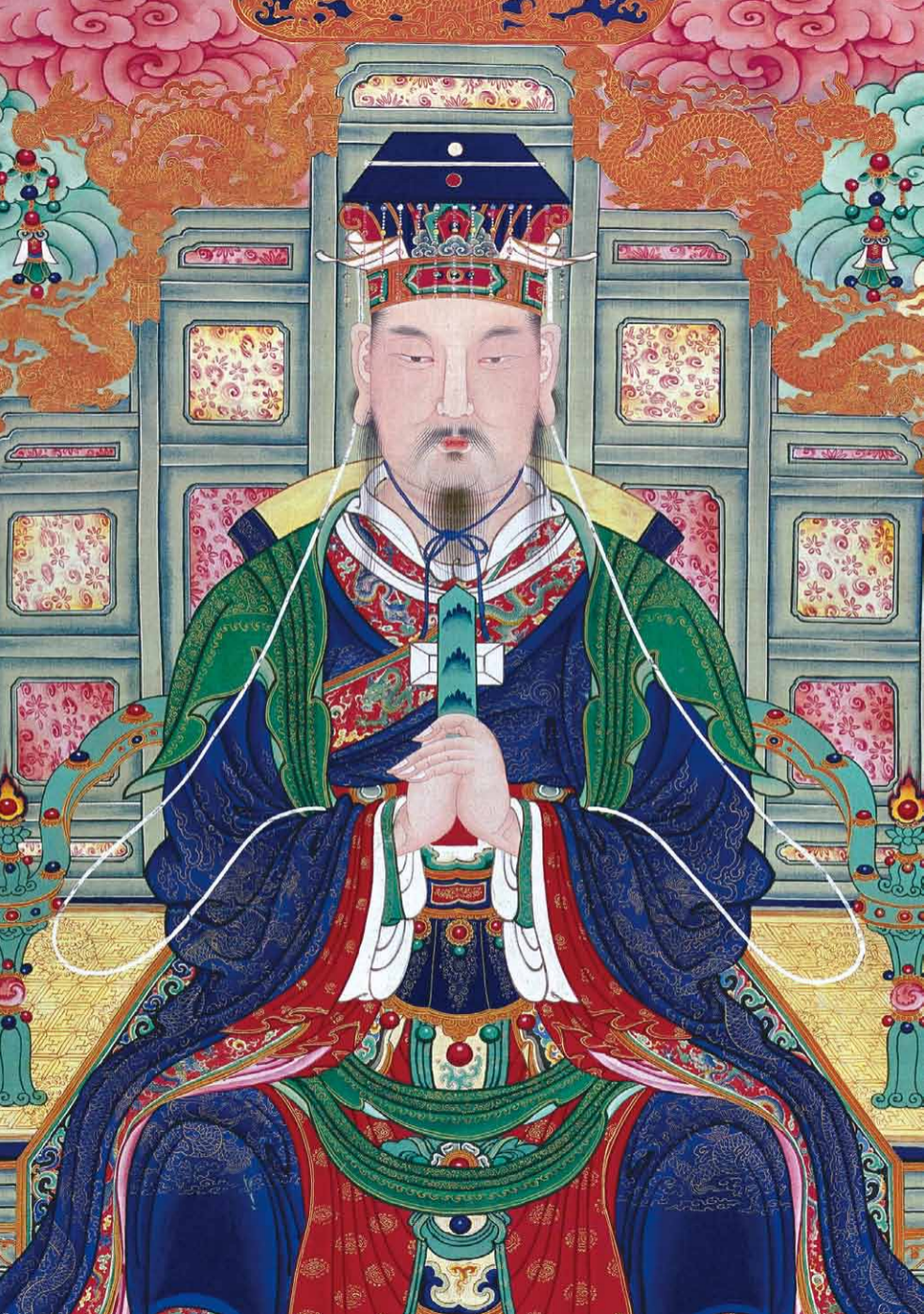
Zheng Fashi of the Northern Zhou was skilled at figure murals. The figures he painted had an extraordinary bearing, their caps, tassels, and sashes flowing like moving clouds and running water, capturing the wonder of form and appearance.