
Chiyang Daoren, Eastern Taoism
The Tao created heaven, earth, and all things. The mountains have witnessed and borne the thousand-year unfolding of the Tao.
The Wudang Mountains of Hubei Province, known in ancient times as Mount Taihe, stretch for eight hundred li. Above they connect with the Pivot of Heaven, below they coil around the Axis of Earth; they rest against the Qinling and Daba Mountains and guard the Han River at their feet. Seventy-two peaks pay homage to the Golden Summit; the land is utterly secluded and the scenery extraordinary. “None but the Perfected Warrior is worthy of it” (wu dang)—it is a feng shui treasure of Taoism unmatched through the ages.
The Wudang Mountains are famous throughout the world because the Great Emperor Zhenwu cultivated himself here and attained the Tao.
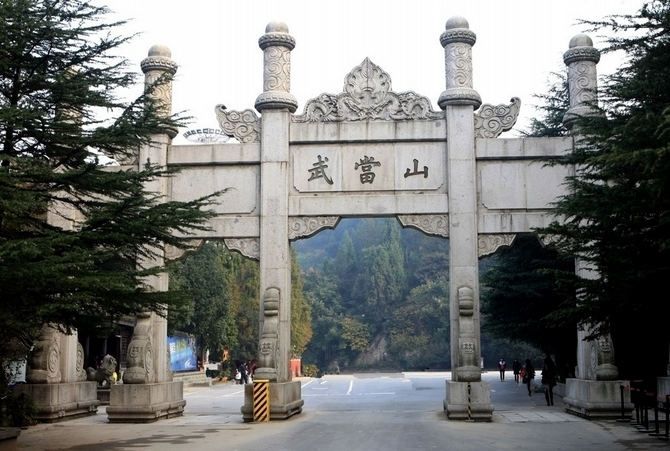
The Wudang Mountains, Hubei
The Taoist Canon (Daozang) records that the Perfected Warrior, Supreme Emperor of the Dark Heaven (Zhenwu), was born in the remote age of the Divine Farmer, the Flame Emperor, to Queen Shansheng of the kingdom of Pure Joy, on the third day of the third month. Divine and numinous from birth, he resolved as a youth to cultivate the Tao and declined to inherit the throne.
Enlightened by the Primordial Sovereign of Purple Qi, the holy ancestor of Jade Clarity, he came to the Wudang Mountains at fifteen to cultivate alone in seclusion. During his long and arduous practice, his resolve in the Tao began to waver. The Primordial Sovereign of Purple Qi transformed into an old woman grinding an iron pestle into a needle to move him. Suddenly awakened, he returned to his practice with single-minded devotion to the Tao.
Forty-two years later, on the ninth day of the ninth month, he finally attained the supreme great Tao and ascended at Nanyan (South Cliff). At that moment, five dragons appeared in the auspicious clouds below the cliff bearing up the sage; the divine lords of the Five Dragons surrounded him and raised him to the Golden Palace. The Jade Emperor enfeoffed him as Patriarch of the Three Teachings, God of Blessings Who Orders the World, Marshal of Great Mystery, and Heavenly Worthy Who Sweeps Away Demons, and granted him the title “Supreme Emperor of the Dark Heaven” (Xuantian Shangdi). He commands three hundred thousand heavenly soldiers and generals and governs the Three Realms, punishing evil and promoting good, subduing demons and sweeping away monsters, and bringing blessings to the human world. He is depicted with flowing hair and bare feet, in golden armor and a black robe, treading on the flying serpent (pronounced teng) and the divine tortoise of the Eight Trigrams.
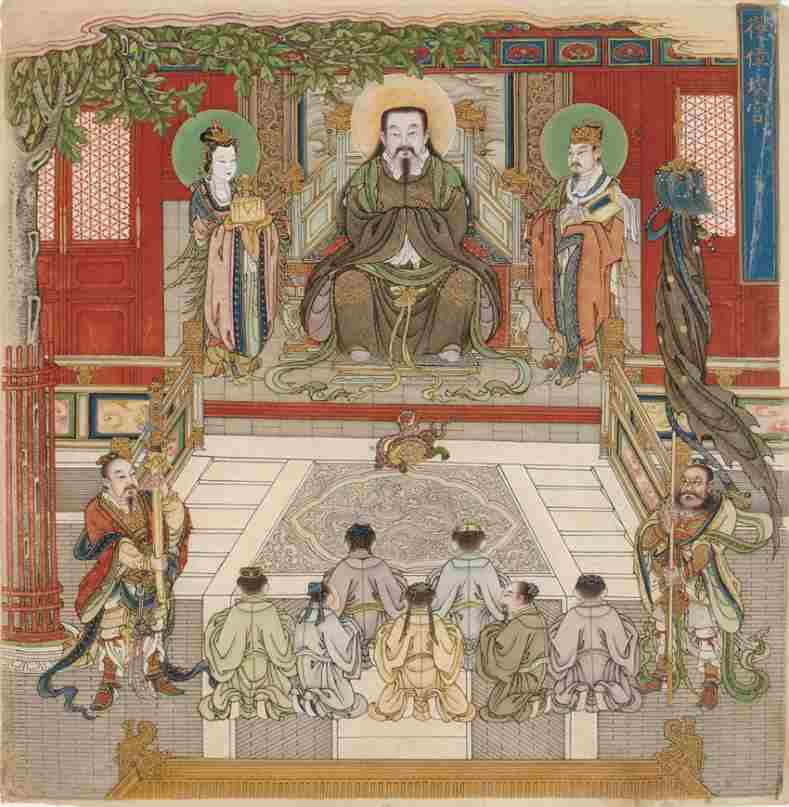
The Great Emperor Zhenwu received state sacrifices as early as the Spring and Autumn and Warring States periods.
From the Tang on, emperors of every dynasty repeatedly conferred titles and decrees on him and built palaces and temples, honoring him to the utmost. The illustrious standing of the ancestral court of Zhenwu made the Wudang Mountains famous throughout the world.
The mysterious and ethereal Wudang Mountains have since ancient times been grotto-heavens and blessed lands for remarkable people and recluses, a cave dwelling of immortals.
Tracing the Taoist lineage to its source, Yin Xi is the first Taoist Perfected recorded in the historical sources of the Wudang Mountains.
Yin Xi, a grand master under King Kang of Western Zhou, styled Master Wenshi, was Keeper of the Hangu Pass when he saw purple qi coming from the east, welcomed Laozi through the pass, and earnestly asked him to write a book to leave to the world. Laozi agreed. Tradition says that after Yin Xi received Laozi's Tao Te Ching, he studied it for three years at Louguantai in Shaanxi and wrote the Guanyinzi (True Classic of Wenshi); he then resolved to resign his office to cultivate the Tao and, drawn by its fame, withdrew to the Wudang Mountains.
He crossed the Qinling Mountains, passed Mount Funiu, took a small boat south across the Han River, and came to the foot of the Wudang Mountains. Yin Xi went to Hidden Immortal Cliff to cultivate in purity, building a rock chamber and a stone bed and walking down to the gully to fetch water. Bathed in the fresh breeze, he played the qin and awakened to the Tao, studying the Tao Te Ching. This feng shui treasure of the Wudang Mountains made him feel keenly the harmony of body and mind with nature. When hermits of the mountains came to visit, Yin Xi spoke freely of Laozi's “Tao that is not the constant Tao”: the great Tao has no form and is made manifest through virtue; the Tao is the great law of “the harmonious union of heaven, earth, and humanity”; all things live and flourish together and must revere the Tao and honor virtue.
The Complete Record of the Perfected records that Yin Xi and Laozi made many spirit journeys to the Wudang Mountains and met as immortals at places such as Green Goat Gully and Ox Trough Gully.
During his days of cultivation, Yin Xi often saw the peaks all around, all bowing toward the Golden Summit, full of boundless vitality; deeply struck by the mystery of it, he resolved to climb to the summit to cultivate.
The Yuan-dynasty Complete Record of the Perfected of the Blessed Land of Wudang records that Yin Xi settled beneath the stone cliff of the Third Heavenly Gate in the Wudang Mountains, facing the wall in seated meditation and pure cultivation.
It was Yin Xi's bond with the Wudang Mountains more than two thousand years ago that let the Tao Te Ching spread from here, living on without end. This not only forged the unbreakable bond between the Wudang Mountains and Taoism but also made the Tao Te Ching the most translated, most widely spread, and most influential Chinese classic in the world. The appearance and spread of the Tao Te Ching allowed Laozi's Taoist thought to bless all humanity.
In the Eastern Han, Zhang Daoling founded Taoism. Taoism takes the Tao as the core of its faith and becoming an immortal through cultivation as its ultimate aim; it takes Laozi's Tao Te Ching as its doctrinal scripture, reveres Laozi as its highest god, “Lord Lao the Most High” (Taishang Laojun), and honors Yin Xi as “Chief Minister of Jade Clarity.”
At the end of the Han, Taoism gradually spread to Wudang.
The Tang brought a golden age of Taoist development. Emperor Taizong of Tang called himself a descendant of Laozi and supported and honored Taoism; members of the imperial family vied to receive registers and enter the Tao. The court held examinations on the Taoist classics to select officials, and every household among the people had a copy of the Tao Te Ching—a sign of the peace and prosperity of the great Tang.
The first to bring Wudang Taoism to the attention of the imperial house was Yao Jian, prefect of Junzhou.
In 638, during the Zhenguan era of the Tang, there was a great drought across the land. The emperor issued an edict to pray for rain at the famous mountains and great rivers of the realm, but there was no response. He then ordered Yao Jian, prefect of Junzhou, to pray for rain in the Wudang Mountains. With a purified mind, Yao Jian went into the mountains alone to pray for rain; the mountains were high, strange, and perilous, but he pressed on with great difficulty, heedless of the danger to his life. Legend says that as he crossed ridge after ridge he met five old men one after another, who kindly advised him to go home for his safety. But Yao Jian's resolve was great and firm, and he pressed bravely on. His loyal devotion to relieving the people's distress moved heaven, and he met the five elders at Five Dragons Peak. The old men said: “We are the Dragon Lords of the Five Qi, charged by the Supreme Emperor of the Dark Heaven with guarding this mountain, and we have come to help you.”
In an instant the heavenly dragons manifested their power, thunder and lightning crashed together, and torrential rain fell across the land, ending the drought.
When Emperor Taizong of Tang heard of this, he ordered the Five Dragons Shrine built at the place where Yao Jian had met the Dragon Lords of the Five Qi—the first shrine in the Wudang Mountains built by imperial order. Afterward Yao Jian resigned his post of his own accord and withdrew with his whole family to the Wudang Mountains.
The flourishing of Taoism in the Tang gave rise to many eminent Taoists and immortal Perfected, and to the spread of folk tales of immortals.
Lü Dongbin, one of the Eight Immortals, formed a little-known but unbreakable bond with the Wudang Mountains. Lü Dongbin, styled Chunyangzi, was a native of Yongji County, Shanxi, and passed the highest imperial examination at sixty-four. Later he met Zhongli Quan, who enlightened him and passed on to him “the sword method of the great Tao for escaping through heaven and the secret formula of the dragon-and-tiger Golden Elixir.”
After attaining the Tao, Lü Dongbin was enfeoffed by the Jade Emperor as “Top Scholar Among Celestial Immortals, Patriarch Who Saves Lives and Transmits the Teaching.”
Lü Dongbin traveled the world with his sword, saving people and rescuing the world, and many legends about him spread widely among the people; people called him a living immortal.
The gazetteers of the Wudang Mountains record that Lü Dongbin, with the bearing of an immortal, visited the Wudang Mountains many times and lived on Zigai Peak to cultivate the Tao, writing the Jade Book of the Nine Perfected. Pure of heart and few of desires, he devoted himself to saving the world, teaching the scriptures and the Tao to his outstanding disciples and expounding the essentials of nurturing life through inner alchemy—setting up the furnace and establishing the cauldron. He was very strict in accepting disciples, personally teaching them the art of the green-edged sword, and he instructed them: “If a person can be loyal to the country, filial at home, trustworthy with friends, kind to those below, never arrogant in his own heart, and never deceitful even in a dark room, he will be known in the world for helping others. By hidden merit he moves heaven, and everyone loves him.”
The Yuan-dynasty Record of the Manifestations of the Supreme Emperor of the Dark Heaven contains Lü Dongbin's lines in praise of the Wudang Mountains: “How many immortal companions, past and present, for love of this famous mountain have left and come back again.”
Lü Dongbin devoted himself to cultivating perfection at Nanyan and wrote a commentary on the Tao Te Ching. His highly original commentary opened a door of wisdom for later generations cultivating the Tao and awakening to the truth.
Lü Dongbin was an important figure in the history of Chinese Taoism at the end of the Tang, linking what came before with what came after, and he gave an extremely important impetus to the development of Taoist inner alchemy and martial arts. Many famous eminent Taoists of the Five Dynasties, Song, and Yuan were his direct heirs. His good deeds reached far and wide and his virtue was praised throughout China; the people worshiped him as a “divinity.”
He is held in very high regard in popular faith, called the “Sword Immortal,” “Lord Benefactor,” and so on, and generally known as “Patriarch Lü”; believers of all three teachings, Confucianism, Buddhism, and Taoism, revere him alike. Taoism calls him the “Heavenly Worthy of the Wondrous Tao,” “Patriarch Chunyang,” and one of “the Five Northern Patriarchs of Quanzhen Taoism.”
At the end of the Tang, the Wudang Mountains were listed as the ninth of the Seventy-Two Blessed Lands of Chinese Taoism.
The now-famous Wudang Mountains drew a visit from the “Sleeping Immortal,” Patriarch Chen Tuan.
Chen Tuan, courtesy name Tunan, styled Fuyaozi, was a native of Zhenyuan in Bozhou. At fifteen he studied poetry and the classics and mastered numerology, philosophy, prescriptions, and medicines, a talent that astonished the world.
Declining Emperor Mingzong's generous invitation to office, he then lived in seclusion in the Wudang Mountains for twenty-four years, calling himself a disciple of the Taoist community. The Five Dragons Palace was where he obtained the “Five Dragons Sleeping Method,” nurtured himself through sleep practice, and completed his great elixir. Taking in qi and practicing grain avoidance (bigu), he could sleep for months without rising, becoming the foremost “Sleeping Immortal” in the world. Because too many people came to visit and disturb him, he moved several times. Nine Chambers Cliff was where he lived in seclusion the longest.
Chen Tuan's many writings were mostly completed in the Wudang Mountains. He was the first to draw a series of diagrams of the Changes, such as the Diagram of the Ultimate of Nothingness (Wuji) and the “Diagram of the Generation and Transformation of the Eight Trigrams,” and he published works such as the Discourse on the Supreme Ultimate and Yin and Yang, and so became the founder of Chinese Taiji culture.
He created a distinctive theory of inner alchemy and in the Wudang Mountains wrote eighty-one poems titled Pointing to the Mystery from the Nine Chambers, which set out the matters of cultivation and nurturing in detail.
Chen Tuan later went to Mount Hua to cultivate the Tao. Living through the Later Tang, the Five Dynasties, and the early Song, he was summoned several times to meet the emperors of three dynasties, who granted him the titles “Recluse of Pure Emptiness,” “Master White Cloud,” and “Master Xiyi.”
He is a dazzling peak in the history of Chinese culture. He departed as an immortal at 118; Taoism reveres him as a patriarch, Neo-Confucians praise him as a founding father, and he became a milestone figure who influenced later ages.
The Song was another peak in the history of Chinese Taoism. Its emperors believed in Taoism and worshiped Zhenwu, enfeoffing the god Zhenwu many times. Before generals and soldiers went on campaign, they had first to worship the god Zhenwu.
In 1284, the thirty-one-year-old Zhang Shouqing came to the Wudang Mountains to leave home as a Taoist, taking as his teachers eminent Taoists such as Lu Dongyun, an heir of the Wudang school. Inheriting the mantle of the Wudang talismans and registers, he founded a new Wudang school that venerated the god Zhenwu, refined the great Way of the Golden Elixir within, practiced Qingwei thunder rites without, and fused the various traditions into one.
Around the time he led the Taoist affairs of the whole mountain, Zhang Shouqing took disciples and followers numbering more than four thousand.
While building temples, he led his followers in reclaiming several hundred qing of farmland. He opened two sacred roads, east and west, each more than a hundred li long. With his disciples he compiled Taoist books such as the Illustrations of the Manifestations of the Sage and Auspicious Celebrations and the Record of the Manifestations of the Supreme Emperor of the Dark Heaven, spreading the stories of how the Supreme Emperor of the Dark Heaven blesses and protects all beings.
For twenty-seven years Zhang Shouqing persisted in sitting in meditation every night to cultivate the great Way of the Golden Elixir, and trained hard in Qingwei thunder rites. To practice these methods, the six senses must rest in clarity and stillness and virtue must be the foundation; only then can one communicate with the gods of heaven.
When Emperor Renzong of Yuan came to the throne, there were two consecutive years of drought. Zhang Shouqing was repeatedly summoned to pray for rain in the Yuan capital, Dadu. Through the Taiji methods of the unity of heaven and humanity, he reached the mysterious state of summoning wind and calling rain, and all the fasts and offerings (zhaijiao) he performed had their effect.
Deeply moved, the Empress Dowager donated her private funds to rebuild the Nanyan Palace. After twenty-seven years of painstaking work, its restoration and expansion were completed in 1312. The Empress Dowager named it the “Taiyi Zhenqing Palace.” This magnificent Nanyan Palace made the Wudang Mountains, for the first time, an imperial ritual site for praying to vast heaven for the emperor's longevity.
Emperor Renzong of Yuan enfeoffed Zhang Shouqing as “Perfected Tixuan Miaoying Taihe.” He was a key figure in the history of Wudang Taoism, linking past and future, and the patriarch of his generation who revived Wudang Taoism.
At eighty-three Zhang Shouqing traveled to Mount Longhu, and later retired to the Qingwei Miaohua Cliff in the Wudang Mountains to cultivate the highest Way intensively, ascending in broad daylight.
Through the hard work of several generations of eminent Taoists, the Taoist temples and monasteries of Wudang reached the scale of nine palaces and eight temples in the Yuan, becoming a Taoist holy site of great renown at the time.
At the end of the Song and beginning of the Yuan, Chinese Taoism underwent a historic transformation: Patriarch Wang Chongyang founded the Quanzhen school (Complete Perfection). The sacred Wudang Mountains also welcomed an epoch-making figure, the “living immortal” Zhang Sanfeng.
Zhang Sanfeng is an unfathomable figure in the history of Taoism and of martial arts. The History of Ming records: the Wudang Taoist priest Zhang Sanfeng was from Liaodong; his original name was Zhang Quanyi, and his style was Sanfeng. Winter and summer he wore only a patched robe and a straw cape; sometimes he ate once in three or five days, sometimes not at all for months. When happy he traversed mountains and walked over rocks; when tired he made the clouds his bed and lay in the snow. He was nicknamed “Zhang the Slovenly.” Zhang Sanfeng, of wondrous bearing and unpredictable whereabouts, won the admiration of five emperors including Taizu and Chengzu of Ming, who repeatedly issued proclamations throughout the realm seeking him eagerly, but none ever met him.
Wudang historical sources record that Zhang Sanfeng entered the Wudang Mountains early in the Hongwu era of the Ming, paid homage to the Supreme Emperor of the Dark Heaven on Tianzhu Peak, lived in seclusion in the Wudang Mountains for more than twenty years, chose sites to build hermitages, founded the Huixian Palace, and taught his disciples the methods of refining and nurturing the great elixir.
He devoted himself to cultivating the Tao, held that the three teachings share a common source and that the great recluse hides in the marketplace, and stressed putting the principles of loyalty and filial piety into practice. He once served as abbot of the Five Dragons Palace, later resigned, and went off wandering.
Zhang Sanfeng wrote many books, which later generations collected as the Complete Works of Master Zhang Sanfeng. He not only had deep attainment in inner alchemy but was also a superb martial artist, skilled with fist and sword. Legend says that one day, watching a magpie and a snake sparring and fighting in play, he was suddenly enlightened and created Wudang internal boxing, which uses stillness to control movement, softness to overcome hardness, and striking after the opponent to gain the upper hand.
Zhang Sanfeng preached and took disciples at the Zixiao Palace, breaking down sectarian barriers, and in teaching martial arts always put morality first. His disciples then spread it widely among the people, with far-reaching influence, and he became the forefather of Chinese internal boxing styles such as tai chi, xingyi, and bagua.
Zhang Sanfeng raised the great banner of Chinese martial arts for the Wudang Mountains; it became Chinese kung fu, a benefit to all humanity, adding to the Wudang Mountains' peerless preeminence.
Zhang Sanfeng prophesied that “this mountain will one day flourish greatly,” and in the early Ming the prophecy was indeed fulfilled.
In the “Jingnan Campaign,” Zhu Di ascended the throne thanks to the protection of the god Zhenwu, and afterward he undertook great works at Wudang, as the saying goes: “In the north, build the Forbidden City; in the south, build Wudang.” In 1405, langmei fruit from the Wudang Mountains was sent to the palace as an auspicious omen, and the Yongle Emperor, Zhu Di, became even more convinced that his long-held wish to “build up Wudang” would soon be realized.
In 1412, the Yongle Emperor, Zhu Di, issued an edict asking Sun Biyun, then sixty-eight, who had long served at the emperor's side, to carry out the mission of planning and designing the southern construction of Wudang.
Sun Biyun left home as a Taoist on Mount Hua at thirteen and later became a disciple of Zhang Sanfeng, obtaining the art of “riding cranes and leading phoenixes.” He was summoned by the emperor many times and received imperial favors.
Following Zhu Di's decree that “the mountain itself must not be altered in the slightest,” Sun Biyun came to the Wudang Mountains. He worked alongside his disciples, personally surveyed the land, and devised a careful plan: taking “the Tao follows what is so of itself” as his guiding principle and the story of Zhenwu's cultivation and deification as the main architectural storyline, he laid out the imperial buildings according to the feng shui of yin and yang and the Five Phases, fully embodying the majesty and grandeur of an imperial ritual site that “protects the state and blesses the people.” His plan won high praise from the imperial house.
Sun Biyun also became the Wudang Taoist priest who received more imperial edicts than any other in history.
In the fifteenth year of the Yongle era, the seventy-two-year-old Sun Biyun said to his disciples, “The teaching has now flourished; I shall depart.” The next day he burned incense and bowed from afar, gave thanks to the patriarchs, worshiped heaven and earth, and sat upright at Nanyan, ascending as a feathered immortal.
Through twelve years of construction by three hundred thousand soldiers and civilians under the Yongle reign, and expansion by the Jiajing Emperor, thirty-three architectural complexes including the nine palaces and eight temples, with a total floor area of 1.6 million square meters, stretched along a sacred road 160 li long. By imperial order, 400 eminent Taoists were brought from across the country, and together with ten thousand Taoist priests and ten thousand guards, soldiers, and civilians they were stationed at Wudang. The vast and magnificent imperial buildings and the grand spectacle of “a million pilgrims coming to worship the mountain” made the Wudang Mountains the largest imperial ritual site in Chinese history, its fame surpassing the Five Peaks.
Because of the imperial house's wholehearted veneration, Zhenwu's title ran to a hundred characters. In the divine hierarchy he ranked just below the Three Pure Ones, and faith in Zhenwu reached its peak throughout the country.
Wudang Taoists enjoyed all the privileges of imperial Taoists and played out the glorious history of Chinese Taoism over the 276 years of the Ming dynasty. The Wudang Mountains became a brilliant pearl of Taoism for all ages, a spiritual home of the Chinese nation, and a sacred Taoist mountain bringing blessings to all the world.
History moved on to the Qing dynasty, whose Manchu rulers chiefly followed Buddhism. But the god Zhenwu is a god who governs destiny, with the functions of protecting the home and the country and of answering those praying for blessings, peace, and health, so the Qing imperial house also took up faith in Zhenwu.
The Kangxi Emperor wrote in his own hand the inscription “Wondrous Form of Golden Light” for the Golden Hall.
Affected by war and the times, Wudang Taoism declined for a time. Then Wang Changyue, the seventh-generation patriarch of Longmen, “Perfected Kunyang,” came to the Wudang Mountains.
Wang Changyue attained the Tao after practicing for many years at the Baidou Terrace on Mount Hua; he was the patriarch of the revival of the Quanzhen Longmen lineage in the early Qing. He wrote the Heart Method of the Dragon Gate (Longmen Xinfa) and held public ordination with precepts and preached at White Cloud Temple (Baiyun Guan). The Shunzhi Emperor granted him purple robes of office three times, and the Kangxi Emperor granted him the title “Recluse Who Embraces the One.”
In 1673, Wang Changyue set up an altar at the Yuxu Palace to confer the precepts and ordained countless disciples. He taught the precepts and the heart method openly, giving Quanzhen Taoist practice a new look. The Quanzhen Longmen lineage, silent for four hundred years, flourished as never before; the number of Quanzhen Taoist priests on Wudang grew to more than three thousand, and for the first time they surpassed the Zhengyi school to become the mainstream on the Wudang Mountains.
Eminent Taoists, immortal Perfected, and worthies of every age gathered at Wudang in numbers too great to describe in detail. For example, the famous Three Kingdoms chancellor Zhuge Liang, the Han general Dai Meng, Yin Changsheng of the Han, who smelted gold to relieve the poor, the Tang King of Medicine Sun Simiao, the Northern Song chancellor Zhang Shixun, the Song Perfected Sa Shoujian, Liu Daoming of the Yuan, compiler of the Complete Record of the Perfected of the Blessed Land of Wudang, the Ming medical sage Li Shizhen, and the Qing eminent Taoist Yang Laiwang all had deep ties to the Wudang Mountains.
In modern times, amid warlord conflict and rampant soldiers and bandits, the former holy land of Zhenwu also went through the trials of the age. Xu Benshan, fifteenth-generation heir of the Longmen lineage and head Taoist of the mountain, turned back the tide, so that the Wudang religious community survived and its incense was revived.
Timeless Taihe, towering Wudang. For a thousand years and more, the Perfected of great virtue who cultivated in purity and awakened to the Tao at Wudang, handing down their deep virtue to the world, have roamed freely between heaven and earth and wandered at ease above the cloud-capped summits and empty valleys. With their whole lives they practiced the true meaning of life; the lofty Taoist faith and eternal pursuit of generation after generation of disciples of the Mysterious Gate have built the Wudang Mountains into a Taoist holy land carrying the lineage of the Chinese Tao and the spirit of Great Harmony.