
Chiyang Daoren, Eastern Taoism
The Two Immortals of Harmony and Union (Hehe Erxian) are kindly gods of Chinese folk legend who preside over marital harmony in the human world, and so they are also called the Two Sages of Harmony and Union. They are among the most popular deities of folk religion. They are seldom enshrined in temples but are often seen in New Year pictures and door-god prints. They appear as two chubby immortal boys, one dressed in red satin and the other in green satin; one holds high a lotus in full bloom, and the other holds a bamboo box in both hands. Both wear their hair in twin topknots and look delighted. Sometimes the Two Immortals of Harmony and Union also appear as attendant deities alongside the God of Wealth, the God of Fortune, and others, symbolizing blessings, wealth, and joy.
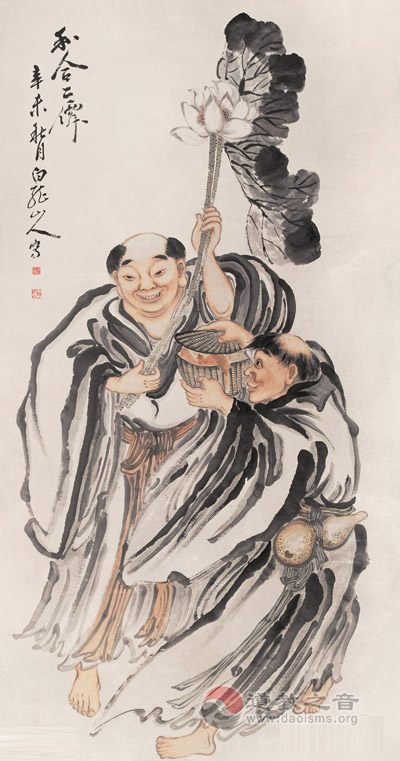
The “Offices of Earth” section of the Rites of Zhou contains the phrase “sending a matchmaker to seek a wife, bringing two surnames into harmony and union,” which is taken to refer to the Two Immortals of Harmony and Union as gods of marriage. For this reason pictures of the Two Immortals are often hung at weddings to express harmony and happiness between husband and wife. In ancient times, pictures of the Two Immortals also carried a four-character verse: “Harmony brings all together; united hearts make all things harmonious. If people can live in harmony and union, how great their happiness will be!”
Legend has it that in the Tang dynasty there was a man named Zhang Wanhui, simple-minded by nature. His elder brother was serving as a soldier on the eastern frontier, and no news of him had come for a long time; his parents wept and longed for him day and night. So Zhang went out as if flying, traveling ten thousand li there and back in a single day, and brought home to his parents a letter in his brother's handwriting. For this he was called “Wanhui” (Returning from Ten Thousand Li). Zhang Wanhui looked strange and was said to be an immortal reborn. Emperor Gaozong of the Tang once summoned him to the palace, and Empress Wu Zetian gave him a brocade robe and a jade belt. What he foretold often came true. After Wanhui died, both the court and the common people made offerings to him, believing that he could foresee the future and resolve disasters. Emperor Xuanzong of the Tang also conferred honors on him. Later generations regarded him as a “god of reunion” and called him the god of “Harmony and Union.”
In the Song dynasty, the common people also made offerings to Wanhui at festivals, believing that he could bring family members home from ten thousand li away for a reunion. Because his title was “Harmony and Union” (hehe), later generations thought it should be the joint name of two deities, namely Hanshan and Shide (said to be the reincarnations of two eminent Tang monks). Over long transmission, Hehe also became a god of joy in charge of marriage. Symbolizing the “harmony and union” of family and relatives, the god of Harmony and Union has been worshipped since the Song dynasty.
In the Yongzheng reign of the Qing dynasty, the Tang poet-monks Hanshan and Shide were again recognized as the Two Sages of Harmony and Union. Legend has it that the two were as close as brothers and loved the same woman. On the eve of the wedding Hanshan learned of this and at once left home to become a monk; Shide too left the woman and went in search of Hanshan. When they met, both became monks and founded a temple, the Hanshan Temple. From then on the image of the god of Harmony and Union handed down in the world changed from one into two. The pictures show them as monks, both with tousled hair and smiling faces, one holding a lotus and the other a round box, signifying “harmony” (he, a pun on the word for lotus) and “union” (he, a pun on the word for box), which together make “harmony and union.” On the wedding day the picture must be hung in the bridal chamber with its decorated candles, or hung permanently in the main hall, for good fortune.
At traditional Chinese wedding celebrations, a hanging scroll of the Two Immortals of Harmony and Union is often displayed. On the scroll are two lively and lovable children with long hair over their shoulders, one holding a lotus and the other a round box from which five bats fly out. They love each other dearly and smile broadly, a delightful sight. People use it to wish the newlyweds a long life together into white-haired old age and eternal union of hearts. They are also called the Two Sages of Harmony and Union.
The Yongzheng emperor formally named Hanshan the “Sage of Harmony” and Shide the “Sage of Union,” and from then on the Two Immortals of Harmony and Union became famous throughout the land.
Tian Rucheng of the Ming dynasty writes in scroll 23 of his Supplement to the Record of Sightseeing at West Lake: “In the Song, the people of Hangzhou worshipped Brother Wanhui in the twelfth lunar month. His image has tousled hair and a smiling face, wears green clothing, holds a drum in his left hand and a stick in his right, and is said to be the god of Harmony and Union. Worshipping him enables a person ten thousand li away to return, hence the name ‘Wanhui.’”
Zhai Hao of the Qing dynasty, in the entry “The Two Sages of Harmony and Union” in scroll 19 of his Compendium of Common Expressions (Wubuxuan Studio edition), says: “Today Harmony and Union are worshipped as two gods together, but Wanhui is only one person and cannot fill the role.” It seems that Hanshan and Shide are the Two Sages of Harmony and Union.
Yet “Harmony and Union” are also called the Two Immortals. In the first chapter of Flowers in the Mirror by Li Ruzhen of the Qing dynasty we read: “As they were talking, the Great Immortals of the Four Numinous Creatures passed by, and then they saw the five Star Lords of Fortune, Emolument, Longevity, Wealth, and Joy, together with the Lord of Wood, Lord Lao, Pengzu, Immortal Zhang, the Old Man Under the Moon, Liu Haichan, and the Two Immortals of Harmony and Union, coming from afar.” In the past their image was usually painted as two people with tousled hair and smiling faces, one holding a lotus and the other a round box, taking the meanings of “harmony” (lotus) and “union” (box), and displayed at weddings, or hung all year round in the central hall for the sake of harmony and good fortune. Originally it was Wanhui who was worshipped. Wanhui's elder brother was garrisoned at Anxi, and his parents sent him to ask after him; he set out in the morning with what they had prepared and returned home by evening, traveling more than ten thousand li in a day, hence the name Wanhui. This too carries the meaning of family harmony and union, and so in the Song he was worshipped as the god of Harmony and Union.
The article “The Two Immortals of Harmony and Union Pass Down Friendship,” published in the eighth issue of Folk Literature in 1979, still identifies the Two Immortals as Hanshan and Shide. The story runs roughly as follows: Hanshan and Shide lived in the same remote village in the north. Though of different surnames, they were as close as brothers. Hanshan, the slightly older, and Shide loved the same woman without Hanshan knowing it; only on the eve of the wedding did he find out. He then left home, went south to Fengqiao at He Mountain in Suzhou, shaved his head to become a monk, and built a hermitage for his spiritual practice. Shide too left the woman and went to look for Hanshan. Having found out where Hanshan lived, he picked a lotus in full bloom and went to pay his respects; when Hanshan saw Shide coming, he hurried out to greet him holding a box of vegetarian rice. The two were overjoyed and danced facing each other. Both then became monks and founded a temple called the Hanshan Temple. To this day, the Hanshan Temple (in Suzhou) still preserves a bluestone stele carved with the images of the two brothers and inscribed with the names Hanshan and Shide. But the common people could not read, and through the ages they only knew that one held a “lotus” (he) and the other a “box” (he), and so they called them the “Two Immortals of Harmony and Union.”
The Hanshan Temple outside the city of Gusu (Suzhou) is where the Two Immortals of Harmony and Union “finally attained the true fruit.” In its Hanshan and Shide Hall, exquisite gilded wooden statues of Hanshan and Shide are still enshrined today. Set into the back wall of the Mahavira Hall of the Hanshan Temple is a stone carving of freehand portraits of Hanshan and Shide by the great painter Luo Ping, one of the Eight Eccentrics of Yangzhou. Set into the back wall of the Buddha hall are 31 of Hanshan's poems. Every New Year's Eve, large numbers of Japanese visitors come to the Hanshan Temple to hear the bell and pay homage to the Two Immortals of Harmony and Union.