
Chiyang Daoren, Eastern Taoism
In the development of Taoism in modern China, Chen Yingning was a figure of major influence. He devoted his life to the study of Taoism and of the “study of immortality,” working with diligence and achieving remarkable results. In an age of social upheaval and national peril, he never lost his love for his country and actively led Taoists across China to unite against foreign aggression. As Western thought pressed hard upon Chinese culture, he explored ways to renew Taoist theory and vigorously promoted traditional culture. With deep devotion to family and nation, outstanding learning, and firm conviction, he made important contributions to guiding Taoists to love both their country and their religion, and to advancing the modern transformation and healthy transmission of Taoism.
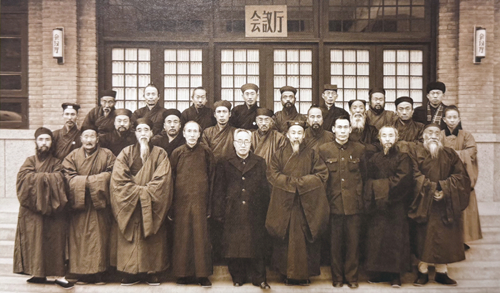
(The preparatory committee of the China Taoist Association is founded in Beijing on November 26, 1956. Chen Yingning is fourth from left in the front row.)
From Medicine to the Tao Through Personal Practice
Chen Yingning (1880–1969) came from a family whose ancestral home was Huaining in Anhui. His original names were Yuanshan and Zhixiang. Because of his love for the Way of the immortals, he later took the name Yingning from a line in the Zhuangzi: “Yingning means that which is accomplished after disturbance.” Yingning thus means stillness that follows movement. As the chapter “The Great and Venerable Teacher” of the Zhuangzi's Inner Chapters says: “As a thing, there is nothing it does not send off, nothing it does not welcome, nothing it does not destroy, nothing it does not complete. Its name is Yingning—tranquility in disturbance.” The commentator Cheng Xuanying explains: “Ying means disturbance; ning means stillness… Moving yet always still, disturbed yet at peace.”
Chen Yingning grew up in a family of scholars. His father, a successful candidate in the provincial imperial examinations of the Qing dynasty, ran a private school and made his living by teaching. Chen was a diligent student: he began lessons at home at the age of three, knew the Confucian classics thoroughly, and passed the county-level imperial examination.
Chen Yingning was later admitted to the Anhui Higher School of Law and Politics in Anqing. He had been frail since childhood, and before he could finish his studies there, a recurrence of consumption threatened his life. He had to leave school to recuperate, and from then on he traveled widely in search of famous physicians and remedies.
He visited eminent monks and elders at Mount Jiuhua, Mount Tiantong, and elsewhere in Anhui, but concluded that Buddhist cultivation emphasized the mind and neglected the body, so its benefits for curing illness and prolonging life were unsatisfactory. He then visited renowned Taoist mountains such as Mount Mao in Jurong and Mount Lao in Qingdao, but found nothing there either and returned disappointed.
Chen Yingning's interest in the study of immortality had begun when, as a boy, he read the Biographies of Divine Immortals (Shenxian Zhuan). He once came across old editions of The Seal of the Unity of the Three (Cantong Qi) and Awakening to Perfection (Wuzhen Pian) kept by his great-uncle's family, tried out the methods of nurturing life described in them, and felt his health gradually improve. He later said, “This was the starting point of my lifelong research into the methods of the study of immortality.”
After his search for famous doctors failed, he tried reading the Taoist Canon himself. Over three full years he read through the more than 5,000 scrolls of the Ming-dynasty Zhengtong Taoist Canon and the Wanli Supplementary Taoist Canon. Through careful study and practice of Taoist health methods, he cured his own illness and set out on the path of Taoist health cultivation.
Love of Country and Service to the World: Saving the Nation Through the Study of Immortality
Chen Yingning began to influence Chinese society in the 1930s, after he helped found the periodical Yangshan Semimonthly (later renamed Xiandao Monthly) and became its chief writer.
From 1933 to 1937, Chen Yingning published more than 100 articles in the Yangshan Semimonthly, covering questions of good and evil in human nature and moral standards, historical studies of Taoism and its immortals, and annotations and commentaries on Taoist scriptures and methods of cultivation. He used the journal as a platform to promote the study of immortality and published his replies to letters from readers, bringing together many people devoted to the Tao. The study of immortality he advocated was, in fact, a discipline of health and longevity that he had distilled, from years of personal study and practice, out of China's traditional Confucianism, Buddhism, and above all Taoism.
The study of immortality that Chen Yingning championed did not stop at health cultivation; it carried his patriotic passion to save the nation from ruin. China at the time was torn by warlord conflict and foreign invasion, and calls for “wholesale Westernization” were loud; the country was beset by troubles at home and abroad, and its people were exhausted. Deeply worried about the state of the nation and its culture, Chen Yingning held that “military aggression merely carves up a people's land and destroys their bodies, and its harm is shallow; cultural and religious aggression can seize a people's thoughts and rob them of their souls, and its harm is deep.”
Chen Yingning therefore drew together his years of reflection on Confucian, Buddhist, and Taoist thought, joined the development of traditional culture to the needs of the age, and—aiming to lift the spirit of the Chinese nation and strengthen the bodies of its people—put forward the idea of “saving the nation through the study of immortality” to resist the cultural and military aggression of imperialism. He urged a return to China's own culture as the way to save the country, writing: “When we speak of Taoism today… we must not belittle ourselves, destroying our own pearls and jade while praising the broken tiles of others. Know that to believe in Taoism is to protect oneself, and to spread Taoism is to save the nation. Do not cling to a passive attitude and merely survive; take active measures to ensure our survival, and then our nation may yet hope for revival.” Through the Yangshan Semimonthly and the Xiandao Monthly he promoted the study of immortality and called on Taoists to cast off blind worship of foreign things, helping a generation of lovers of traditional culture—especially Taoist believers—regain confidence in their national culture.
In the face of national crisis, Chen Yingning opposed passive withdrawal from the world among Taoists. He argued that in the struggle for national independence and liberation, Taoists should promote the Taoist spirit of helping the world and saving people, making it “a tool for uniting the national spirit today.” He urged students of the Tao not merely to seek their own attainment of the Tao and immortality, but to throw themselves into the practical work of saving the nation and helping the world, contributing their strength and ideas to strengthening the people and reviving the country.
Bold Reform: Advancing the Modernization of Taoism
In the 1930s, Chen Yingning distilled the theory and practice of health and longevity from Confucianism, Buddhism, and above all Taoism into his thought on the study of immortality. In the 1950s, after he helped prepare the founding of the China Taoist Association, he specifically defined the Taoist teachings on health and longevity as Taoist health cultivation. The theory and practice of Taoist health cultivation that he promoted were of great significance in modernizing Taoism and dispelling its image of superstition and ignorance. Scholars and Taoists alike recognize him as a pioneer of scientific health cultivation and, above all, as an important forerunner in bringing Chinese Taoism into the modern age.
Traditional Taoist alchemy has two main forms of practice: outer alchemy and inner alchemy. Chen Yingning first experimented with outer alchemy; after it failed, the focus of his research shifted to inner alchemy. The study of immortality he advocated set aside numerology and liturgy. He held that “talismans and incantations, sacrificial refinement, dispatching spirits and commanding ghosts, subduing demons and catching monsters, transporting and transforming things, the arts of the three stilts and five escapes, blinding the eyes and freezing the body, capturing snakes and foxes—all such strange magical arts” did not belong to Taoist health cultivation. He brought the spirit of modern science into Taoist health cultivation, hoping to free it from talismans, the worship of spirits, and magical arts.
Chen Yingning championed a pragmatic spirit of practice verified by experience, emphasizing four principles: “First, value substance over emptiness; second, discuss facts rather than theory; third, prize going against the current over going with it; fourth, value oral instructions over texts.” Holding that one must change with the times, he both upheld traditional Taoist teachings on health cultivation and incorporated science, so that the spirit of verification in health cultivation and the spirit of experiment in science echoed each other, setting Taoism on a path of development in step with the times.
With his profound scholarship, Chen Yingning worked throughout his life to advance Taoist theory and built important theoretical support for the transmission and development of Taoism. In his early years he studied the Cantong Qi in depth, and he wrote many articles on Taoist health cultivation, acupuncture and medicine, his insights into tai chi, and interpretations of and commentaries on the classics of alchemy. His important works include Lectures on the Scripture of the Yellow Court, Annotations on Sun Bu'er's Poems on the Stages of Female Alchemy, and A Classification of the Taoist Canon. He reclassified the contents of the Taoist Canon, dividing it by nature into fourteen categories—Taoist philosophy, general works, cultivation, arts, relief, miscellany, history, collected works, religion, scriptures, precepts, methods, rituals, and general references—providing an important reference for later researchers of the Canon.
Living Up to His Charge: Leading Taoism into a New Chapter
In 1942, deeply concerned about the fate of the nation and the development of Taoism, Chen Yingning wrote A Plan for Reviving Taoism. He believed that Chinese Taoism should be scholarly, modern, compassionate, and devoted to helping the world. What he sought was not only the revival of Taoism but, even more, the revival of the Chinese people and the nation.
A Plan for Reviving Taoism covered every aspect, from training Taoist talent and making religious communities self-supporting to academic research, cultivation practice, and cultural dissemination and transmission. Systematic and practical, it is an important argument on the path Taoism should take toward modernization. He also took part in organizing the Shanghai Taoist Association, in an attempt to revive Taoism through organization.
When the Shanghai Taoist Association was founded in 1947, Chen Yingning revised A Plan for Reviving Taoism, and the association printed 5,000 copies for circulation within the Taoist community.
In 1953, at the invitation of his disciple Hu Haiya, Chen Yingning lectured on Chinese medicine and Taoist learning. That same year, the Zhejiang provincial government appointed him a member of the Zhejiang Research Institute of Culture and History.
In 1956, Chen Yingning and Taoists from around the country launched preparations for a national Taoist organization. When the China Taoist Association was founded in 1957, he was elected vice president and secretary-general, and in 1961 he was elected president of its second council.
While leading the China Taoist Association, he united Taoists in loving their country and their religion, helped the government implement its policy of freedom of religious belief, and encouraged Taoists across the country to take an active part in socialist construction.
In 1961, Chen Yingning and others promoted the founding of the association's research office, which he headed himself, drawing up its research plans.
In August 1962, he promoted the founding of the Journal of the Taoist Association, which later became China Taoism. In his later years he directed the research office in collecting and organizing Taoist documents, and it compiled important works such as Classified Knowledge of Taoism, An Outline History of Chinese Taoism, The Origins of Taoism, and An Introduction to Taoist Doctrine, setting an example for scholarly research in the Taoist community.
Chen Yingning attached great importance to training Taoist talent. As early as the 1930s he lamented that “Taoism has too few capable people” and conceived of establishing a “Taoist scripture-lecture forum” and a “Taoist research institute.”
In September 1962, he guided the establishment of a continuing-education class for Taoists, which had an important influence on the later founding of the China Taoist Academy and of Taoist educational institutions throughout the country. He often taught classes and wrote teaching materials himself, pouring great effort into training Taoist talent and into academic research, and he was loved and supported by Taoists across the nation.
Throughout his life, Chen Yingning held firmly to his faith in seeking the Tao, strove constantly to raise the level of Taoist scholarship and theory, and, with heartfelt love for his country, lived out the spirit of helping the world and benefiting others, setting an example for all Taoists. The Taoist thought on health cultivation that he championed offers important inspiration today for promoting traditional Chinese culture and the sinicization of Taoism.