Master Beikong
Eastern feng shui, a culture unique to China, has been handed down for thousands of years, and people still use and develop it today. Many people do not know much about feng shui, so here is an introduction to its basics.
1. A Brief Introduction to Feng Shui
Feng shui, also called kanyu (geomancy), tuzhai (charting dwellings), qingnang (the blue satchel), or the art of mountains and waters, is an important part of the esoteric culture of the East.
Guo Pu of the Jin dynasty wrote in the ancient Book of Burial (Zang Jing): “Qi rides the wind and scatters; it meets water and stops. The ancients gathered it so that it would not scatter and guided it so that it would stop; hence it is called feng shui (wind and water). In the method of feng shui, obtaining water is best, and storing wind comes next.”
“Feng shui” is generally called the art of feng shui, also known as reading the land or the art of kanyu. It is a mystical art and a numerological art with a long history in China. Feng shui is one of the Five Arts, and its basic framework derives from the I Ching (Book of Changes). It is divided into “the method of reading dwellings of the living (yangzhai), which examines the door, well, and stove,” and “the method of reading dwellings of the dead (yinzhai), which examines the dragon, lair, sand, water, and facing.” Its main schools include the Sanyuan (Three Primes) method, the Sanhe (Three Harmonies) method, and the Nine Stars method.
Kanyu carries the sense of reading the land and of divination. “Kan” is interchangeable with a homophone meaning “to survey,” and so has the sense of surveying; “yu” originally meant the body of a carriage, with the sense of bearing a load, and by extension refers to territory and the way of the earth. The ancient Chinese held that kan is the way of heaven and yu the way of earth, so that kanyu is the way of heaven and earth, and they held it in high regard. Kanyu is the substance and feng shui the function.
2. The Elements of Feng Shui
Wind: The phenomenon of moving air.
Water: Flowing water, or the image of flowing water.
Qi: The immaterial breath of the ground, the sky, and space, invisible to the naked eye.
The Five Elements: Metal, wood, water, fire, and earth, the five attributes of the forms of matter.
There are also other important elements, such as the dragon, sand, lair, water, sitting direction, and facing direction.
3. Tools Commonly Used by Feng Shui Masters
(1) The Luopan
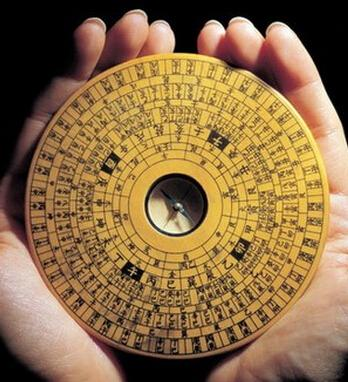
Feng shui masters regard the luopan (feng shui compass) as the working tool for analyzing qi patterns. It consists mainly of a magnetic needle in the center of the plate and a series of concentric rings, each of which represents the ancient Chinese understanding, interpretation, and application of a certain level of information in the great system of the universe.
(2) Landscape Paintings
Feng shui masters hold that water represents wealth. When hanging a landscape painting in the living room, take care that the water in the painting does not flow toward the door or out of the house; it is best for it to flow toward the master bedroom and into the house. Above all, do not hang paintings of “ten thousand galloping horses” or “a fierce tiger coming down the mountain” in the bedroom, or they will easily disrupt the harmony between husband and wife.

(3) Feng Shui Swords
Feng shui masters recognize many kinds of feng shui swords—Seven-Star swords, Peach Blossom swords, or swords made of other materials. Their main function is to counter the sha qi of sharp corners and utility poles outside the house and to avoid lawsuits and quarrels. Note that a feng shui sword does not need to be sharpened; in fact, one could say it should not be, because a sharpened sword is keen and can easily hurt people, while a blunt sword hurts no one yet can still drive away yin spirits.
(4) Bagua Mirrors
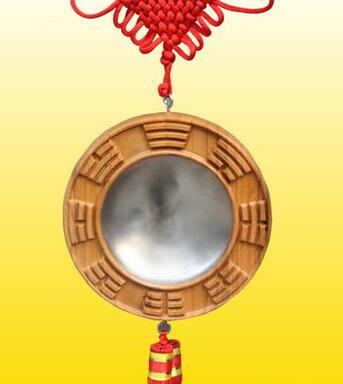
Feng shui masters consider the sha-resolving power of mirrors to be truly first-rate. Walking through the streets and alleys, you can easily spot Eight Trigrams (bagua) mirrors hanging from eaves and walls. There are three things to note when hanging a bagua mirror: 1. hang it at exactly 12 noon; 2. have it undergo consecration (kaiguang); 3. the direction in which it reflects must not strike other people's houses—you must not turn the sha from your own home onto someone else's.
(5) Feng Shui Fish Tanks
Feng shui masters regard keeping a tank of feng shui fish as a well-known way of changing one's luck. But because it is simple, people assume that just keeping fish will work. In fact there is a great deal to watch out for in keeping fish: for example, to attract wealth the tank must be placed at the visible wealth position, that is, diagonally opposite the front door of the home; and the fish must be well cared for, not constantly falling ill or dying.
(6) Pictures of Gods and Taoist Patriarchs
Feng shui masters note that people bring pictures of gods and Taoist patriarchs home to enshrine and worship, without knowing that the pictures must first be consecrated by a professional. For foul, evil qi can also attach itself to a picture and instead ruin the luck of those who enshrine and worship it.
(7) Potted Plants
Feng shui masters hold that many potted plants can adjust feng shui and bring good luck; lucky bamboo and orchids are among everyone's favorites. When these auspicious potted plants have faded flowers or withered leaves, they must be replaced with a new pot at once so that they can continue to gather qi.
(8) Wind Chimes
Feng shui masters note that wind chimes, with the clear, ringing sound of their striking and their charming shapes, are loved by many people. In feng shui, a wind chime is a tool for controlling sha, and it is especially suited to hanging at the front entrance. But never hang one in a child's study or the master bedroom, because hearing the sound of wind chimes for a long time makes people restless and agitated.
(9) Auspicious Beasts
Feng shui masters regard lions, elephants, qilin, deer, horses, dragons, money toads with coins in their mouths, pixiu, and the like as auspicious beasts to be considered when adjusting feng shui. The heads of lions, qilin, and money toads must face the door, signifying drawing in wealth, blessings, and prosperity from all directions. But deer and horses must run toward, and have their heads facing, the inside of the house, representing auspicious spirits entering the home.
4. The Schools of Feng Shui
Historically there has been a major misconception in classifying feng shui schools: dividing them into two broad categories, the Form school and the Qi Pattern school. This is wrong and does not fit the facts. It has no practical meaning and easily leads people astray.
Chinese feng shui has now developed into a field with many schools, each with its own theory. They can be divided mainly into two major branches:
First, the Landform (Luantou) branch: (1) the Configuration school; (2) the Image school; (3) the Form Method school.
Second, the Qi Pattern (Liqi) branch: (1) the Eight Mansions school; (2) the Fate Calculation school; (3) the Sanhe (Three Harmonies) school; (4) the Hexagram-Turning school; (5) the Flying Star school; (6) the Five Elements school; (7) the Xuankong Great Hexagram school; (8) the Eight Trigrams school; (9) the Nine Stars Flying and Anchoring school; (10) the Qimen school; (11) the Three Essentials of the Yang Dwelling school; (12) the Twenty-Four Mountains school; (13) the Lunar Mansions school; (14) the Golden Lock and Jade Pass school.
In fact, whatever the school, as long as it is not a fraudulent pseudo-feng-shui, all hold to the basic principle that landform is the substance of feng shui and qi patterns are its function. The division into schools actually arises from differences in the methods of analyzing qi patterns.
In their methods of analyzing qi patterns, they can be roughly divided into two major schools, each with many branches beneath it.
The schools that analyze qi patterns directly through the principles of the eight trigrams are the Trigram Principle school. They include the Eight Mansions school, the Xuankong Flying Star school (with six major lineages comprising dozens of smaller ones), Qimen feng shui, Heluo feng shui, the Great Sanyuan Yi-Principle school, the Golden Lock and Jade Pass school, and others.
The schools that analyze qi patterns through the principles of yin and yang and the Five Elements in the River Chart (Hetu), the Luo Writing (Luoshu), and the Bagua of prior heaven and later heaven are the Five Elements school. They include the Yang Gong feng shui of southern Jiangxi, the New Sanhe school, fate-calculation feng shui, the Orthodox Five Elements feng shui, and others.