
Chiyang Daoren, Eastern Taoism
1. Chinese Feng Shui Originated in the Yin-Shang Period
Archaeological evidence and artifacts show that Chinese feng shui originated in the Yin-Shang period. By the Yin and Zhou periods, there were already written records of activities for reading the land. For example, the oracle-bone inscriptions unearthed at Yinxu contain a great many divinations about construction, such as building towns, building an “an” structure, building ancestral temples, building palace halls, and building ponds.
2. Chinese Feng Shui Took Shape in the Qin and Han Periods
The art of Chinese feng shui gradually took shape in the Qin and Han periods. During this time, large-scale construction of palaces created the material preconditions for its formation. The theory of yin and yang and the Five Elements of Dong Zhongshu and the Yi (Changes) scholarship of Meng Xi, Jing Fang, and others provided theory and method for feng shui and for all the numerological arts. In particular, the theological currents of the Eastern Han made all kinds of building taboos and superstitions ever more widespread; rules such as “a day must be chosen before building a house” and “do not break ground over the head of Taisui (the Grand Year deity)” had become important rules to be observed in building dwellings of the living.
At this time the feng shui theory of dwellings of the dead (yinzhai) was also gradually taking shape. For example, when Han Xin was young his mother died, and his family was so poor that he could not bury her in the village graveyard, so he chose high, open ground to bury her. Later he achieved fame and success and was enfeoffed as King of Chu.
At the end of the Qin there was also Li Zhongxiang, whose ancestor was buried at Chengji. Three times he dreamed that someone told him the mountain at the burial site was shaped like the character chuan (river, written with three parallel strokes), which meant he was bound to die in battle. Zhongxiang did not believe it, but early in the Han he did indeed die in battle at Didao.
Alongside frequent feng shui activity, the Qin and Han also saw a number of specialized works on feng shui, such as the Golden Casket of Kanyu (Kanyu Jingui), the Terrain of Palaces and Dwellings (Gongzhai Dixing), the Duke of Zhou's Classic of Divining Dwellings (Zhougong Buzhai Jing), the Art of Charting Dwellings (Tuzhai Shu), the Dayan Yuanji, and the Burial Almanac (Zangli). This shows that by the Qin and Han the art of feng shui had completed its development from practice to theory and could be called a field of learning.
3. Chinese Feng Shui Spread in the Sui and Tang Periods
In the Sui and Tang periods, the Sui chancellor Yang Gongren, preparing to choose a burial site for his forebears, invited the most famous land readers in the realm to divine the site. Each had his own system, and Yang Gongren did not know whom to listen to. So he secretly sent someone back to his hometown to fetch one dou of earth from each of the four corners of the site, and wrote the lie of the land in an almanac. None of the land readers got it right. One named Shu Chuo said: “Five chi below this earth there are the five grains; if you find one of them, it is a blessed land, and your family will be dukes and marquises for generations.” Yang Gongren invited Shu Chuo to inspect the site. They dug seven chi down and did indeed find a cavity storing seven or eight dou of millet: the place had once been a millet field, and ants had carried the grain there and made the hollow. Yang Gongren then rewarded Shu Chuo handsomely.
In the Tang dynasty, the reading of land and the art of feng shui became increasingly separate, with feng shui concentrating on grave sites and becoming heavily tinged with superstition. According to the Rites of the Kaiyuan Era (Kaiyuan Li) as cited in chapter 138 of the Comprehensive Institutions (Tongdian), in the Tang dynasty everyone, official or commoner, had a site and a day chosen for burial upon death; this became a very widespread custom. The Tang also had a Directorate of Astronomy, whose officials all understood feng shui.
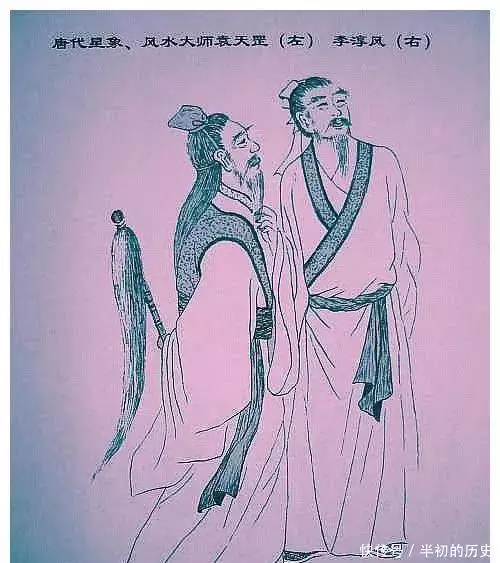
Li Chunfeng and Yuan Tiangang were the outstanding representatives of this period. Legend has it that when each separately chose a tomb site for Wu Zetian, the burial spots they chose were only a copper coin's ring apart. Above all, holding posts in the Directorate of Astronomy of the reigning court, they had a tremendous influence on the promotion of feng shui.
4. Chinese Feng Shui Flourished in the Northern and Southern Song
Chinese feng shui reached its heyday in the Northern and Southern Song. Emperor Huizong of Song was an emperor who believed deeply in feng shui. At first he had no sons. A practitioner of the arts named Liu Hunkang told him that the northwest corner of the capital was too low-lying, and that if it were built up higher he would have the joy of many sons. Huizong ordered a great construction project to pile up a hill several ren high, and afterward he did indeed have sons. Huizong then believed in feng shui all the more; he rebuilt the Yanfu Palace and ordered Lin Lingsu to choose a site for building the Palace of the Precious Register of Highest Clarity (Shangqing Baolu Gong).
In the Song dynasty, the quality of a burial site was believed to be bound up with good and ill fortune. The people of Song held that old grave sites were not suitable for burial. Qian Xibai's Anecdotes (Xiaoshuo) records that early in the Song, the wife of Qian Wenbing died. Wenbing, skilled in reading the land from his youth, chose a spot in the pine grove beside the Bao'en Cloister. A monk told him that an ancient sage was already buried there and that it must not be used for a new burial. Wenbing did not listen. Digging, he found several layers of stone slabs, and from among the stones a black bee flew out and stung Wenbing on the right eyebrow. His head swelled up as big as a dou measure, and he died that very night.
But not everyone can enjoy a treasured feng shui site; every piece of land has its rightful owner. The Record of the Listener (Yijian Zhi), telling of the grave of the father of Duke Chen of Wei, relates that a rich man in Putian, Fujian, had a burial site there, and after he was buried there his descendants all fell ill.
A feng shui master said that the land should be sold to cut off the root of the illness. The rich man's family sold the land as the feng shui master advised, and the descendants recovered; the family that bought the land not only did not fall ill but produced a chancellor. The feng shui master said this was the land finding its rightful owner.
5. Chinese Feng Shui Reached Its Peak in the Ming and Qing Periods
In the Ming and Qing dynasties, the art of Chinese feng shui entered its golden age. Zhu Yuanzhang, the founding emperor of the Ming, made his capital at Jinling (Nanjing) and devoted a great deal of effort to the feng shui of the capital. The mountains outside Jinling all faced toward the city, as if paying court and bowing to it. Only Mount Niushou and Huashan (Flower Hill) outside the Taiping Gate turned their backs on the city walls, lacking any sense of bowing and guarding, and Zhu Yuanzhang was unhappy about this. Legend has it that he ordered the Ministry of Punishments to take its instruments of torture and give Mount Niushou a hundred heavy blows of the rod; he also had several holes bored in the rock where it looked like an ox's head and had it chained with iron chains and turned so that it faced inward. He also had people cut firewood freely on Huashan so that it would have no green, living color.
Later, the Yongle Emperor moved the capital to Beijing after all. The building of Beijing was carried out throughout according to feng shui ideas. For example, northwest of the Circular Mound Altar of the Temple of Heaven stands the Hall of Abstinence, which sits in the west and faces east. Its orientation is unusual, different from the traditional sitting in the north and facing south. This is because people at the time held that when the emperor went to the Temple of Heaven to worship heaven, heaven was the father and the emperor was the Son of Heaven, and a son must not sit in the north facing south (the seat of honor) before his father, or he would violate the rites. Even the tiles of the Hall of Abstinence could not be yellow; green glazed tiles were used instead, to show the distinction.
The Qing dynasty was also very particular about buildings for the living. For example, the Hall of Dispelling Clouds (Paiyun Dian) in the Summer Palace is a place of excellent feng shui. It lies midway along the central axis running from the Tower of Buddhist Incense to the “Yunhui Yuyu” (Cloud-Radiant Jade Heavens) archway; protected by sacred objects and sitting securely in the middle, it expresses peace and good fortune. The plaques in the hall read “Abundant Blessings, Warp and Weft” and “An Eternally Secure Great Foundation.” The hall is named after the two words “dispelling clouds” in a poem by Guo Pu, the patriarch of feng shui: “The immortals come forth dispelling the clouds; one sees only terraces of gold and silver.” The Hall of Dispelling Clouds leans against the hill and borders the water, with its back to the verdant Longevity Hill and facing the jade-green Kunming Lake. Empress Dowager Cixi's sixtieth and seventieth birthday celebrations were both held here.
It was not only the imperial house that cared about feng shui; the common people also widely paid attention to it, the scholar class most of all. The famous Chinese novel The Scholars (Rulin Waishi) records that after Fan Jin's mother died, Fan Jin asked a yin-yang master to write out the qidan. The yin-yang masters of the time were professional practitioners who calculated the days and hours for encoffining and burial for bereaved families, read feng shui, examined the veins of the land, and chose auspicious days for people. The qidan was a list recording the double hour of the deceased's encoffining, the taboos incurred, and the dates of the seven seventh-day rites. To “thank the feng shui,” Fan Jin spent a good deal of silver. The yin-yang master said that the mountain directions were unfavorable that year, so the coffin had to be kept at home unburied, while he spent all his days searching for a treasured feng shui site in the hope of securing good fortune.