
Chiyang Daoren, Eastern Taoism
Incantations are an essential part of Taoist cultivation and an important method for achieving the unity of heaven and humanity.
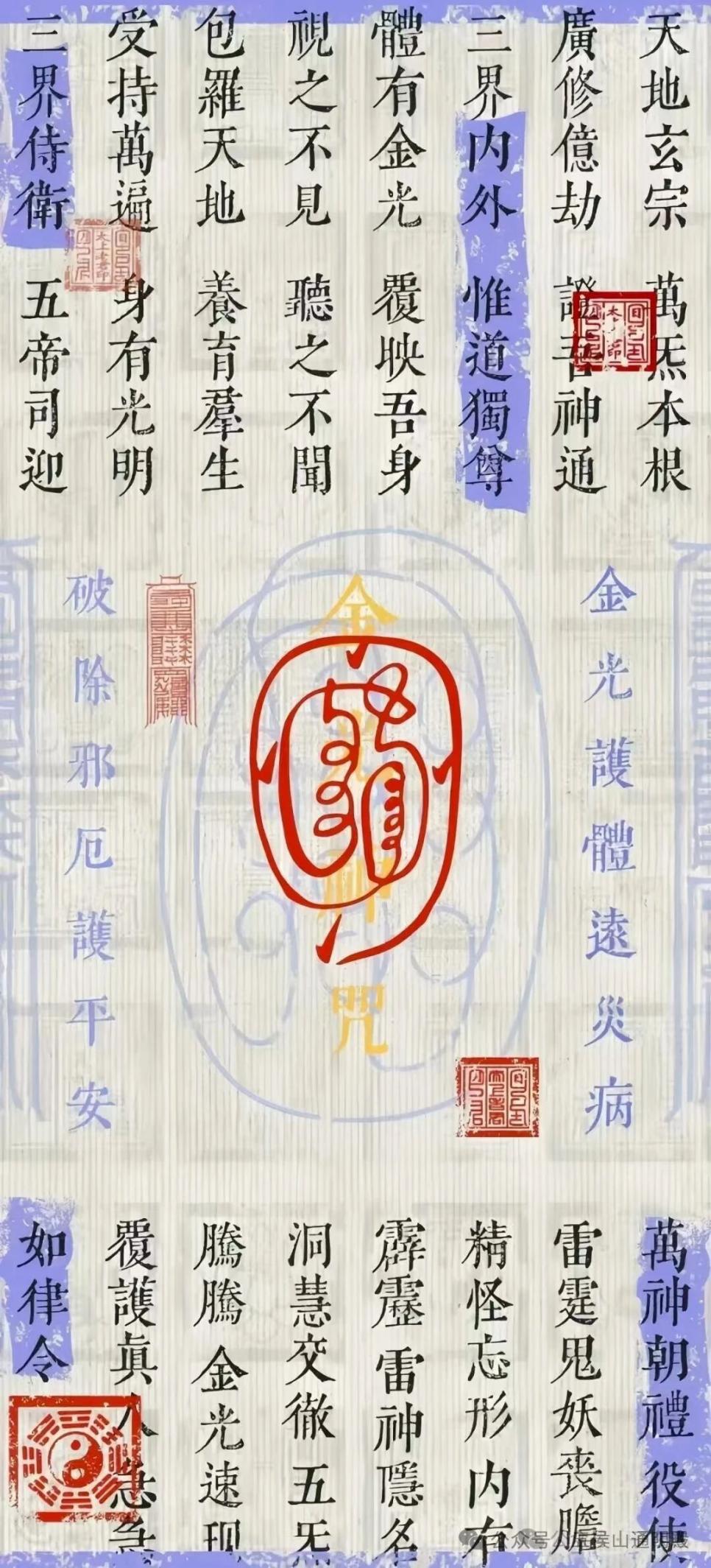
What is an “incantation”? The Shuowen Jiezi records: “Zhu (invocation) is zhou (incantation).” In the time of the Yellow Emperor, zhu and zhou were not distinguished. As early as the Yellow Emperor's time, an official post was established called zhuyou, also called zhouyou.
Taoist incantations originated in the prayers used by ancient shamans in sacrifices. The chapter “Against Luxurious Ease” of the Book of Documents says: “Their mouths curse and invoke,” and the subcommentary says: “Zhu is pronounced zhou; it means to report to the spirits above so that they send down calamity and blame.” This shows that in their earliest development incantations meant using words to ask the spirits to help punish wrongdoers, and swearing oaths to the spirits while promising them certain benefits.
Taoist incantations originated in the shamans and invocators of antiquity and were most widespread in the Eastern Han dynasty. At that time incantations and talismans were closely linked: drawing a talisman always required reciting an incantation, using a talisman also required an incantation, and every ritual service had its corresponding incantations and oral formulas.
As a means of conveying spiritual power, the incantation became the voice from the depths of the heart through which the practitioner expresses his utmost sincerity; only thus can the efficacy of every rite be assured.
In prayer, incantations are words praising the spirits and asking that wishes be fulfilled; in healing, incantations are words demanding that the rite show its power and that all illnesses be dispelled; in cultivation, incantations are mostly words for calming the spirit, settling the intention and clarifying the mind, and asking the spirits for help.
Taoist incantations usually end with the phrase “Swiftly, swiftly, as the law commands!” Zhao Yanwei of the Song dynasty explained in his Yunlu Manchao: “‘Swiftly, swiftly, as the law commands’ was a common phrase in official documents of the Han, like what we now say, ‘carry this out as soon as the order arrives.’ Celestial Master Zhang was a man of the Han and therefore adopted it, and so Taoists came to follow it as precedent.” This shows that the phrase was handed down from the Han dynasty through Celestial Master Zhang, meaning that the talisman takes effect as soon as it arrives.
In the chapter “Climbing Mountains and Crossing Rivers” of the Inner Chapters, Ge Hong recorded the Six Jia secret incantation of his time: “When entering the mountains, one should know the Six Jia secret invocation. The invocation goes: lin, bing, dou, zhe, jie, lie, zhen, qian, xing. Nine characters in all; always recite them secretly, and there is nothing they will not ward off. The essential Tao is not complicated—this is what is meant.”
From this passage we can see the power of incantations. Nine characters that seem perfectly ordinary to most people—“lin, bing, dou, zhe, jie, lie, zhen, qian, xing”—can actually ward off everything. It is truly inconceivable, and it shows that the mysteries of incantations are endless.
When Taoist priests use incantations to restrain evil, they often combine them with techniques such as focused intention and circulating qi. That is, while reciting the incantation they enter the functional state of qigong; every incantation is the voice of the heart arising from utmost sincerity, and through visualization they see themselves in communion with the spirits.
What, after all, is the secret of incantations? In recent years it has attracted the attention and research of many scientists in China and abroad, and the essence of performing incantations has gradually been understood and made public.
The first thing established is that an incantation is a controlled sound wave, possessing all the characteristics of sound waves.
(1) Penetration. Its speed is 332 meters per second, and it can pass through solids, liquids, and gases. When it meets an obstacle of great density it refracts, changing its direction of propagation according to the density.
(2) Dependence on temperature. When the temperature rises (or falls) by one degree, the speed of the voiced sound increases (or decreases) by 0.6 meters per second.
(3) Sound pressure. The magnitude of sound pressure reflects the pitch of a sound. When a sound exceeds a certain maximum, it causes pain in the ear, can raise blood pressure, damage hearing, and bring on illness. Within the normal range, it makes a person cheerful and lets wisdom well up.
(4) The higher the frequency, the higher the pitch; the lower the frequency, the lower the pitch. The range of frequencies the human ear can hear is 20–20,000 hertz. Musical sounds pleasant to the ear mostly lie between 40 and 40,000 hertz.
(5) The vibration of sound waves can produce resonance and create harmony.
Clearly, performing an incantation can be understood as using the penetration and refraction of sound waves to drive the movement of inner qi, so that where the intention goes, the sound goes and the qi goes. The intention leads the qi, the intention urges the sound, and sound and qi combine to form a powerful chaotic current of qi, achieving special effects.
Recently Comrades Zhao Chi and Zhao Qichang together tested the voicing of the Taoist “Six Healing Sounds” and the “method of exhaling with sound,” and found that during voicing in the qi-incantation method a distinct infrasonic vibration was received. This provides a scientific basis for why the qigong “Six Qi Formula” and the “method of exhaling with sound” can cure illness, and also provides a means of testing for correct voicing.
The testing procedure was as follows: using an HP3582A spectrum analyzer (0–25 kHz), vibration pickups were placed on the head and chest of the person voicing, and the signal was fed through a charge amplifier to the spectrum analyzer. During voicing, a distinct infrasonic vibration was received. For example, when voicing the sound “shang,” an infrasonic signal of 6 Hz appeared; the 3–4 Hz signal was relatively large and flat, and then declined as frequency increased. When voicing the sound “duo,” an infrasonic signal of about 6 Hz also appeared, the curve declining from 3 Hz as frequency increased.
Infrasound has a frequency between 0.0001 and 20 Hz. Its low vibration frequency makes it hard to absorb; its long wavelength makes it hard to block; and low-frequency vibration does not attenuate easily. It can therefore propagate within the human body and penetrate into diseased tissue (cells), reopening blocked blood vessels in the diseased tissue and driving the flow of blood, thereby improving blood circulation in the diseased tissue.
In the qigong state, besides the increase in blood flow velocity, blood viscosity also falls and blood cells are suspended. This creates favorable conditions for the delivery of blood and of the oxygen, negative ions, phagocytes, immunoglobulins, and other substances in the blood into the diseased tissue, and favorable conditions for the body to resist disease, so that diseased tissue (cells) can return to normal cells.
In recent years, researchers at the University of Missouri in the United States have made considerable progress in studying the relationship between incantations and brain waves and the brain's magnetic field. They made the astonishing discovery that when a person silently meditates on an incantation, a corresponding magnetoencephalogram can be measured with a superconducting magnetometer that does not touch the subject. They tested 27 words and phrases and obtained magnetoencephalograms for all 27.
In our own cultivation we feel that the qi-incantation method is a mind-body qigong effect centered on the rhythm of sound. It includes at least several indispensable factors—tone and rhythm, state of mind, power of intention, and atmosphere—and is their combined effect.