
Chiyang Daoren, Eastern Taoism
Taoism and the numerological arts are explorations of the laws of heaven and earth. Following the principle that “the Tao follows what is so of itself,” they are used to solve all kinds of practical problems in everyday life. Among the many Taoist methods of prediction, most people are unfamiliar with “Divine Light divination.”
1. Divine Light Divination and Its Origins
Tradition holds that Divine Light divination was written down by Li Jing, the great general of the Tang dynasty. The scripture attributes it to a dialogue between Duke Ping of Jin and Shi Kuang in the Spring and Autumn period, and through that dialogue it introduces the art of Divine Light divination.
Duke Ping of Jin asked Shi Kuang: “When a person sets out on a journey, or leads troops into battle, victory and defeat are decreed by fate; can survival and ruin be known in advance?”
Shi Kuang replied: “One must observe the assisting stars beside the Northern Dipper. …”
The Duke asked: “When the sky is overcast and they cannot be seen, how can one know good fortune from bad?”
He replied: “If they cannot be seen, one should look at the divine light. If the divine light is not seen, one must not act rashly.”
This passage means that the “divine light” is the radiance of the two assisting stars, Fu and Bi, of the Northern Dipper. The seven stars of the Northern Dipper, together with Zuofu (the Left Assistant) and Youbi (the Right Helper), are called by Taoists the Nine Sovereigns. The Dongshen Division, Basic Texts category, of the Taoist Canon contains the Heart Scripture of the Most High Mysterious and Numinous Dipper Mother, Great Sage and Primordial Sovereign, on Prolonging Life According to One's Natal Star (Taishang Xuanling Doumu Dasheng Yuanjun Benming Yansheng Xinjing), which tells how the Dipper Mother gave birth to the nine star officials. It lists the names of the Northern Dipper stars and the Nine Sovereigns and establishes the myth of the Dipper Mother giving birth to the Nine Sovereigns. The text says: “The Dipper Mother bathed in the Flowery Pool of the Nine Bends … nourishing her divine perfection and refining her essence and soul … she released the subtle and wondrous light of the Ultimate of Nothingness, which shone through the Flowery Pool and transformed into nine buds of golden lotus … revealing the Tao-bodies of the Nine Sovereigns: the first is called Tianhuang (Heavenly Sovereign), the second Ziwei (Purple Tenuity), the third Tanlang, the fourth Jumen, the fifth Lucun, the sixth Wenqu, the seventh Lianzhen, the eighth Wuqu, and the ninth Pojun.” It also says: “Tianhuang and Ziwei … these two stars divided off their remaining radiance to become the Left Assistant and the Right Helper.”
The Left Assistant and the Right Helper are thus the two stars Tianhuang and Ziwei, which Taoism reveres as two of the Four Sovereigns: the Great Emperor of the Curved Array (Gouchen Tianhuang Dadi) and the Great Emperor of Purple Tenuity (Ziwei Dadi) of the North Pole. This shows how exalted the stars represented by the divine light are.
But where is the divine light? That is the crucial question.
The Duke said: “What is the divine light like?”
Shi Kuang replied: “It always dwells within the eyes. In a dark place, press the corners of the eyes with the fingers; shake the head, and the fingers will reveal the assisting stars.”
So the divine light is hidden “within the eyes” of every person, which is why anyone can use Divine Light divination.
In fact, the origins of Divine Light divination are earlier than the Tianlao Classic of the Divine Light (Tianlao Shenguang Jing) of Li Jing of the Tang dynasty. A preface to the Classic of the Divine Light (Shenguang Jing) sets out its history, saying that it first appears in the chapter “Far-Reaching Survey” of the Jin-dynasty Baopuzi. The text says: examining the chapter “Far-Reaching Survey” of the Baopuzi, which lists the titles of the scriptures of the immortals, we find a Divine Light Divination, with no number of scrolls given.
In the astronomy section of the Masters category of the Treatise on Literature of the History of the Sui, citing the Seven Records (Qilu), there is an Inner Transcription of the Divine Light in one scroll.
In the astronomers' section of the Catalogue of Books Extant in Japan there is a Divine Light Divination in two scrolls.
In the Five Phases section of the “Treatise on Literature” of the History of Song there is Su Deng's Classic of the Divine Light in one scroll; in the section on the immortals there is Su Deng's Tianlao Classic of the Divine Light in one scroll.
In Jiao Hong's Treatise on the Books of the National History (Guoshi Jingji Zhi), under “Military Writers: Military Yin-Yang,” there is the Tianlao Classic of the Divine Light in one scroll; under “Five Phases Writers: Physiognomy,” there is the Yellow Emperor's Classic of the Divine Light in one scroll.
Among the Taoist scriptures there is the Classic of the Divine Light of Mount Tai and the Northern Dipper by the Former Master of Lingbao, in one scroll. Among the Taoist talismans and registers there is Cai Deng's Classic of the Divine Light, with no number of scrolls given.
In the Methods category of the Dongshen Division in Bai Yunji's Annotated Catalogue of the Taoist Canon (Daozang Mulu Xiangzhu) of the Ming dynasty, there is the Tianlao Classic of the Divine Light in one scroll.
The Divine Light is an ancient book handed down from the Jin dynasty. Originally it was a single book, which various masters of the numerological arts each put to their own use. From the Six Dynasties to the present, each age has added to or cut from it, so the transmitted versions differ slightly and carry different titles. The compilers of the historical bibliographies never saw the original book and therefore recorded the versions separately; this is why the Methods category of the Dongshen Division of the Taoist Canon contains the Tianlao Classic of the Divine Light.
2. The Divine Light and Divine Light Divination Explained in Plain Language
Why can the light seen within the eyes be called divine light, and why can it be used for divination? On this question, Patriarch Lü Dongbin says in The Secret of the Golden Flower (Taiyi Jinhua Zongzhi): “Nature and life cannot be seen; they are lodged in the light of heaven. The light of heaven cannot be seen; it is lodged in the two eyes.”
Here “nature and life” are the nature and life of the “dual cultivation of nature and life.” What one sees with the eyes open is ordinary scenery; what one sees with the eyes closed is the “light of heaven.” The so-called “divine light” is what Patriarch Lü calls the “light of heaven.” Since the light of heaven can be used in profound inner alchemy (neidan), it can of course be used for the small matter of divination.
Having settled the question of theory, let us turn to the most important matter: how to use Divine Light divination and how to judge good and ill fortune with it.
1. How to Use Divine Light Divination
The Tianlao Classic of the Divine Light mentions how to use it in two places.
The first is: “Shi Kuang replied: ‘It always dwells within the eyes. In a dark place, press the corners of the eyes with the fingers; shake the head, and the fingers will reveal the assisting stars.’”
The second is: “Qi Bo said: ‘In a dark place, cover the eyes with the hands and visualize the divine light.’”
Both passages mention a “dark place,” that is, somewhere dimly lit, but neither makes the specific method very clear. One says “press the corners of the eyes with the fingers”—the corners of the eyes being where the upper and lower eyelids meet, that is, the middle of the eye. The other says “cover the eyes with the hands.”
It is hard to know which is right. However, there is another ancient book, the Classic of the Divine Light, which explains the method of Divine Light divination in detail. The original text says: “Whenever you examine the divine light, you should first clear the mind and still your thoughts, and reverently and silently visualize the direction you are heading, the matter you are undertaking, and the person you wish to meet. Once the visualization is settled, press the left and right eye sockets firmly with the middle fingers of both hands, then slowly release, and the light will appear of itself.”
Based on this ancient book and on my own experience, the method is to press both eyes with the fingers—neither too hard nor too lightly, just enough that the eyes feel the pressure without great discomfort. After a while you will feel as if your eyes are full of golden stars; after a little longer you will see a round image, perhaps with a dark spot in the middle, somewhat like an eyeball: the dark spot in the middle is like the pupil, the image has a dark rim, and colors can be seen within it. The image will not necessarily be very round, and this too bears on the divination. See the illustration:
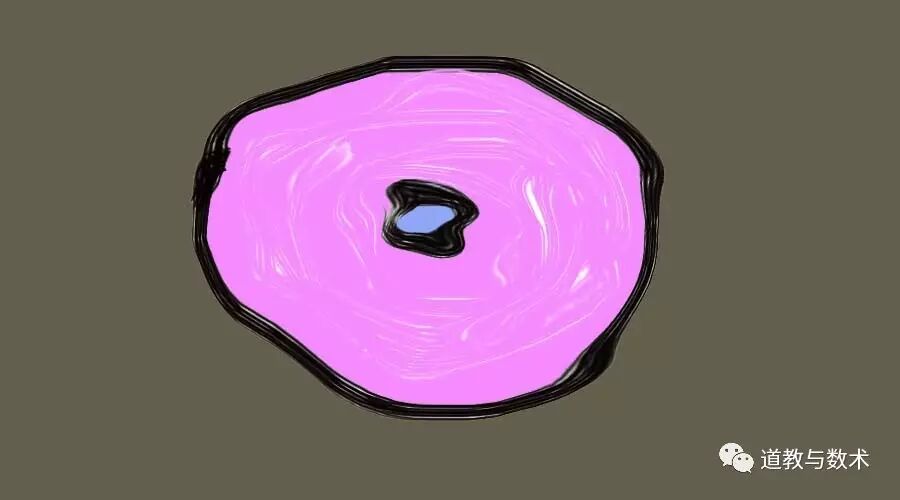
(This is a sketch I drew of what I saw. It is not very precise, but this is roughly what it looks like.)
The key is to see this image, which depends on the pressure and technique of the fingers on the eyes, but everyone should be able to master this through practice. The colors in the image are what is used to judge good and ill fortune.
To repeat the essentials, there are three important steps in using Divine Light divination: first, silently contemplate the matter to be divined, ideally summing it up in a sentence and reciting it silently a few times; second, press the eyes with the fingers to obtain the divine light; third, judge good and ill fortune from the color and shape of the light.
2. Judging Good and Ill Fortune with Divine Light Divination
The Tianlao Classic of the Divine Light already contains some discussion of this. Let us look at the original text:
Shi Kuang said: “If the light is yellow or red and round, there will be virtue and joy. If it is white, there are troops in ambush, and someone will die. If it is green and broken, there will be sorrow. If it is black, there will be bandits and sick soldiers.”
Qi Bo said: “Green means sorrow, white means war, red means virtue, yellow means joy, and black means misfortune.”
Liu Gen said: “If the light is white, there is also virtue.”
To sum up the above: red and yellow light are auspicious, and a round shape is auspicious. Everything else is inauspicious. Black is the most inauspicious, and green and white are both ill omens.
Now let us look at what the Classic of the Divine Light says: “Green means sorrow, white means a false alarm, red and yellow mean good fortune and happy events, and black is greatly inauspicious. If no light appears when you seek it, you will die within days.”
This is similar to what was said above. To sum up: red and yellow are auspicious. Green means sorrow—that is, things will not go smoothly, but it is not yet inauspicious.
White is said in the earlier texts to mean war, that is, fighting or dispute; but the Classic of the Divine Light calls it a false alarm, which shows that danger can still be turned into safety.
Black is greatly inauspicious. No color at all is the most dangerous.
As for shape, round is greatly auspicious; if the light is not round, there will always be something that does not go smoothly.
3. Sample Cases of Divine Light Divination
The Classic of the Divine Light describes many sample cases of divination in detail. They can serve as a reference and are recorded below:
1. On Serving the Ruler
Serve the ruler with loyalty. Whether presenting a sealed memorial or answering in person before the throne, the slightest error brings the greatest calamity. You must first examine the divine light at midnight. If you obtain a red light, it surely portends a happy event: the ruler will be pleased and will gladly accept what you say. If it is yellow and the light is round, it surely portends rewards, a banquet with wine and food, and the joy of promotion in office and rank. If it is green, it surely portends a false alarm. If it is white, what you present will not be accepted, and there is the fear of severe punishment. If it is black, it is greatly inauspicious, and you should be on your guard.
2. On Facing the Enemy and Punishing the Guilty
Whenever you face the enemy or go to punish the guilty, you must examine the divine light. If its color is red or yellow, bright and dazzling, you will surely win a great victory; even if the enemy attacks with a thousand troops and ten thousand horsemen, you need have no worry. If it is green or black, or the divine light does not appear, you should quickly move your camp elsewhere. If it is white, you should not advance your troops, or you will surely suffer the disaster of a broken army and lost generals.
3. On Camping in the Open
Whenever you must stay out overnight, or have doubts about where you are, you must clear the mind, still your thoughts, and quickly examine the divine light. If it is green, a treacherous person will come; if black, bandit troops will come; if white, someone close to you is plotting; if red or yellow, you may sleep soundly without worry. Whenever you are in a dangerous place and your eyelid twitches, one twitch means one li away, two or three twitches mean two or three li away, and ten twitches mean ten li: treacherous people and bandits will surely arrive ahead of you. If you know this in advance, you can capture the traitors and bandits while laughing and talking.
4. On Traveling Far
Whenever you travel far and stop for the night in a village, you must examine the divine light. If it is absent and your heart stirs and your eyelid twitches, you should quickly keep well away and not go in. If you are staying in a valley, below a cliff, or beneath a dead tree or a broken wall, and the divine light is absent, there will surely be the danger of a landslide, falling rocks, a falling tree, or a collapsing wall. When passing in and out of lonely places in the mountains and forests, if the divine light does not appear, you must on no account act rashly, lest you be harmed by tigers, wolves, snakes, or vipers. If you guard against this carefully, there will be no harm.
5. On Wind, Rain, Thunder, and Lightning
Whenever you are outdoors and are suddenly caught in a violent storm, quickly examine the divine light. If it does not appear, there will certainly be the danger of floods, landslides, and collapsing city walls. You must not stay there long, but must move to higher ground; only then can you escape.
6. On Crossing Water
Whenever you are to cross a river or the sea, or a place of dangerous waters and fierce waves, examine the divine light one day in advance. If it is red or yellow, you may cross; if green, there will be strong winds; if white, heavy rain; if black, you may meet with the disaster of the boat capsizing, the rudder breaking, and drowning—losing your life in an instant. How can you not be careful!
7. On Food and Drink
Whenever you drink or dine with others, or are invited by someone while staying as a guest, and fear that some harm may come to you, you must examine the divine light. If it is a bright red flame, or yellow, round, and large, there will surely be joyful celebration and the pleasure of eating and drinking one's fill, without any harm. If it is green or white, it surely portends a quarrel, or poor food and wine and an unsatisfying occasion. If the light is black, you may be harmed by the food and wine, choke on a bone, or eat something poisonous by mistake—troubles will arise in a hundred ways.
8. On Visiting Friends
Whenever you go to visit friends, also examine the divine light. If it is yellow or red, the person is at home, and you will have the joy of a glad welcome and generous hospitality with food and wine. If it is green or white, the person may be busy at home, rushing about on other business, or dealing with a death, injury, or other misfortune, and will have no time to receive you. If it is black, do not go, for fear that something unexpected will arise and nothing will go well.
9. On Illness, Life, and Death
If a person's divine light is unclear, or shows no form, for seven nights, it greatly portends danger. If on one of five nights it does not appear, you may examine it at dusk; if it is still absent, examine it again at midnight. If it appears, the weather is simply unsettled, and there will certainly be no danger of death. If the examination shows red or yellow, the person will recover within a day; if green or white, it only portends a lingering illness; if black, or if there is no light, the time of death is near.
4. Conclusion
Although this method of divination does not mention that spiritual attainment is needed to use it, in general, if one has attainment in qi cultivation, the accuracy of the prediction should improve.
This article has also mentioned the chapter “Far-Reaching Survey” of the Baopuzi and Liu Gen. Interested readers may learn more about Ge Hong of the Jin dynasty and the biography of the immortal Liu Gen in the Biographies of Divine Immortals (Shenxian Zhuan).