
Chiyang Daoren, Eastern Taoism
1. Observing the Plum Blossoms (A Case Cast by Year, Month, Day, and Hour)
In the Shen hour on the seventeenth day of the twelfth month of a Chen year, Master Kangjie happened to be looking at plum blossoms when he saw two sparrows fight over a branch and fall to the ground. The Master said: “One does not divine when nothing moves, and does not divine without a reason. Now two sparrows have fought over a branch and fallen to the ground—this is strange.” So he divined. The Chen year is five, the twelfth month twelve, and the seventeenth day seventeen, thirty-four in all. Taking away four eights, thirty-two, leaves two, which is Dui (Lake), the upper trigram. Adding nine for the Shen hour gives a total of forty-three; taking away five eights, forty, leaves three, which is Li (Fire), the lower trigram. Again, the total of upper and lower is forty-three; dividing by six, six sevens are forty-two, leaving one as the moving line. This gives Lake over Fire, Ge (Revolution). The first line changes, giving Xian (Influence), and the nuclear trigrams are Qian (Heaven) and Xun (Wind).
He judged: “Looking closely at this hexagram, tomorrow evening a girl will come to pick flowers; the gardener, not knowing who she is, will chase her; the girl will fall to the ground in fright and injure her thigh. Moreover, Dui Metal is the Ti, and Li Fire controls it. Within the nuclear hexagram is Xun Wood, which further kindles the Li Fire, so the qi of the trigrams controlling Ti is strong. Dui is the young girl, so we know it is a young girl who is injured. The Xun Wood within the nuclear hexagram also meets Qian Metal and Dui Metal controlling it, so the Xun Wood is harmed, and Xun is the thigh; therefore I judge that there will be an injured thigh. Fortunately the hexagram changes to Gen Earth, which generates Dui Metal, so we know that although the girl will be injured, it will not be dangerous.”
Plain-Language Interpretation
In the Shen hour on the seventeenth day of the twelfth month of a Chen year, Master Shao Kangjie happened to see two sparrows on a plum tree fighting over a branch, and both fell to the ground together. The Master said: “If a thing does not suddenly stir of itself, and if nothing has happened, I will not divine. Now I have seen two sparrows fight over a branch and fall to the ground—this is truly strange.” So he decided to divine from this scene.
He first took numbers from the year, month, and day: the Chen year corresponds to five, the twelfth month to twelve, and the seventeenth day to seventeen, adding up to thirty-four. Then, by the rule of “four eights are thirty-two,” he took them away, leaving two. Two corresponds to the Dui trigram among the eight trigrams, so the upper trigram was Dui.
Next, he added nine for the Shen hour, bringing the total to forty-three. Then, by the rule of “five eights are forty,” he took them away, leaving three. Three corresponds to the Li trigram, so the lower trigram was Li.
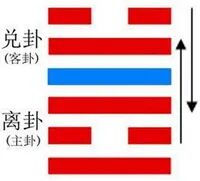
Lake over Fire: Ge (Revolution)
Finally, he divided the total of forty-three by six—six sevens are forty-two—leaving one, which became the moving line. Thus he obtained the hexagram Lake over Fire, Ge. When the first line changes, it becomes the hexagram Xian, and the nuclear trigrams are Qian and Xun.
Master Shao Kangjie made his prediction from this hexagram, saying: “Analyzing this hexagram carefully, I judge that tomorrow evening a girl will come to pick flowers; the gardener, unaware of what she is doing, will go to chase her away, and the girl, startled, will fall to the ground and injure her thigh. Moreover, the Dui trigram represents a young girl and is also the Ti trigram, and it is controlled by the fire of the Li trigram. The Xun Wood in the nuclear hexagram is in turn burned by the Li Fire of the third line, showing that the qi of the trigrams controlling Ti is very strong. Dui is a young girl, so we can judge that it is a young girl who is injured. And the Xun Wood in the nuclear hexagram is controlled by the Metal of Qian and the Metal of Dui, showing that the Xun Wood is harmed too. Since the Xun trigram represents the thigh, we can judge that there will be an injured thigh. Fortunately, however, the hexagram then changes to Gen Earth, and the Dui Metal is generated and supported by the Gen Earth, so we can know that although the girl will be injured, her life will not be in danger.”
2. The Peony
In the Mao hour on the sixteenth day of the third month of a Si year, the Master went with a guest to the home of Lord Sima to view the peonies. The flowers were in full bloom, and the guest said: “The flowers are so abundant—do they too have their fixed numbers?”
The Master said: “Everything has its fixed number, and since you ask, we can divine.” So he divined. The Si year is six, the third month three, and the sixteenth day sixteen, twenty-five in all; taking away three eights, twenty-four, the remainder gives Qian, the upper trigram. Adding four for the Mao hour gives twenty-nine; again taking away three eights, twenty-four, the remainder of five gives the Xun trigram, the lower trigram. This gives Heaven over Wind, Gou (Coming to Meet). Dividing the total of twenty-nine by six, four sixes are twenty-four, and the remainder of five means the fifth line moves, changing to Ding (The Cauldron), and the nuclear trigrams are Qian doubled. He then said to the guest: “How strange! Tomorrow at the Wu hour these flowers will be trampled and destroyed by horses.” The guests were astonished and did not believe it. The next day at the Wu hour, an official dignitary did indeed come to view the peonies; two of his horses fought and ran amok, galloping in fright among the flowers, and the flowers were all trampled and destroyed.
He judged: “Xun Wood is the Ti, and Qian Metal controls it; in the nuclear hexagram Qian appears again, doubled, so there are many trigrams controlling Ti, and there is no sign of life in the hexagram. Therefore I knew that the peonies would surely be trampled and destroyed. As for horses, Qian is the horse. As for the Wu hour, it is the image of the brightness of Li. This is how I knew.”
Plain-Language Interpretation
In the Mao hour on the sixteenth day of the third month of a Si year, Master Shao Kangjie went with a guest to the home of Lord Sima to admire the peonies. The peonies were in full bloom, and the guest could not help asking: “The flowers are blooming so abundantly—do they too have a fixed destiny?”
The Master replied: “Everything in the world has its fixed number, and since you have raised the question, we can take the opportunity to divine.” So the Master began to divine.
He first took numbers from the year, month, and day: the Si year corresponds to six, the third month to three, and the sixteenth day to sixteen, adding up to twenty-five. Then, by the rule of “three eights are twenty-four,” he took them away, leaving one. One corresponds to the Qian trigram, so the upper trigram was Qian.
Next, he added four for the Mao hour, bringing the total to twenty-nine. Then, again by the rule of “three eights are twenty-four,” he took them away, leaving five. Five corresponds to the Xun trigram, so the lower trigram was Xun.
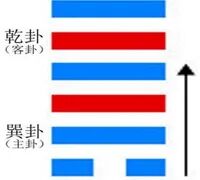
Heaven over Wind: Gou (Coming to Meet)
Finally, he divided the total of twenty-nine by six—four sixes are twenty-four—leaving five, which became the moving line. Thus he obtained the hexagram Heaven over Wind, Gou. When the fifth line moves, it becomes the hexagram Ding, and the nuclear hexagram shows two Qian trigrams.
From this hexagram the Master said to the guest: “How strange! Tomorrow at the Wu hour these peonies will be trampled and destroyed by horses.” All the guests were greatly surprised on hearing this and said they did not believe it.
But the next day at the Wu hour, an official dignitary did indeed come to admire the peonies. His two horses suddenly began to fight and fell into chaos, running in terror among the flowers, and the peonies were all trampled and destroyed.
The Master explained his judgment: “The Xun trigram represents Wood and is the Ti trigram of the peonies; it is controlled by the Metal of the Qian trigram. Moreover, two Qian trigrams appear in the nuclear hexagram, showing that the qi of the trigrams controlling Ti is very strong. There is no sign of life in the hexagram, so we could judge that the peonies would surely be trampled and destroyed. The horse is the symbol of the Qian trigram, and the Wu hour is the symbol of the brightness of the Li trigram. From these, all of this could be inferred.”
3. The Neighbor Knocking at Night to Borrow Something (A Case Divined by Sound)
On a winter evening, at the You hour, the Master was sitting by the stove when someone knocked at the door, first knocking once and stopping, then knocking five more times, and saying he wished to borrow something. The Master told him not to say what, and had his son divine to test what was to be borrowed. One knock belongs to Qian, the upper trigram; five knocks belong to Xun, the lower trigram. One for Qian and five for Xun make six, plus ten for the You hour, sixteen in all; dividing by six leaves four. This gives Heaven over Wind, Gou, with the fourth line changing to give Xun, and the nuclear trigrams are Qian doubled. In the hexagram there are three Qian Metals and two Xun Woods—nothing but metal and wood. Judging further by Qian Metal as short and Xun Wood as long, it is an axe that is being borrowed.
The son judged: “Short metal and long wood make a tool; what is being borrowed is a hoe.” The Master said: “Not a hoe—it must be an axe.” They asked, and indeed it was an axe. His son asked why, and the Master said: “With numbers one must also understand reason. Inferring from the hexagram, it could be an axe, or it could be a hoe; but inferring from reason, what use is a hoe in the evening? It must be an axe, for an axe is needed for splitting firewood. In working out numbers one must also understand reason—this is essential in divination. To work out numbers without working out reason is to fail. Let students of numbers remember this!”
Plain-Language Interpretation
One winter evening, at the You hour, Master Shao Kangjie was sitting at home warming himself by the fire. Suddenly someone knocked at the door. At first there was just one light knock, then five more knocks in a row, together with a request to borrow something.
The Master did not answer directly, but told the visitor not to speak, and instead instructed his son to divine from the knocking and try to judge what the visitor wanted to borrow.
Following the Master's guidance, the son took the single knock as the Qian trigram, the upper trigram, and the five knocks that followed as the Xun trigram, the lower trigram. Next, he added the total of six from one for Qian and five for Xun to ten for the You hour, making sixteen in all. Then he divided this total by six, leaving a remainder of four, which meant the fourth line would move. So they obtained the hexagram Heaven over Wind, Gou, in which the fourth line moves and changes to give the Xun trigram, and the nuclear hexagram shows two Qian trigrams.
Heaven over Wind: Gou (Coming to Meet)
Looking at this hexagram, the son saw that it contained three Qian Metals and two Xun Woods, and judged: “Something shaped with short metal and long wood should be a tool; what is being borrowed should be a hoe.” But the Master shook his head and said: “Not a hoe—it must be an axe.”
When they asked, it turned out that the visitor did indeed want to borrow an axe. Curious, the son asked the Master how he could be so certain. The Master explained: “In divination we must reason both from the principles of numbers and from common sense. From the principles of numbers, this hexagram could be interpreted either as an axe or as a hoe. But reasoning from common sense, people do not generally use a hoe in the evening; they are more likely to need an axe to split firewood. So by combining the principles of numbers with common sense, we can judge more accurately that the visitor wants to borrow an axe. Therefore, in divination one must both work out the numbers and understand reason; this is the key to divination. If you know only how to work out numbers but do not know how to combine them with common sense, you cannot reach an accurate judgment. Those who study divination must remember this!”
4. What Will Today's Movement and Stillness Be? (A Case Divined by Sound)
A guest asked: “What will today's movement and stillness be?” So the Master divined with these six characters. Dividing them equally, the three characters “jin ri dong” (“today's movement”) form the upper trigram: “jin” is in the level tone, one; “ri” is in the entering tone, four; “dong” is in the departing tone, three; eight in all, giving the Kun (Earth) trigram as the upper trigram. The three characters “jing ru he” (“stillness—what will it be?”) form the lower trigram: “jing” is in the departing tone, three; “ru” is in the level tone, one; “he” is in the level tone, one; five in all, which is Xun, the lower trigram. The total of eight and five is thirteen; taking away two sixes, twelve, leaves one. This gives Earth over Wind, Sheng (Pushing Upward), with the first line moving, changing to Tai (Peace), and the nuclear trigrams are Zhen (Thunder) and Dui. He then said to the guest: “Today someone will invite you to a meal. There will not be many guests, the wine will not make you drunk, and the fare will be no more than millet and chicken.” By evening, it was so.
He judged: “Sheng has the meaning of ascending the steps. The nuclear trigrams Zhen and Dui indicate the division into east and west seats. In the hexagram, Dui is the mouth and Kun the belly, matters of mouth and belly, so I knew someone would invite you to a meal. There will not be many guests because Kun Earth stands alone, with no trigram of the same kind of qi. The wine will not make you drunk because there is no Kan (Water) in the hexagram. The fare will be only chicken and millet because Kun is chicken, millet, and grain; and since the hexagram has no qi of mutual generation, I knew there would not be much wine and the food would not be abundant.”
Plain-Language Interpretation
A guest came and asked Master Shao Kangjie: “What activities or events will happen today?” The Master decided to divine with the six characters the guest had spoken.
He divided the six characters equally into two parts. The three characters “jin ri dong” served as the basis for the numbers of the upper trigram: “jin” is in the level tone, corresponding to one; “ri” is in the entering tone, corresponding to four; “dong” is in the departing tone, corresponding to three. Adding these three numbers gives eight, and according to the eight trigrams, eight corresponds to the Kun trigram, so the upper trigram was Kun.
Next, he took the three characters “jing ru he” as the basis for the numbers of the lower trigram: “jing” is in the departing tone, corresponding to three; “ru” is in the level tone, corresponding to one; and “he” is also in the level tone, corresponding to one. Adding these three numbers gives five, and five corresponds to the Xun trigram, so the lower trigram was Xun.

Earth over Wind: Sheng (Pushing Upward)
Then he added the eight of the upper trigram to the five of the lower trigram, making thirteen. He divided this total by six (since a hexagram is formed of six lines), leaving one, which became the moving line. Thus he obtained the hexagram Earth over Wind, Sheng, in which the first line moves and changes to give the hexagram Tai, and the nuclear hexagram shows the Zhen and Dui trigrams.
From this hexagram the Master said to the guest: “Today someone will invite you to a meal, but there will not be many guests, the wine will not make you drunk, and the food will be only chicken and millet.”
By evening, things turned out just as the Master had predicted.
Analysis of the judgment: the hexagram Sheng has the meaning of rising and advancing. The Zhen and Dui trigrams in the nuclear hexagram represent east and west respectively, which may indicate a distinction between east and west seats or directions at the banquet. In the hexagram, the Dui trigram represents the mouth and the Kun trigram the belly, which relate to matters of eating and drinking, so the Master knew someone would invite the guest to a meal.
There would not be many guests because the Kun trigram stands alone, with no other trigram of the same kind of qi to support it. The wine would not make him drunk because there is no Kan trigram in the hexagram, and the Kan trigram represents water and wine.
The food would be only chicken and millet because the Kun trigram is symbolically associated with chicken and with crops such as millet and grain. Moreover, there is no qi of mutual generation in the hexagram as a whole, so the Master knew there would not be much wine and the food would not be very abundant.
5. The Plaque of Xilin Temple (A Case Divined by Characters)
The Master happened to see the plaque of Xilin Temple and noticed that the character “lin” (grove) lacked its two hooks, so he divined. The character “xi” (west), with seven strokes, is Gen (Mountain), the upper trigram; the character “lin,” with eight strokes, is Kun, the lower trigram. Seven strokes above and eight below make fifteen strokes in all; taking away two sixes, twelve, leaves three. This gives Mountain over Earth, Bo (Splitting Apart), with the third line moving, changing to Gen, and the nuclear trigrams are Kun doubled.
He judged: “A temple is a dwelling of pure yang. Now the hexagram has doubled yin lines, and there is also the omen of many yin splitting apart the yang. From this, there should be trouble from women in the temple.” When asked, it was so. He then said to the monks: “Why not add the two hooks to the character ‘lin’? Then naturally there will be no more trouble from women.” The monks believed him and added the two hooks to the character “lin,” and the temple indeed had no more trouble.
Moreover, the dwelling of people of pure yang obtained a hexagram of pure yin, so it was inauspicious; and there was the meaning of many yin splitting apart the yang, so there was trouble from women. If the two hooks are added to the character “lin,” it has ten strokes; taking away eight leaves two, which is the Dui trigram. Combined with Gen above, this gives Mountain over Lake, Sun (Decrease). The fifth line changes, moving to Zhongfu (Inner Truth), and the nuclear trigrams are Kun and Zhen. Sun is the beginning of Yi (Increase); the Yong and the nuclear trigrams all generate the Ti, so it is an auspicious hexagram, and peace and stability can be obtained.
All of the above use the prior heaven numbers: casting a hexagram from numbers is what is called the prior heaven numbers.
Plain-Language Interpretation
Once, Master Shao Kangjie happened to see the plaque of Xilin Temple and noticed that the character “lin” on it was missing two hooks. Taking this as his reason, he decided to divine.
He used the character “xi” as the basis for the number of the upper trigram: because “xi” has seven strokes, and seven corresponds to the Gen trigram, the upper trigram was Gen. Next, he used the character “lin” (although it was missing two hooks, he took it as eight strokes according to its original form) as the basis for the number of the lower trigram; eight corresponds to the Kun trigram, so the lower trigram was Kun.
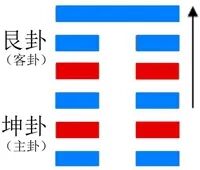
Mountain over Earth: Bo (Splitting Apart)
Then he added the seven strokes of the upper trigram to the eight strokes of the lower trigram, making fifteen strokes in all. He divided this total by six (since a hexagram is formed of six lines), leaving three, which became the moving line. Thus he obtained the hexagram Mountain over Earth, Bo. When the third line moves, it becomes the hexagram Gen, and the nuclear hexagram shows two Kun trigrams.
From this hexagram the Master judged: “A temple ought to be a place where the qi of pure yang dwells, but the hexagram obtained has doubled yin lines, and there is also the omen of many yin splitting apart the yang. From this it appears that trouble involving women may occur in the temple.”
Later, on inquiry, this was found to be so. The Master then said to the monks of the temple: “Why not add the two hooks to the character ‘lin’? Then naturally you will avoid trouble from women.” The monks took the Master's advice and added the two hooks to the character “lin,” and from then on nothing of the kind happened in the temple again.
The Master further explained: “If the dwelling of people of pure yang obtains a hexagram of pure yin, that is naturally inauspicious. And since there is also the meaning of many yin splitting apart the yang, there will be trouble from women. But if the two hooks are added to the character ‘lin,’ it will have ten strokes. Ten divided by eight leaves two, and two corresponds to the Dui trigram. Combining the Dui trigram with the upper Gen trigram gives the hexagram Mountain over Lake, Sun. When its fifth line moves, it becomes the hexagram Zhongfu, and the nuclear hexagram shows the Kun and Zhen trigrams. Sun is the beginning of increase, and the Kun and Zhen trigrams in the nuclear hexagram can both generate and support the Ti trigram, so this is an auspicious hexagram, meaning that peace and stability can be obtained.”
All of the above are examples of divination using the prior heaven numbers.
6. The Old Man with a Worried Look (A Case Cast by Observation)
On a Jichou day at the Mao hour, the Master happened to be walking along the road when he saw an old man heading toward the Xun direction (southeast) with a worried look. He asked him why he was worried, and the old man said: “I am not.” Finding this strange, the Master divined. The old man belongs to Qian, the upper trigram; the Xun direction gives the lower trigram; this is Heaven over Wind, Gou. The numbers of Qian, one, and Xun, five, plus four for the Mao hour, make ten in all; dividing by six leaves four as the moving line, which is the nine in the fourth place of Gou. The Changes says: “No fish in the wrapper; rising up brings misfortune.” This line statement is inauspicious. Judging by the trigrams, Xun Wood is the Ti and Qian Metal controls it; in the nuclear hexagram Qian appears again, doubled; all control the Ti, and there is no sign of life. Moreover, since the moment was on the road, the response would be swift. So, taking the number of the hexagram and dividing it in half, he said to the old man: “Be careful in your comings and goings for the next five days, for I fear there will be a grave calamity.” Indeed, within five days the old man went to a celebratory banquet, choked on a fish bone, and died. Also, in all divination, to judge the timing of fulfillment, look at your own movement or stillness to decide whether things will come quickly or slowly. When walking, the response is swift, so the number of the hexagram may be divided in half. When sitting, the response is slow, and the number of the hexagram should be doubled to fix the date. When standing, it is half slow and half swift, and the date may simply be fixed by the number of the hexagram. Even so, one must also adapt; as with the peony and the plum blossoms, both flowers were matters of a morning or an evening—why wait as long as the full number of the hexagram?
Plain-Language Interpretation
On a Jichou day at the Mao hour, Master Shao Kangjie happened to be walking along the road when he saw an old man heading toward the Xun direction with a worried look on his face. Curious, the Master went up and asked the old man why he was worried, but the old man answered: “I am not.”
Finding this strange, the Master decided to divine for the old man. He took the old man to represent the Qian trigram, the upper trigram, and the Xun direction the old man was heading toward to represent the Xun trigram, the lower trigram. In this way he obtained the hexagram Heaven over Wind, Gou.
Heaven over Wind: Gou (Coming to Meet)
Next, he added one for the Qian trigram and five for the Xun trigram, plus four for the Mao hour, making ten in all. Then he divided this total by six, leaving four, which became the moving line. Thus he obtained the nine in the fourth place of the hexagram Gou. The I Ching says: “No fish in the wrapper; rising up brings misfortune.” This statement is inauspicious.
Looking at the trigrams, the Xun trigram represents Wood and is the Ti trigram, and it is controlled by the Metal of the Qian trigram. Moreover, two Qian trigrams appear in the nuclear hexagram, all of them trigrams controlling Ti, and there is no sign of life in the hexagram at all. Furthermore, since he had met the old man on the road, what was foretold should happen very quickly.
So the Master took half of the total number of the hexagram and said to the old man: “Be careful in your comings and goings for the next five days, for I fear there will be a grave calamity.”
Sure enough, five days later, at a banquet, the old man choked on a fish bone while eating fish and died.
In addition, the Master summed up a rule for divination: the timing of fulfillment can be decided, as to whether things will come quickly or slowly, by the diviner's own movement or stillness. If the diviner divines while walking, what is foretold will happen quickly, and it can be judged by taking half the total number of the hexagram. If the diviner divines while sitting, what is foretold will happen more slowly, and the total number of the hexagram should be doubled to determine it. If the diviner divines while standing, what is foretold will be half quick and half slow, and it can be determined directly by the total number of the hexagram.
Although there is such a rule, in actual use one must still adapt to the specific circumstances. As with the peony and plum blossom readings mentioned earlier, both events happened within a very short time—why wait as long as the total number of the hexagram?