
Chiyang Daoren, Eastern Taoism
Da Liuren and Xiao Liuren are two methods of prediction (divination) often used in traditional Chinese prediction. Because their names differ by only one character, many people mistakenly think they are two methods of prediction (divination) that differ little, and even treat them as the same thing.
In fact, although their names are very similar, the two are actually very different—one could even say they have almost nothing to do with each other and are two entirely different methods of prediction (divination). Da Liuren and Xiao Liuren differ markedly in their origins and development, theoretical basis, mode of operation, method of calculation, complexity, range of application, accuracy, and users.
1. Basic Concepts
1. Da Liuren is also called the “Liuren Divine Lesson” and the “king of human affairs” in prediction. It was therefore a very famous numerological art of prediction in ancient times, and together with Taiyi Shenshu and Qimen Dunjia it is known as one of the “Three Arts” of prediction (divination); among them, Da Liuren is regarded as “the first of the Three Arts.”
2. The origin of the name Da Liuren:
Da (great): the word “great” is added to distinguish it from the simple folk divination Xiao Liuren (lesser Liuren), because the system of Da Liuren is complete, orthodox, and profound.
Liu (six): represents six cycles of flourishing and decline of Ren Water as time and space flow, and also refers to the six stem-branch combinations containing Ren in the sixty jiazi, the sixty-day and sixty-year cycle (Renzi, Renyin, Renchen, Renwu, Renshen, and Renxu); hence the name “Liuren.”
Ren: one of the ten Heavenly Stems, whose element is yang Water. It represents flow, change, and resonance, and it is the core image of the system of deduction, standing for the capture of information that changes from moment to moment.
Da Liuren is fairly accurate: it can analyze in fine detail the course of things and their final fortune, and it is praised as “the most efficacious divine lesson.” It is used mainly for affairs of state, military decisions, predicting wars, and decisions on major matters, though it can of course also offer in-depth guidance for individuals on life planning, career development, relationships, and marriage. Those who use Da Liuren must be highly skilled predictors (practitioners of divination); a predictor needs experience, learning, and self-cultivation to grasp its essentials. Its users were mainly the emperors, generals, ministers, and scholar-officials of ancient times, and so Da Liuren is difficult to learn, demands a high level of education from the student, and requires a dedicated master to teach it.
3. Xiao Liuren, also called “the Horse-Front Lesson” or “casting a lesson by the hour,” is a simple ancient Chinese method of prediction (divination). Because it is worked out simply by “counting on the fingers,” it has spread extremely widely among the people. At its core, it follows set rules to turn the time (month, day, and hour) into a landing place among the “Six Spirits,” and so judges whether the matter asked about is auspicious or inauspicious.
The accuracy of Xiao Liuren is relatively low; it mainly gives a general indication of good or ill fortune and is applied mostly to the small matters of daily life—short-term judgments such as whether a trip will go smoothly, whether a lost item can be found, how one's luck will be that day, or whether a relationship will lead to marriage. It demands little education of the learner and is simple and easy to learn. Its users are mainly ordinary people, and it has spread widely among the people. Because a prediction (divination) gives a quick result—within a few minutes—it is widely used and suits newcomers.
2. Origins, Development, and Present State of Transmission
1. The origins of Da Liuren can be traced back to remote antiquity; legend connects it with the time of the Yellow Emperor. After a thousand years of development, it is one of the most complex and systematic sciences of prediction in the ancient numerological system. Da Liuren is an applied science of astronomy in ancient China, originating in astronomy and the calendar, and is “the first of the astronomical numerological arts.” It arose very early and can be traced back to astronomical observation in high antiquity. It had taken rudimentary shape and was flourishing by the Han dynasty, and it is already recorded in ancient books such as the Spring and Autumn Annals of Wu and Yue and the Yuejue Shu. By the Wei, Jin, and Northern and Southern dynasties, Da Liuren had spread widely among the scholar-officials; its theory reached its peak in the Tang and Song, and in the Ming and Qing it spread widely among the people. It was a predictive model commonly used by ancient official astronomical institutions (such as the Directorate of Astronomy) and by literati and eminent scholars.
Da Liuren is hard to transmit: it requires a dedicated master to teach it, and learners need a high level of education and patience. Moreover, few books on it were printed in ancient times; most are hand-copied manuscripts of uneven reliability. Although enthusiasts still study it today, they are a small minority—as the saying goes, “the higher the tune, the fewer who can join in.” If you wish to study traditional numerology in depth, pursue precise prediction, do professional research, or provide reference for decisions on major matters, you can undertake systematic study of it.
2. Xiao Liuren arose later and was used mostly among the people. Tradition holds that it was one of the methods often used before battle by the revered Zhuge Liang of the Three Kingdoms period; it is also called the “Horse-Front Lesson,” the “Liuren Hour Lesson,” and “casting a lesson by the hour,” or it may be the Liuren hour lesson created by Li Chunfeng of the Tang dynasty. It first appears in the Ming and Qing folk almanac Jade Casket Records (Yuxia Ji), and part of its content is a simplified version of the numerology of Da Liuren. Although Xiao Liuren has some connection with Da Liuren, it has its own independent system, principles, and methods. Because “casting a lesson is simple and quick to learn,” it is often used for everyday matters (such as finding lost items, the date of someone's return, or the weather) to settle doubts quickly.
Xiao Liuren has been widely handed down and popularized among the people. It later spread to Japan and became popular there, while in China it gradually declined; in recent years, however, it has revived somewhat, is now quite popular on social media, and has become a hot topic in the study of traditional culture. Because its calculation is simple and quick and does not involve complex combinations of stems and branches, yin and yang and the Five Phases, or structures of lessons, it requires little specialized knowledge or complex deduction, so it is quick to learn and easy to use, and it is very popular with ordinary people.
If you want to learn good and ill fortune quickly as an everyday reference, ordinary people can start with Xiao Liuren, which can be learned and put to use in a short time.
3. Role and Features
1. Da Liuren is praised as “the most efficacious divine lesson”; there is a saying that “once you have learned Da Liuren, you need not ask a visitor why they came,” and it has long been celebrated as the “king of human affairs” for decision-making. It mainly provides decision support on major questions and matters for the state and even for individuals.
The theoretical system of Da Liuren is extremely complex, including the Heavenly Stems and Earthly Branches, the Four Lessons and Three Transmissions, the auspicious and inauspicious stars (shensha), and the generation and control of the Five Phases. Its method of calculation is intricate: the Four Lessons and Three Transmissions method requires laying out the chart, taking the Useful God, looking at the divine generals, distinguishing yin and yang, and judging good and ill fortune—many cumbersome steps.
Role: Da Liuren is known for “divining human affairs” and excels at “detailed judgment” and “precise timing.” It can work out the causes, setbacks, obstacles, sources of help, and final outcome of a specific event. It is not limited to predicting destiny at the macro level; it can also address a person's specific present concerns—such as success or failure in a career, the fortune of a partnership, or the union or separation of a couple—and can offer reference on wealth, career, marriage, health, lawsuits, and more.
Features: a vast system, rigorous logic, and subtle deduction. It combines complex elements such as the Heaven Plate, the Earth Plate, the Four Lessons, the Three Transmissions, and the Heavenly Generals, and yields a very large amount of predictive information. Because its deduction is so intricate, there is a saying that “Liuren turns your hair white” (it is extremely hard to learn).
2. Xiao Liuren is a simple folk method of divination with a relatively simple theoretical system; it needs only six spirits (Great Peace, Lingering, Swift Joy, Red Mouth, Minor Luck, and Void). It is mainly used to solve small problems met in daily life.
The method of calculating Xiao Liuren is simple: count out three numbers—month, day, and hour—clockwise across six positions on the hand.
4. Core Structure and Methods of Deduction
1. The Core Structure and Methods of Deduction of Da Liuren
Da Liuren is essentially an ancient model for reasoning about cause and effect and for decision-making. Its value lies in using symbolic logic to help people sort out the hidden conditions in complex events and so make more rational judgments.
The deduction of Da Liuren is based on the philosophy of “the unity of heaven and humanity” and “the correspondence of time and space.” By simulating the interaction between the energy field of the cosmos (heaven) and geographical directions (earth), it analyzes changes in human affairs.
In Da Liuren, the combination of Heavenly Stems and Earthly Branches is used with great subtlety. For example, a complete Da Liuren lesson contains the “Four Lessons” and the “Three Transmissions,” which involve the arrangement and interrelation of many stems and branches. There are ten Heavenly Stems: Jia, Yi, Bing, Ding, Wu, Ji, Geng, Xin, Ren, and Gui; and twelve Earthly Branches: Zi, Chou, Yin, Mao, Chen, Si, Wu, Wei, Shen, You, Xu, and Hai. The stems and branches work together, and the Four Lessons and Three Transmissions are determined by specific calculations.
The stems and branches themselves carry rich attributes of yin and yang and the Five Phases. For example, Jia Wood is yang Wood, Yi Wood is yin Wood, Zi Water is yang Water, Hai Water is yin Water, and so on. These attributes play a key role in judging the fortune of things and their trends of development. The core structure of deduction includes:
The “Heaven and Earth Plates” are the underlying framework of the deduction. The Earth Plate is fixed and represents the underlying conditions of the environment; the Heaven Plate rotates freely and represents the present timing and external changes. The rotation of the Heaven Plate is determined jointly by the “Monthly General” (the sun's position on the ecliptic) and the “double hour” (the moment the question is asked).
Arranging the “Four Lessons” (two lessons each from the day stem and the day branch): four sets of information drawn from the Heaven and Earth Plates, representing the surface of the matter, its inner circumstances, one's own state, and the state of the external environment, used to present the whole picture of the present event.
Determining the Four Lessons is an important step in Da Liuren prediction. Based on the hour of divination and the stem and branch of the day, the Four Lessons are obtained by a specific method of calculation. They reflect different information of time and space and the outward appearance of things. For example, the first lesson often reflects the beginning or the present state of a matter, while the second lesson may relate to the matter's related factors or sources of help.
The “Three Transmissions” are drawn from the Four Lessons according to rules: the Initial Transmission (the cause), the Middle Transmission (setbacks and turning points), and the Final Transmission (the final outcome), used to present the complete timeline and course of an event.
The Three Transmissions are a further derivation on the basis of the Four Lessons. They symbolize the course of a matter's development and are divided into the Initial, Middle, and Final Transmissions. The Initial Transmission represents the matter's opening movement, the Middle Transmission its intermediate state, and the Final Transmission foretells its final result. The process is like a dynamic chain that fully shows the course of a matter from beginning to end.
The “Heavenly Generals” are twelve personified symbols layered over the Heaven and Earth Plates, such as the Azure Dragon, the White Tiger, and the Noble Person, representing the different energies and characters in an event. By looking at the divine generals, the Heavenly Generals, and the relations of generation and control among the Five Phases, they help in judging good and ill fortune.
The steps for raising a lesson are complex and mainly include: placing the Monthly General on the hour to obtain the Heaven and Earth Plates (the Monthly General is the sun's position, fixed according to the Twenty-Four Solar Terms); raising the Four Lessons and fixing the Three Transmissions (by the rules of the Nine Methods: Controlling Clash, Comparison, Involved Harm, Distant Control, Mao Star, Separate Responsibility, Hidden Moaning, Reverse Moaning, and Eight Specials);
arranging the Twelve Heavenly Generals and fixing the Six Relations; finding the year of birth; and analyzing and judging the lesson. The predictor must master classics such as the Rhapsody on the Complete Methods (Bifa Fu) and the Classic of Lessons (Ke Jing).
2. The Predictive Principles of Da Liuren
Da Liuren makes predictions by analyzing the stems and branches and the structure of the lesson, taking into account the auspicious and inauspicious stars (shensha) and other factors. The shensha are a special system of symbols in Da Liuren, such as the Nobleman Star (Tianyi Guiren), the Travel Horse, and the Canopy. These stars have particular meanings and functions; for example, the Nobleman Star is an important indicator in predicting personal relationships and help from benefactors.
Da Liuren also pays attention to the relationship between the Heaven and Earth Plates. The Heaven and Earth Plates are a structure made up of stems and branches, and from their interrelations—such as generation and control between upper and lower, punishment, clash, combination, and harm—one judges the trend of things. For example, if a Heavenly Stem controls an Earthly Branch, it may indicate a situation of restraint or pressure.
Da Liuren builds a vast and complex predictive system on the theories of yin and yang and the Five Phases, the Heavenly Stems and Earthly Branches, the Four Lessons and Three Transmissions, and the unity of heaven and humanity. Its method of calculation requires complex charting and specialized knowledge to judge good and ill fortune and trends comprehensively; that is why the ancients said, “Once you have learned Da Liuren, you need not ask a visitor why they came.”
Because the system of Da Liuren is complex and contains rich information, it has great advantages in the precision and depth of prediction. It can analyze a matter comprehensively and in detail, predicting not only its outcome but also the various circumstances during its development, the factors that influence it, and the people involved. For example, in predicting a person's career development, Da Liuren can accurately point out, by analyzing the stems and branches and the structure of the lesson, the opportunities, challenges, and help from benefactors that the person will meet at different stages.
Using Da Liuren for prediction requires mastery of yin and yang and the Five Phases, the stems and branches, the shensha, and the types of lessons (the nine types, such as Controlling Clash, Comparison, and Involved Harm), and it requires transmission from a master and long practical experience.
3. The Core Structure and Methods of Deduction of Xiao Liuren
The deduction of Xiao Liuren is based on the philosophical ideas of “responding to the scene at the moment” and “the mutual resonance of heaven and humanity.”
The core elements of Xiao Liuren are the “six spirits” (in a fixed order), which reduce the result of the calculation to the “Six Spirits”: Great Peace, Lingering, Swift Joy, Red Mouth, Minor Luck, and Void.
4. Judging Good and Ill Fortune by the Six Spirits of Xiao Liuren
(1) The three auspicious ones: Great Peace (auspicious: safety, good fortune, smoothness—matters progress smoothly; it is best to keep still); Swift Joy (auspicious: quick success, swift achievement, celebration—matters progress quickly and there are happy events); Minor Luck (auspicious: small success, small gains, minor good fortune, harmony).
(2) The three inauspicious ones: Lingering (inauspicious: delay, repetition, entanglement—matters meet obstacles and one must wait); Red Mouth (inauspicious: quarrels, danger); Void (inauspicious: coming to nothing, loss, no result).
These six positions are fixed on six finger joints of the left hand (or the right hand) (base of the index finger, tip of the index finger, tip of the middle finger, tip of the ring finger, base of the ring finger, and base of the middle finger), forming the “hand diagram,” and in calculating one counts clockwise.
5. How Xiao Liuren Is Calculated
The three-step method of Xiao Liuren: count on the fingers by month, day, and hour in turn.
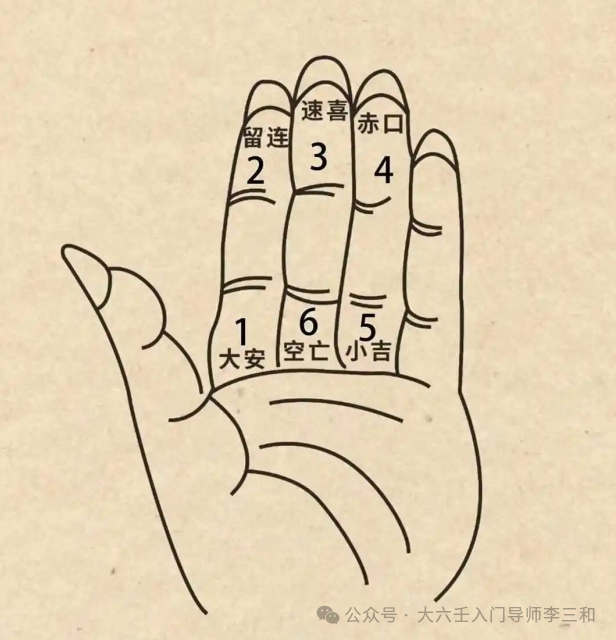
(1) Starting the day from the month: begin at Great Peace (the first month) and count clockwise through the Six Spirits in order to the month in question, to find the “month landing point”;
(2) Starting the hour from the day: take the month landing point as the new starting point for the day and count clockwise to the day of the month, to find the “day landing point”;
(3) Fixing the result by the hour: take the day landing point as the new starting point for the hour and count clockwise to the double hour of the day, to find the “hour landing point.”
All this is done by counting clockwise with the left thumb across the six hand positions—“take the month, day, and hour and calculate by the rules”—and the spirit at the final hour landing point is the result of the divination.
Because of its simplicity, Xiao Liuren is relatively imprecise, giving more of a general trend and outcome. It is mainly suited to quick judgments about simple, short-term matters. For example, in predicting whether a day is suitable for travel, Xiao Liuren can give a basic judgment, but it cannot analyze in depth, as Da Liuren can, the various specific situations one may encounter on the journey.
Xiao Liuren is mainly used among the people to predict small matters of daily life, such as whether an individual's everyday outing will be auspicious. It is a convenient and quick folk method of divination, closer to the needs of ordinary people's lives.
Because it is simple and easy to learn, Xiao Liuren has been widely handed down and popularized among the people. There are users of Xiao Liuren in almost every region; it has spread by word of mouth, and many ordinary people know its basic calculation and simple applications.
In short, although Da Liuren and Xiao Liuren are both methods of prediction (divination), they differ clearly in complexity, predictive precision, scenarios of application, and extent of transmission and popularity. In practice, people can choose the method of prediction (divination) that suits their needs and abilities.