
Chiyang Daoren, Eastern Taoism
The origins and development, forms and classification, rules for materials, and ritual practice of Taoist talismans are all rooted in the Taoist cosmology and the traditional cultural system. They have a sacred lineage of scripts, a rigorous division of functions, and a complete, standardized method of ritual practice; between brush and ink lie all the principles of the workings of heaven and earth and the creative transformations of the human body.
The culture of Taoist talismans has a long history; its rudiments can be traced back to the nature worship, star beliefs, exorcism of evil spirits, and shamanic and invocatory customs of ancient peoples.
The ancients regarded peach wood as an immortal wood and made peach-wood charms to drive away evil and bring in blessings, pioneering the talismanic culture of later ages.
In the pre-Qin period, the prayers for blessings and the soothing of souls in bronze decorations, the expulsion of pestilence and evil in nuo rites and nuo dances, the averting of calamity and removal of defilement in sacrifices to the gods, and the manifestation of heaven's will in auspicious mandates and omens were continually blended and integrated through many occult arts, gradually forming the early shape of talismans.
In the Han dynasty, the study of prophetic and apocryphal texts flourished, and belief in the Five Emperors of the five directions was incorporated into talismans. Talismans for summoning spirits, Lingbao talismans, life-protecting talismans, evil-expelling talismans, demon-suppressing talismans, petitionary talismans, and others arose accordingly, and talismans began to carry the meaning of settling the five directions, safeguarding the fortunes of the state, and protecting a region.
In the Wei and Jin period, Taoism was formally established and talismans were incorporated into the orthodox Taoist system. Texts such as the Charts of the True Forms of the Five Peaks and the Inner Writ of the Three Sovereigns were handed down and became the core scriptures of early Taoist talismans.
From the Sui and Tang through the Song and Yuan, Taoist schools such as the Zhengyi (Orthodox Unity) school, the Shangqing (Highest Clarity) school, the Lingbao (Numinous Treasure) school, the Shenxiao (Divine Empyrean) school, and the Qingwei (Pure Subtlety) school flourished, and the talismanic system became ever more complete.
In the Song and Yuan, the thunder rites were deeply integrated with talismans and reached their height; the forms of all kinds of talismans for summoning thunder and praying for rain, healing illness and delivering the dead, and guarding homes and pacifying the people were perfected, and the liturgy gradually became standardized.
In the Ming and Qing, as Taoism developed in a more popular direction, talismans spread deep among the common people; Celestial Master talismans, Maoshan talismans, and many other streams appeared in profusion, each regional tradition with its own character, making a magnificent spectacle.
The making of talismans requires that the writing have its source and the ritual its rules.
The Source of Talismanic Script: The Eight Forms and Six Scripts, True Traces of Heavenly Writing
Taoist scriptures classify talismanic script into the “Eight Forms and Six Scripts,” the source system of talismanic forms.
The Great Meaning of the Mysterious Gate of Dongxuan Lingbao records: “Talismans take the forms of clouds, rosy vapors, the sun, the moon, and the stars; writings analyze the sense of sounds, phrases, and meanings; diagrams depict the shifting states of the numinous workings. Within talismans writing is hidden and merged into images; within writing images are contained, so that form, sound, and meaning are all present. Hence there are ‘the Eight Forms and Six Scripts’, which illuminate and expound one another.”
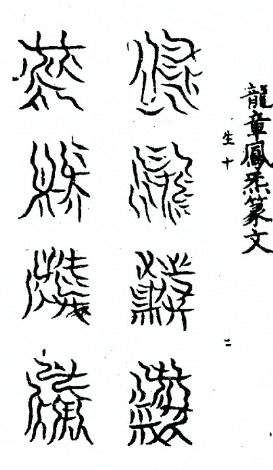
The “Eight Forms” focus on the source, nature, and uses of the scripts and are divided into “heavenly writing,” “divine writing,” “earthly writing,” “inner writing,” “outer writing,” “ghost writing,” “Xia writing,” and “Rong-Yi writing.” The “Six Scripts” focus on the forms and origins of the sacred scripts of prior heaven and are divided into “cloud seal,” “eight majesties,” “dragon script,” “phoenix script,” “jade characters,” and “hidden script.” The two complement each other and together make up the complete lineage of scripts of Taoist talismans.
“Heavenly writing” is the source of talismans, also called the Dragon Script of the Eight Majesties or the Writing of the Eight Assemblies of All the Heavens. With rays hanging from its eight corners and a dazzling essential light, it is the spontaneous manifestation of the true writ of the Primordial, the sacred script from the beginning of the kalpa when heaven and earth opened, whose mysteries ordinary people can scarcely glimpse.
“Divine writing” is cloud seal script, whose characters flow like clouds; it is the script used specifically within Taoism for communicating with the numinous, cultivating perfection, and performing rites, mostly in high-level liturgies and inner cultivation.
“Earthly writing,” also called dragon and phoenix script, takes the images of mountains, rivers, dragons, and phoenixes and serves to guard the peaks, settle the earth, and protect the grotto-heavens and blessed lands.
“Inner writing” and “outer writing” derive from the forms of living creatures such as tortoises, dragons, birds, and beasts, imitating the ancient bird-and-insect and tadpole seal scripts, and express the idea that all things have spirit and that heaven and humanity are of one origin.
“Ghost writing,” also called thunder script or thunder seal, is writing manifested by the heavenly majesty of the Thunder Department. It mostly appears amid strange signs of heaven's punishment and is used chiefly to slay evil, strike down wickedness, punish the vicious, and remove defilement.
“Xia writing” evolved from traditional Chinese characters in seal, clerical, regular, and cursive scripts. Accessible and easy to pass on, it is widely used among the people for averting calamity, praying for blessings, settling homes, and protecting life.
“Rong-Yi writing” absorbed elements of ancient shamanism and of local folk cultures, enriching the forms of talismans and displaying the breadth of Taoist culture, which embraces all things.
Requirements of Talismanic Form: The Three Powers Connected, Each with Its Office
According to the images and functions they carry, talismans can be divided into three major systems—celestial talismans, geographic talismans, and bodily talismans—connecting the Three Powers of heaven, earth, and humanity and covering every dimension of the cosmos, nature, and the human body.
Celestial talismans carry the principles of the workings of yin and yang in heaven and earth and of the stars and weather. The source of talismans is a cosmic diagram of congealed primal qi, including star talismans such as those of the Northern Dipper, the Southern Dipper, the Twenty-Eight Lunar Mansions, and the Three Terraces and Nine Stars, as well as weather talismans for raising clouds, spreading rain, thunder, praying for clear skies, and summoning wind. In a broad sense, the diagram of the Supreme Ultimate (Taiji), the River Chart, the Luo Writing, and the three Lingbao talismans (the Diagram of the Transformations of Initial Azure, the Diagram of the Void Song of the Azure Heights, and the Diagram of the Great Fuli Earth) are also celestial talismans. They explain the laws of the generation of the cosmos, the waxing and waning of yin and yang, and the turning of the four seasons; they are both symbols of the Great Tao of heaven and earth and vehicles of observation and practice through which those cultivating the Tao realize the unity of heaven and humanity.
Geographic talismans accord with the shapes of mountains and rivers and the veins of feng shui and the land. Represented by the Charts of the True Forms of the Five Peaks, which are ancient topographical maps of mountains and rivers recording grotto-heavens and blessed lands, immortal herbs and numinous plants, paths and water sources, they can also guard homes and secure the state, ward off evil and dissolve sha qi (malign energy), and protect a region's land and waters. They are the crystallized wisdom of the ancients in observing nature and harmonizing the human living environment, and are widely used in architecture, feng shui, settling homes, and protecting territory.
Bodily talismans focus on inner cultivation of nature and life, nurturing life, and dispelling illness, and are the most widely used talismanic system within Taoism. The Jingming, Shenxiao, Qingwei, Tianxin, Beidi, and Donghua schools all have systematic transmissions of them, including talismans for preserving life and calming the soul, opening the channels and regulating qi, opening the orifices and brightening the eyes, dispelling illness and releasing from distress, circulating through the meridians, and visualization of the inner landscape. They are used for refining qi and preserving the spirit, seated meditation and cultivating perfection, healing with talismans and incantations, and protecting the body and nourishing the primal essence, bringing the primal qi of heaven and earth into accord with the essential qi of the human body to achieve harmony of body and mind and dual cultivation of nature and life.