Chiyang Daoren, Eastern Taoism
The Great Meaning of the Mysterious Gate of Dongxuan Lingbao says: “Talismans take the forms of clouds, rosy vapors, the sun, the moon, and the stars; writings analyze the sense of sounds, phrases, and meanings; diagrams depict the shifting states of the numinous workings. Within talismans writing is hidden and merged into images; within writing images are contained, so that form, sound, and meaning are all present. Hence there are the Eight Forms and Six Scripts, which illuminate and expound one another.”
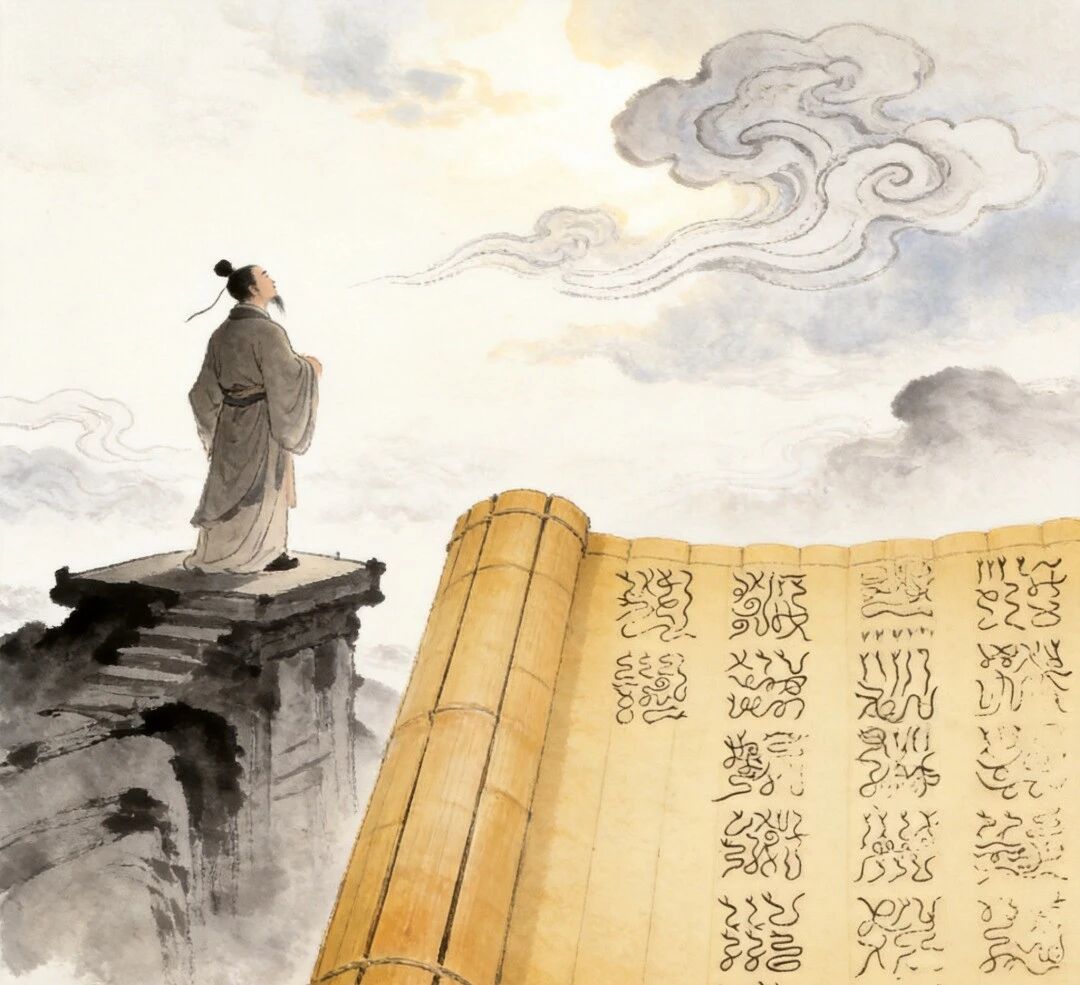
The “Eight Forms” mentioned here are the eight major categories of talismans: “heavenly writing,” “divine writing,” “earthly writing,” “inner writing,” “outer writing,” “ghost writing,” “Xia writing,” and “Rong-Yi writing.”
I. Heavenly Writing
Heavenly writing appears in the sky and changes unpredictably. The Scripture of the Inner Sounds of All the Heavens says: “Suddenly there was heavenly writing, its characters a zhang square, appearing of themselves in the sky. Its patterns were brilliant, with rays hanging from its eight corners and a dazzling essential light that could not be looked at directly. The Heavenly Perfected Sovereign said: This writing is honored and wondrous, unlike the ordinary; therefore it opened the beginning of the Great Origin and displayed the heavenly light and the rhythm of the Tao, so as to treasure and protect the Great Tao and honor the scriptures. Its characters are subtle and profound, not an ordinary script; their value lies in their mysterious and wondrous dharma images, which hold hidden within them the supreme and true Great Tao.”
Scroll 2 of the Great Rites of the Supreme Lingbao Scripture of Limitless Salvation says: “The Primordial ordered the Heavenly Perfected Sovereign to write out its text, which was named the Dragon Script of the Eight Majesties, also called the Writing of the Eight Assemblies of All the Heavens.” That is to say, the Dragon Script of the Eight Majesties is the earliest heavenly writing.
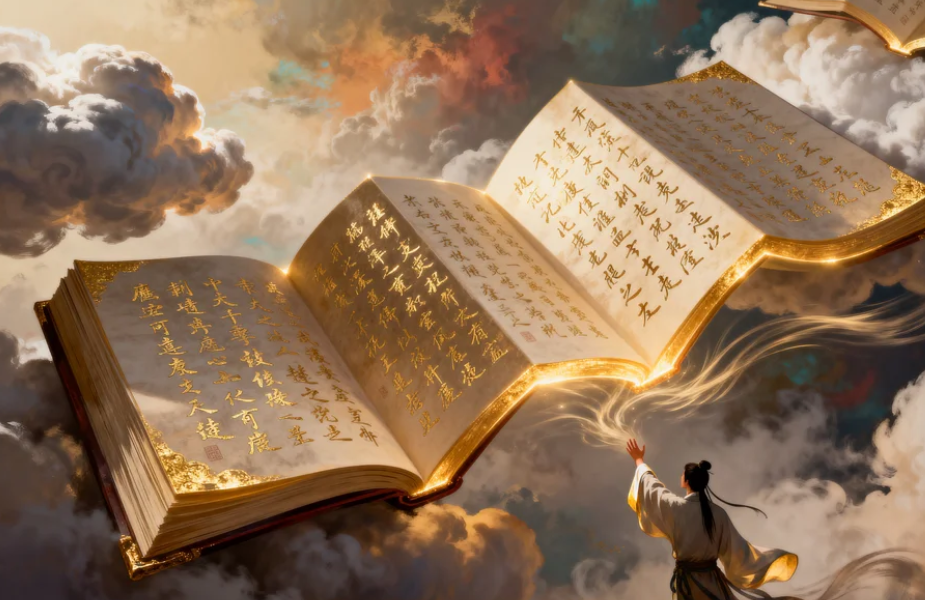
Heavenly writing is the source of all scripts. Further, immortals, perfected beings, and sages “developed the writing of the Eight Assemblies into dragon and phoenix patterns, simplified the brushstrokes of the cloud seal script, and transformed it into Brahma script following its forms. Splitting it into two paths, simplifying the complex, and distinguishing the source from its branches, they derived sixty-four kinds of writing. These then spread through the thirty-two heavens and the Three Realms above and below in the ten directions, each quarter selecting the corresponding chapters and categories and taking what it needed.” Thus the heavenly writing that ordinary people could scarcely know evolved into sixty-four scripts, including both divine talismans and cloud seal script and worldly writing. “Splitting it into two paths” means that from then on talismans and worldly script developed along separate lines: the former used within Taoism for cultivating perfection and communicating with the numinous, the latter used by people for everyday communication.
II. Divine Writing
The second is divine writing, that is, cloud seal script, so named because its characters are shaped like flowing clouds.
The Taoist Canon contains many cloud seal texts, such as the Cloud Seal Scripture of Salvation, written entirely in cloud seal script and highly precious.
III. Earthly Writing
The third is earthly writing. “Earthly writing takes the images of dragons and phoenixes.” It is also called dragon script and phoenix script.
The Lingbao Scripture says: “In the Chiming era the charts were opened and the cycles moved of themselves; the Primordial settled all and spread out the Five Chapters. The red writing and jade characters, the Dragon Script of the Eight Majesties, preserve and govern the course of the kalpas so that heaven may long endure. This is the dragon script.”
The Scripture of the Red Writing of the Purple Phoenix says: “The ancient original of this scripture is kept in the Purple Chamber of the Six Directions of the Most High, guarded on either side by giant six-headed male lions, while jade youths and jade maidens attend and guard the true scripture in phoenix script.”
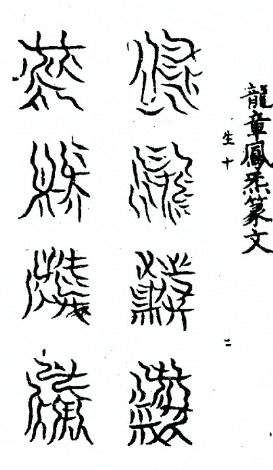
Scroll 30 of the Great Rites of the Supreme Lingbao Scripture of Limitless Salvation contains dragon and phoenix script, and scroll 1 of the Great Rites of the Purple Writing of the True King of Jade Clarity of the Exalted Divine Empyrean contains dragon-script heavenly writing. Looking at their characters, they truly move like dragons and snakes, in wondrous accord with what is so of itself. As the sayings go: “Cloud vapors surge and hang down; dragons and snakes coil around one another.” “Set beside flowing water, each character seems to turn into a dragon.”
IV. Inner Writing
The fourth is inner writing. Scroll 7 of the Seven Slips from the Cloudy Satchel (Yunji Qiqian) says: “The fourth is inner writing: script formed from the breathing of tortoises, dragons, fish, and birds.”
V. Outer Writing
The fifth is outer writing. Scroll 7 of the Seven Slips from the Cloudy Satchel says: “Traces borne by living creatures with scales, shells, fur, and feathers.”
These fourth and fifth kinds of talismanic writing are both related to living creatures, with characters resembling tadpoles, birds, insects, and ancient seal-script talismanic characters of that kind. They usually include the following:
Tortoise script: “Emperor Yao of the Taotang clan first created tortoise script because a numinous tortoise of Xuanyuan carried the River Chart on its back.”
Bird script: “In the time of King Wen of Zhou, a red sparrow carrying a writing in its beak alighted at his door, and in the time of King Wu a cinnabar bird flew into his inner chamber; on the strength of these two auspicious signs, bird script was created.”
Fish script: “The fish script of the Zhou was created because a numinous fish leapt into a boat as an auspicious sign.”
Insect script: “The wife of Qiu Hu of the state of Lu created it by observing the shapes of insects while washing mulberry leaves and raising silkworms.”
Snake script: “In ancient times a man of Tang dreamed that a snake coiled around his body, and on waking created snake script after its form.”
Dragon script: “Fuxi of the Taihao clan received the auspicious sign of a radiant dragon and first created dragon script.”
Luan-phoenix script: “Shaohao of the Jintian clan created luan-phoenix script, using flying birds to fix the system of offices and create writing, taking its images from the scripts of high antiquity.”
Tadpole script: “Named for its resemblance to tadpoles; its characters were created according to their shape.”
Tiger script: “Shi Yi, court historian of King Wen of Zhou, created tiger script, taking as its source the auspicious beast zouyu, which harms no living thing.”
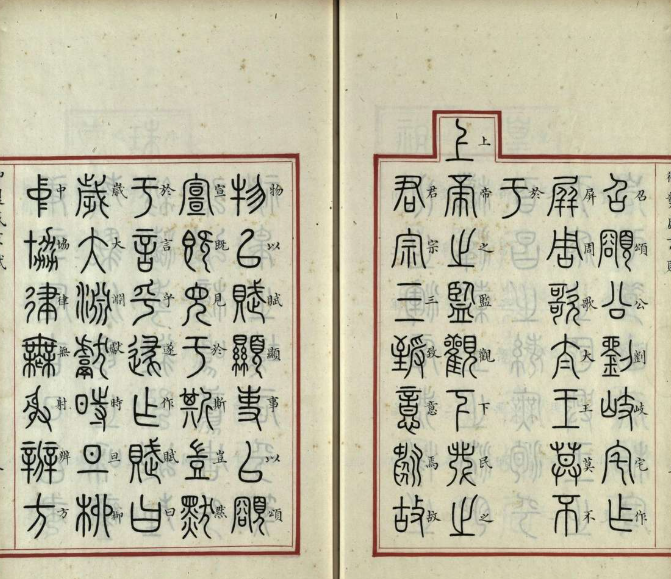
There are also the mansion-turning seal script, shaped like a lotus in bud; the carved-talisman script, with bird heads and cloud feet; the crane-head script, whose characters look like a crane at the top; and the mosquito-leg script, whose characters are as thin as mosquitoes at the bottom. These talismanic scripts are vivid in form, each with its own charm.
VI. Ghost Writing
The sixth is ghost writing. Scroll 7 of the Seven Slips from the Cloudy Satchel says: “The sixth is ghost writing: its form is complex and its strokes obscure, beyond the understanding of ordinary people.” This kind of ghost writing refers to images and writing that appear on or around people struck by lightning.
“As for ghost writing: in the Yuanjia era of the Liu Song dynasty of the Southern Dynasties, a man in Jingkou was killed by a lightning strike, and seal characters resembling bafen clerical script appeared on his arm.”
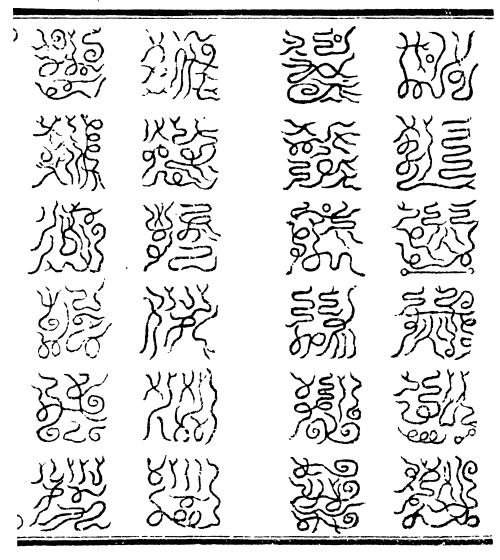
Taoism holds that the Thunder Department holds the power of life and death, and wicked people and poisonous creatures are often struck by lightning as heaven's punishment. “There is always heavenly writing manifested to make their faults known—appearing on the bottom of a pot, written on the wall of a house, or shown on the body. None of it is ordinary worldly script; it is in truth heavenly writing in cloud seal script, similar in form to the ancient liuwen script, tadpole script, and ancient bird-track script.” Such heavenly writing is called thunder script, thunder seal, or thunder writing, and it is what is meant by ghost writing.
VII. Xia Writing
The seventh is Xia writing. Scroll 7 of the Seven Slips from the Cloudy Satchel says: “The seventh is Xia writing: cursive script, artistic script, cloud seal script, and the like all belong to it.” It refers to talismans that evolved from Chinese characters in clerical, regular, cursive, and seal scripts.
Examples are the compound characters in the Scripture of Great Peace (Taiping Jing), formed by combining several clerical-script characters; the talismans in the Complete Collection of Chenzhou Talismans and Incantations, mostly composed of cursive characters; and the talismans in the Thirteen Branches of Zhuyou, often made by combining regular-script characters.
In short, however they change, they never depart from the basis of writing; the structure and form of talismanic diagrams have all evolved and been applied through changes in the various scripts and images.
VIII. Rong-Yi Writing
The eighth is Rong-Yi writing. Scroll 7 of the Seven Slips from the Cloudy Satchel says: “The eighth is Rong-Yi writing, whose characters resemble the postures of insects and crawling creatures.”
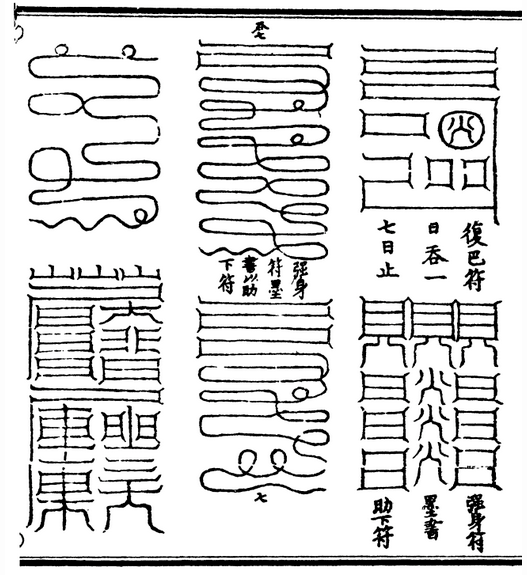
“Rong-Yi” refers in general to the ethnic peoples other than the Han of the Central Plains. One of the sources of Taoism includes the shamanic cultures of these peoples, so it is only natural that elements of Rong-Yi culture were absorbed into talismans.