
Qingdao Taoist Association, Shandong Province
To further implement the state's religious policies and regulations and effectively raise the rule-of-law literacy and the standard of Taoist conduct across the city's Taoist community, the “Study the Laws and Regulations, Keep the Precepts, Value Cultivation, and Build a Good Image” knowledge contest on religious policies and regulations, sponsored by the Qingdao Taoist Association, was solemnly held on April 9, 2026, at Taiqing Palace on Mount Lao (Laoshan), a temple of long history and deep Taoist lineage. Eight teams from the city's Taoist community gathered to compete fiercely. Leaders of the competent government department, members of the leadership of the city's Taoist Association, and several religious scholars and experts were invited to attend and witnessed this meaningful event together.
At nine o'clock sharp in the morning, the contest formally opened in a solemn yet lively atmosphere. A leader of the competent department spoke first. He pointed out that religious policies and regulations are the fundamental guide and important guarantee for the Taoist community in conducting religious activities according to law, protecting its lawful rights and interests, and promoting social harmony and stability. Holding this knowledge contest is both an important measure to foster a good atmosphere of respecting, studying, observing, and applying the law in the city's Taoist community and a concrete practice in strengthening Taoist conduct and raising the quality of cultivation. He hoped that members of the Taoist community would use the contest to promote study and use study to promote cultivation, truly internalizing the spirit of the rule of law in their hearts and expressing it in their actions, carrying it into daily spiritual practice and the management of their venues.
The leader further stressed that this year is the first year of the 15th Five-Year Plan, and also a key year for the Taoist community in advancing the comprehensive and strict governance of the religion and deepening the practice of the sinicization of religion in China. The city's Taoist Association and all Taoist venues must focus closely on this year's key tasks, firmly keep to the correct political direction, carry out in depth Qingdao's practice of the sinicization of religion in China, push forward the comprehensive and strict governance of the religion, and continue to deepen the series of educational activities under the campaign to “study the laws and regulations, keep the precepts, value cultivation, and build a good image.” They must keep working to innovate forms of work, enrich the vehicles for activities, and raise the level of management, seeking real results, striving to help Taoism adapt to socialist society and to follow a path of healthy and orderly development.
Next, Master Jiang Qun, deputy secretary-general of the Qingdao Taoist Association, was invited to share his views on the significance of the contest and on the daily cultivation of Taoists. Master Jiang Qun said: “Laws, regulations, and precepts have never been shackles; they are the bright lamp and guardrails on our path of spiritual practice. Many fellow Taoists may feel in their daily practice that the precepts are far removed from them, but in fact every one of them is closely bound up with our words and deeds and the purification of our hearts. For example, the provisions in the Regulations on Religious Affairs on the management of venues, financial transparency, and the standardization of activities both safeguard our lawful rights and interests and strongly echo Taoism's monastic rules and precepts. Through a lively form like a knowledge contest, policies and regulations that might seem somewhat dry become common knowledge that everyone is willing to learn, can remember, and can put to use, which is very helpful for raising the overall quality of the city's Taoist community.” Drawing on his many years of experience in cultivation and management, he also encouraged the Taoists present: “In studying the laws, we must ‘truly study’; in keeping the precepts, we must ‘truly keep them’; in valuing cultivation, we must ‘truly cultivate’; in building a good image, we must ‘truly act.’ Only by turning the provisions into habits and carrying out the precepts in every detail can we truly establish the good image of Taoists in the new era.”
The contest was divided into two stages, preliminaries and a final, with two rounds of required questions and buzzer questions. The content covered policies and regulations such as the Regulations on Religious Affairs and the Measures for the Administration of Religious Groups, traditional Taoist precepts and monastic rules, and China's fine traditional culture, emphasizing theory while staying close to the practical needs of spiritual practice and venue management. In the preliminaries, the eight teams were divided by lot into Groups A and B, with the top two in each group advancing to the final. In the final, the difficulty and intensity of the competition rose markedly. To let more of the Taoists present take part, an audience interaction round was specially added in the final: questions 4, 8, and 12 were answered by Taoists in the audience raising their hands to buzz in. The audience took part eagerly, many Taoist priests answered correctly and won rounds of applause, and the atmosphere was very lively.
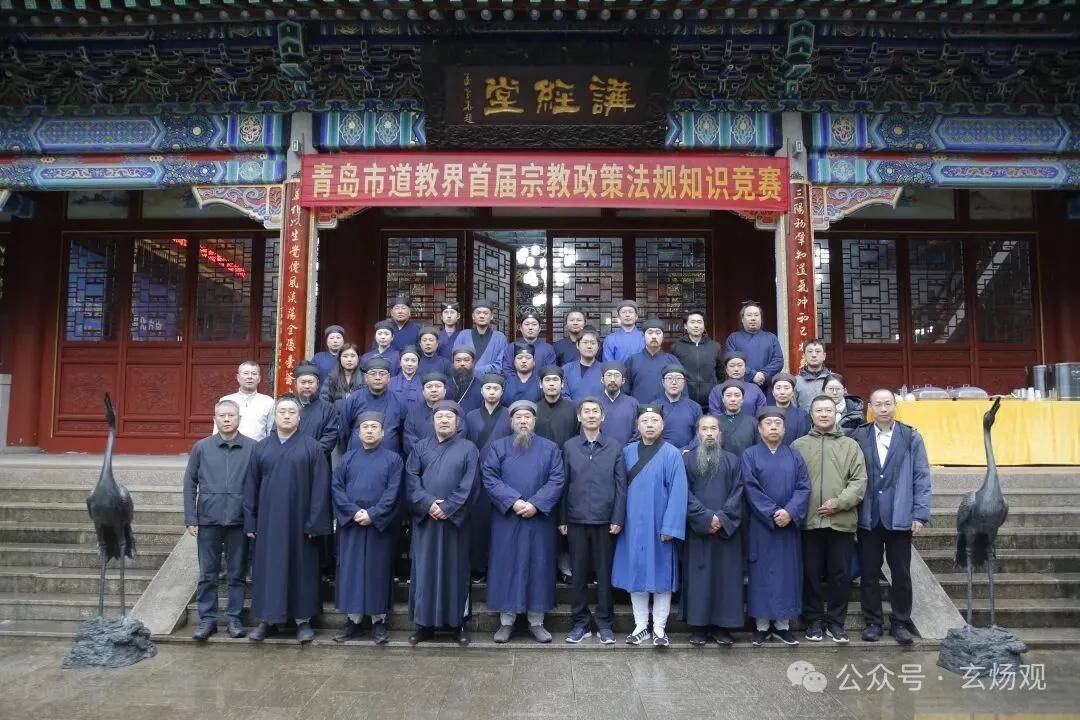
All the teams were well prepared, and the contestants answered in a proper and well-organized manner, fully displaying good rule-of-law literacy, a solid store of religious knowledge, and excellent teamwork. After a tense yet orderly competition, one first prize, one second prize, one third prize, one fourth prize, and four merit prizes were awarded. At the award ceremony that followed, the attending leaders presented certificates of honor to the winning teams and took a group photo with all the contestants, and the venue was filled with the joy of achievement and a spirit of striving forward.
At the closing ceremony, Hou Chengkai, president of the city's Taoist Association, stressed the need to continue advancing the “Study the Laws and Regulations, Keep the Precepts, Value Cultivation, and Build a Good Image” educational campaign in the city's Taoist community in greater depth and with real substance, and to achieve even greater results. The relevant policies, regulations, and institutional requirements must be implemented, with “study, examine, and rectify” as the main thread, focusing on correcting the religion's conduct and addressing irregularities, and working to stimulate the internal drive of the city's Taoist community for self-education, self-management, and self-discipline. They must always uphold the fine tradition of loving the country and loving the religion, consciously respect, study, observe, and apply the law, strictly keep the precepts, and advance diligently in cultivation, striving to be Taoists of the new era who are “politically reliable, accomplished in religion, of a moral character that commands respect, and effective at critical moments.”
The successful holding of this knowledge contest not only further enriched the exploration and practice of the “Study the Laws and Regulations, Keep the Precepts, Value Cultivation, and Build a Good Image” educational campaign in Qingdao, but also effectively strengthened the rule-of-law awareness and the sense of precepts in the city's Taoist community, creating a strong atmosphere of respecting, studying, observing, and applying the law. It can be said that this was a beneficial attempt and a vivid practice in promoting the adaptation of Taoism to socialist society and helping Taoism develop in a healthy and orderly way.
In the future, the Qingdao Taoist Association will continue to innovate the forms of its activities, keep raising the overall quality of the Taoist community, and contribute more positive energy to promoting religious harmony and social civility.